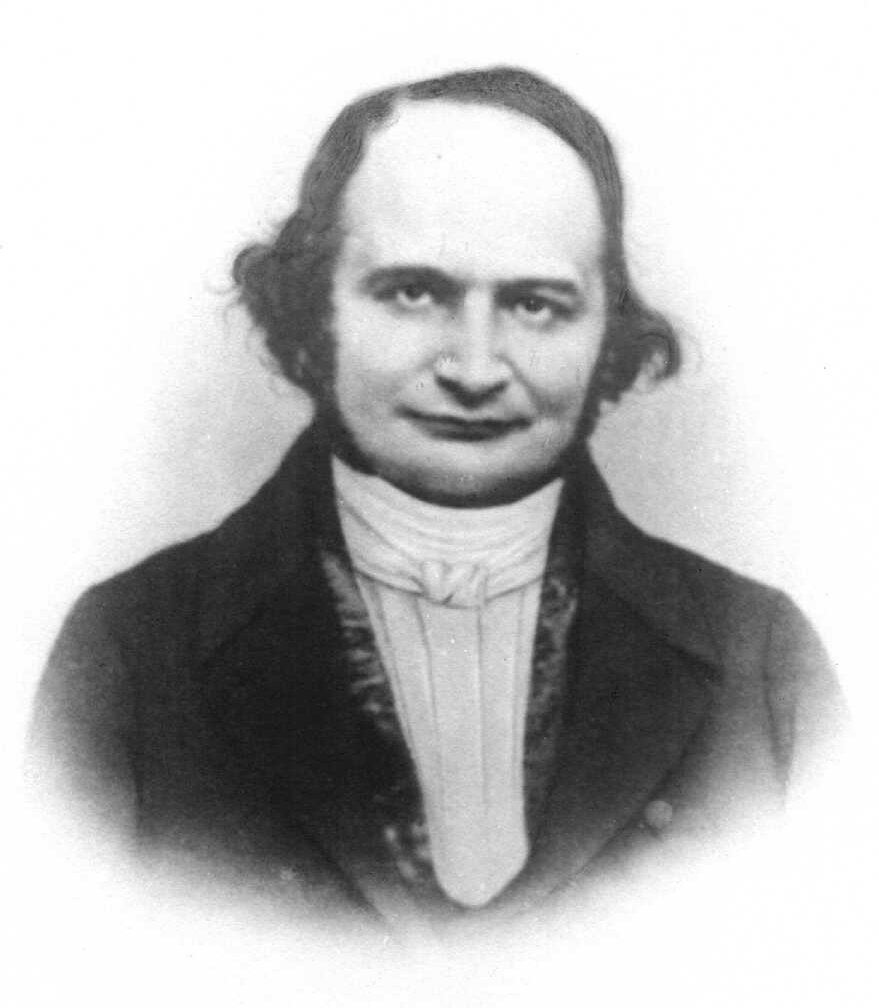
Carl Gustav Jacob Jacobi Quotes

Carl Gustav Jacob Jacobi was a German mathematician who made fundamental contributions to elliptic functions, dynamics, differential equations, determinants, and number theory. His name is occasionally written as Carolus Gustavus Iacobus Iacobi in his Latin books, and his first name is sometimes given as Karl.

Jacobi was the first Jewish mathematician to be appointed professor at a German university. Wikipedia  

✵ 10. December 1804 – 18. February 1851  •  Other names Karl Gustav Jacob Jacobi
Carl Gustav Jacob Jacobi photo
Carl Gustav Jacob Jacobi: 4 quotes2 likes

Famous Carl Gustav Jacob Jacobi Quotes

“Any progress in the theory of partial differential equations must also bring about a progress in Mechanics.”

Carl Gustav Jacob Jacobi

Vorlesungen über Dynamik http://archive.org/details/cgjjacobisvorle00lottgoog [Lectures on Dynamics] (1842/3; publ. 1884).

“It is true that M. Fourier had the opinion that the principal end of mathematics was the public utility and the explanation of natural phenomena; but such a philosopher as he is should have known that the unique end of science is the honor of the human mind, and that from this point of view a question of number is as important as a question of the system of the world.”

Carl Gustav Jacob Jacobi

Letter to Legendre (July 2, 1830) in response to Fourier's report to the Paris Academy Science that mathematics should be applied to the natural sciences, as quoted in Science (March 10, 1911) Vol. 33 https://books.google.com/books?id=4LU7AQAAMAAJ&pg=PA359, p.359, with additional citations and dates from H. Pieper, "Carl Gustav Jacob Jacobi," Mathematics in Berlin (2012) p.46

“History knew a midnight, which we may estimate at about the year 1000 A. D., when the human race lost the arts and sciences even to the memory. The last twilight of paganism was gone, and yet the new day had not begun. Whatever was left of culture in the world was found only in the Saracens, and a Pope eager to learn studied in disguise in their unversities, and so became the wonder of the West. At last Christendom, tired of praying to the dead bones of the martyrs, flocked to the tomb of the Saviour Himself, only to find for a second time that the grave was empty and that Christ was risen from the dead. Then mankind too rose from the dead. It returned to the activities and the business of life; there was a feverish revival in the arts and in the crafts. The cities flourished, a new citizenry was founded. Cimabue rediscovered the extinct art of painting; Dante, that of poetry. Then it was, also, that great courageous spirits like Abelard and Saint Thomas Aquinas dared to introduce into Catholicism the concepts of Aristotelian logic, and thus founded scholastic philosophy. But when the Church took the sciences under her wing, she demanded that the forms in which they moved be subjected to the same unconditioned faith in authority as were her own laws. And so it happened that scholasticism, far from freeing the human spirit, enchained it for many centuries to come, until the very possibility of free scientific research came to be doubted. At last, however, here too daylight broke, and mankind, reassured, determined to take advantage of its gifts and to create a knowledge of nature based on independent thought. The dawn of the day in history is know as the Renaissance or the Revival of Learning.”

Carl Gustav Jacob Jacobi

"Über Descartes Leben und seine Methode die Vernunft Richtig zu Leiten und die Wahrheit in den Wissenschaften zu Suchen," "About Descartes' Life and Method of Reason.." (Jan 3, 1846) C. G. J. Jacobi's Gesammelte werke Vol. 7 https://books.google.com/books?id=_09tAAAAMAAJ&pg=PA309 p.309, as quoted by Tobias Dantzig, Number: The Language of Science (1930).

Similar authors

Jean Paul photo
Jean Paul16
German novelist None
Ludwig Börne photo
Ludwig Börne1
German writer None
Georg Wilhelm Friedrich Hegel photo
Georg Wilhelm Friedrich Hegel106
German philosopher None
Otto von Bismarck photo
Otto von Bismarck35
German statesman, Chancellor of Germany None
Bettina von Arnim photo
Bettina von Arnim1
German writer None
Wilhelm Röntgen photo
Wilhelm Röntgen6
German physicist None
Arthur Schopenhauer photo
Arthur Schopenhauer261
German philosopher None
Theodor Mommsen photo
Theodor Mommsen65
German classical scholar, historian, jurist, journalist, po… None
Ludwig Feuerbach photo
Ludwig Feuerbach36
German philosopher and anthropologist None
Ludwig Van Beethoven photo
Ludwig Van Beethoven43
German Romantic composer None