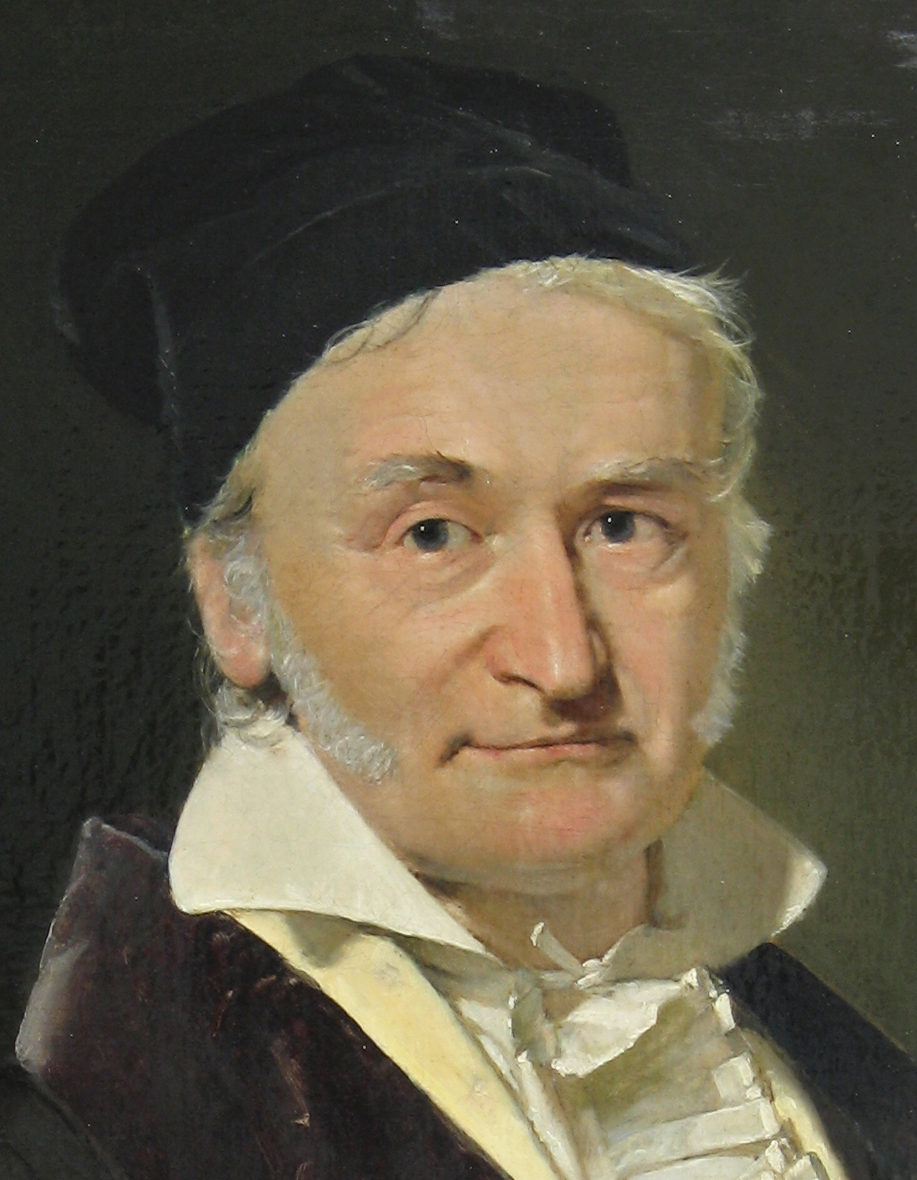
Carl Friedrich Gauss: Titan of Science (1955) by Guy Waldo Dunnington. p. 348
Works
Disquisitiones Arithmeticae
Carl Friedrich GaussDisquisitiones Arithmeticae
Carl Friedrich GaussCarl Friedrich Gauss: 50 quotes7 likes
Famous Carl Friedrich Gauss Quotes
"Gauss's Abstract of the Disquisitiones Generales circa Superficies Curvas presented to the Royal Society of Gottingen" (1827) Tr. James Caddall Morehead & Adam Miller Hiltebeitel in General Investigations of Curved Surfaces of 1827 and 1825 http://books.google.com/books?id=SYJsAAAAMAAJ& (1902) <br class="br">Context: In researches in which an infinity of directions of straight lines in space is concerned, it is advantageous to represent these directions by means of those points upon a fixed sphere, which are the end points of the radii drawn parallel to the lines. The centre and the radius of this auxiliary sphere are here quite arbitrary. The radius may be taken equal to unity. This procedure agrees fundamentally with that which is constantly employed in astronomy, where all directions are referred to a fictitious celestial sphere of infinite radius. Spherical trigonometry and certain other theorems, to which the author has added a new one of frequent application, then serve for the solution of the problems which the comparison of the various directions involved can present.
“The centre and the radius of this auxiliary sphere are here quite arbitrary.”
"Gauss's Abstract of the Disquisitiones Generales circa Superficies Curvas presented to the Royal Society of Gottingen" (1827) Tr. James Caddall Morehead & Adam Miller Hiltebeitel in General Investigations of Curved Surfaces of 1827 and 1825 http://books.google.com/books?id=SYJsAAAAMAAJ& (1902) <br class="br">Context: In researches in which an infinity of directions of straight lines in space is concerned, it is advantageous to represent these directions by means of those points upon a fixed sphere, which are the end points of the radii drawn parallel to the lines. The centre and the radius of this auxiliary sphere are here quite arbitrary. The radius may be taken equal to unity. This procedure agrees fundamentally with that which is constantly employed in astronomy, where all directions are referred to a fictitious celestial sphere of infinite radius. Spherical trigonometry and certain other theorems, to which the author has added a new one of frequent application, then serve for the solution of the problems which the comparison of the various directions involved can present.
Theoria motus corporum coelestium in sectionibus conicis solem ambientum (1809) Tr. Charles Henry Davis as Theory of the Motion of the Heavenly Bodies moving about the Sun in Conic Sections http://books.google.com/books?id=cspWAAAAMAAJ& (1857) <br class="br">Context: The principle that the sum of the squares of the differences between the observed and computed quantities must be a minimum may, in the following manner, be considered independently of the calculus of probabilities. When the number of unknown quantities is equal to the number of the observed quantities depending on them, the former may be so determined as exactly to satisfy the latter. But when the number of the former is less than that of the latter, an absolutely exact agreement cannot be obtained, unless the observations possess absolute accuracy. In this case care must be taken to establish the best possible agreement, or to diminish as far as practicable the differences. This idea, however, from its nature, involves something vague. For, although a system of values for the unknown quantities which makes all the differences respectively less than another system, is without doubt to be preferred to the latter, still the choice between two systems, one of which presents a better agreement in some observations, the other in others, is left in a measure to our judgment, and innumerable different principles can be proposed by which the former condition is satisfied. Denoting the differences between observation and calculation by A, A&rsquo;, A&rsquo;&rsquo;, etc., the first condition will be satisfied not only if AA + A&rsquo; A&rsquo; + A&rsquo;&rsquo; A&rsquo;&rsquo; + etc., is a minimum (which is our principle) but also if A4 + A&rsquo;4 + A&rsquo;&rsquo;4 + etc., or A6 + A&rsquo;6 + A&rsquo;&rsquo;6 + etc., or in general, if the sum of any of the powers with an even exponent becomes a minimum. But of all these principles ours is the most simple; by the others we should be led into the most complicated calculations.
"Gauss's Abstract of the Disquisitiones Generales circa Superficies Curvas presented to the Royal Society of Gottingen" (1827) Tr. James Caddall Morehead & Adam Miller Hiltebeitel in General Investigations of Curved Surfaces of 1827 and 1825 http://books.google.com/books?id=SYJsAAAAMAAJ& (1902) <br class="br">Context: In researches in which an infinity of directions of straight lines in space is concerned, it is advantageous to represent these directions by means of those points upon a fixed sphere, which are the end points of the radii drawn parallel to the lines. The centre and the radius of this auxiliary sphere are here quite arbitrary. The radius may be taken equal to unity. This procedure agrees fundamentally with that which is constantly employed in astronomy, where all directions are referred to a fictitious celestial sphere of infinite radius. Spherical trigonometry and certain other theorems, to which the author has added a new one of frequent application, then serve for the solution of the problems which the comparison of the various directions involved can present.
March 14, 1824. As quoted in Carl Friedrich Gauss: Titan of Science (1955) by Guy Waldo Dunnington. p. 360
Carl Friedrich Gauss Quotes about mathematics
“Mathematics is the queen of the sciences.”
As quoted in Gauss zum Gedächtniss (1856) by Wolfgang Sartorius von Waltershausen; Variants: Mathematics is the queen of sciences and number theory is the queen of mathematics. She often condescends to render service to astronomy and other natural sciences, but in all relations she is entitled to the first rank.
Mathematics is the queen of the sciences and number theory is the queen of mathematics. [Die Mathematik ist die Königin der Wissenschaften und die Zahlentheorie ist die Königin der Mathematik.]
As quoted by Louise Grinstein, Sally I. Lipsey, Encyclopedia of Mathematics Education (2001) p. 235.
The World of Mathematics (1956) Edited by J. R. Newman
As quoted in The World of Mathematics (1956) Edited by J. R. Newman
Gauss-Schumacher Briefwechsel (1862)
Context: It may be true, that men, who are mere mathematicians, have certain specific shortcomings, but that is not the fault of mathematics, for it is equally true of every other exclusive occupation. So there are mere philologists, mere jurists, mere soldiers, mere merchants, etc. To such idle talk it might further be added: that whenever a certain exclusive occupation is coupled with specific shortcomings, it is likewise almost certainly divorced from certain other shortcomings.
As quoted in Carl Friedrich Gauss: Titan of Science (1955) by Guy Waldo Dunnington. p. 306
Carl Friedrich Gauss Quotes about time
Letter to Gerling (1832)
What are we without the hope of a better future? <br class="br">As quoted in Kneller, Karl Alois, Kettle, Thomas Michael, 1911. "Christianity and the leaders of modern science; a contribution to the history of culture in the nineteenth century" https://archive.org/stream/christianitylead00kneluoft#page/44/mode/2up, Freiburg im Breisgau, p. 44-45
“I have had my results for a long time: but I do not yet know how I am to arrive at them.”
The Mind and the Eye (1954) by A. Arber
As quoted in Calculus Gems (1992) by George F. Simmons
Theoria motus corporum coelestium... (1809) Tr. Charles Henry Davis as Theory of the Motion of the Heavenly Bodies moving about the Sun in Conic Sections (1857)
Context: The perturbations which the motions of planets suffer from the influence other planets, are so small and so slow that they only become sensible after a long interval of time; within a shorter time, or even within one or several revolutions, according to circumstances, the motion would differ so little from motion exactly described, according to the laws of Kepler, in a perfect ellipse, that observations cannot show the difference. As long as this is true, it not be worth while to undertake prematurely the computation of the perturbations, but it will be sufficient to adapt to the observations what we may call an osculating conic section: but, afterwards, when the planet has been observed for a longer time, the effect of the perturbations will show itself in such a manner, that it will no longer be possible to satisfy exactly all the observations by a purely elliptic motion; then, accordingly, a complete and permanent agreement cannot be obtained, unless the perturbations are properly connected with the elliptic motion.
A reply to Rudolf Wagner's on his religious views as quoted in Carl Friedrich Gauss: Titan of Science (1955) by Guy Waldo Dunnington. p. 305.
Carl Friedrich Gauss: Trending quotes
Theoria motus corporum coelestium in sectionibus conicis solem ambientum (1809) Tr. Charles Henry Davis as Theory of the Motion of the Heavenly Bodies moving about the Sun in Conic Sections http://books.google.com/books?id=cspWAAAAMAAJ& (1857) <br class="br">Context: The principle that the sum of the squares of the differences between the observed and computed quantities must be a minimum may, in the following manner, be considered independently of the calculus of probabilities. When the number of unknown quantities is equal to the number of the observed quantities depending on them, the former may be so determined as exactly to satisfy the latter. But when the number of the former is less than that of the latter, an absolutely exact agreement cannot be obtained, unless the observations possess absolute accuracy. In this case care must be taken to establish the best possible agreement, or to diminish as far as practicable the differences. This idea, however, from its nature, involves something vague. For, although a system of values for the unknown quantities which makes all the differences respectively less than another system, is without doubt to be preferred to the latter, still the choice between two systems, one of which presents a better agreement in some observations, the other in others, is left in a measure to our judgment, and innumerable different principles can be proposed by which the former condition is satisfied. Denoting the differences between observation and calculation by A, A&rsquo;, A&rsquo;&rsquo;, etc., the first condition will be satisfied not only if AA + A&rsquo; A&rsquo; + A&rsquo;&rsquo; A&rsquo;&rsquo; + etc., is a minimum (which is our principle) but also if A4 + A&rsquo;4 + A&rsquo;&rsquo;4 + etc., or A6 + A&rsquo;6 + A&rsquo;&rsquo;6 + etc., or in general, if the sum of any of the powers with an even exponent becomes a minimum. But of all these principles ours is the most simple; by the others we should be led into the most complicated calculations.
Letter to Farkas Bolyai (2 September 1808)
Context: It is not knowledge, but the act of learning, not possession but the act of getting there, which grants the greatest enjoyment. [Wahrlich es ist nicht das Wissen, sondern das Lernen, nicht das Besitzen sondern das Erwerben, nicht das Da-Seyn, sondern das Hinkommen, was den grössten Genuss gewährt. ] When I have clarified and exhausted a subject, then I turn away from it, in order to go into darkness again. The never-satisfied man is so strange; if he has completed a structure, then it is not in order to dwell in it peacefully, but in order to begin another. I imagine the world conqueror must feel thus, who, after one kingdom is scarcely conquered, stretches out his arms for others.
Carl Friedrich Gauss Quotes
Letter to Sophie Germain (30 April 1807) ([...]; les charmes enchanteurs de cette sublime science ne se décèlent dans toute leur beauté qu'à ceux qui ont le courage de l'approfondir. Mais lorsqu'une personne de ce sexe, qui, par nos meurs [sic] et par nos préjugés, doit rencontrer infiniment plus d'obstacles et de difficultés, que les hommes, à se familiariser avec ces recherches épineuses, sait néanmoins franchir ces entraves et pénétrer ce qu'elles ont de plus caché, il faut sans doute, qu'elle ait le plus noble courage, des talents tout à fait extraordinaires, le génie superieur.)
Context: The enchanting charms of this sublime science reveal themselves in all their beauty only to those who have the courage to go deeply into it. But when a person of that sex, that, because of our mores and our prejudices, has to encounter infinitely more obstacles and difficulties than men in familiarizing herself with these thorny research problems, nevertheless succeeds in surmounting these obstacles and penetrating their most obscure parts, she must without doubt have the noblest courage, quite extraordinary talents and superior genius.
As quoted in Carl Friedrich Gauss: Titan of Science (1955) by Guy Waldo Dunnington. p. 362
“Ask her to wait a moment — I am almost done.”
When told, while working, that his wife was dying, as attributed in Men of Mathematics (1937) by E. T. Bell
As quoted in Carl Friedrich Gauss: Titan of Science (1955) by Guy Waldo Dunnington. p. 365
In his letter to Schumacher on February 9, 1823. As quoted in Carl Friedrich Gauss: Titan of Science (1955) by Guy Waldo Dunnington. p. 361
“But in our opinion truths of this kind should be drawn from notions rather than from notations.”
Carl Friedrich Gauss book Disquisitiones Arithmeticae
About the proof of Wilson's theorem. Disquisitiones Arithmeticae (1801) Article 76
A reply to Olbers' 1816 attempt to entice him to work on Fermat's Theorem. As quoted in The World of Mathematics (1956) Edited by J. R. Newman
As quoted in Kneller, Karl Alois, Kettle, Thomas Michael, 1911. "Christianity and the leaders of modern science; a contribution to the history of culture in the nineteenth century" https://archive.org/stream/christianitylead00kneluoft#page/48/mode/2up, Freiburg im Breisgau, p. 48-49
As quoted in Solid Shape (1990) by Jan J. Koenderink
As quoted by Robert Chambers, "Sir Isaac Newton and the Apple," The Book of Days (1832) Vol. 2 https://books.google.com/books?id=K0UJAAAAIAAJ, p. 757.
As quoted in Kneller, Karl Alois, Kettle, Thomas Michael, 1911. "Christianity and the leaders of modern science; a contribution to the history of culture in the nineteenth century" https://archive.org/stream/christianitylead00kneluoft#page/44/mode/2up, Freiburg im Breisgau, p. 44-45
In a letter to Heinrich Wilhelm Matthias Olbers (14 May 1826), defending Chevalier d'Angos against presumption of guilt (by Johann Franz Encke and others), of having falsely claimed to have discovered a comet in 1784; as quoted in Calculus Gems (1992) by George F. Simmons
Letter to Farkas Bolyai, on his son János Bolyai's 1832 publishings on non-Euclidean geometry.
“Yes! The world would be nonsense, the whole creation an absurdity without immortality.”
As quoted in Carl Friedrich Gauss: Titan of Science (1955) by Guy Waldo Dunnington. p. 357
Mathematical Circles Squared (1972) by Howard W. Eves
In a letter dated April 25, 1825. As quoted in Carl Friedrich Gauss: Titan of Science (1955) by Guy Waldo Dunnington. p. 361
As quoted in Gauss, Werke, Bd. 8, page 298
As quoted in Memorabilia Mathematica (or The Philomath's Quotation-Book) (1914) by Robert Edouard Moritz, quotation #1215
As quoted in The First Systems of Weighted Differential and Integral Calculus (1980) by Jane Grossman, Michael Grossman, and Robert Katz, page ii
“You say that faith is a gift; this is perhaps the most correct thing that can be said about it.”
As quoted in Carl Friedrich Gauss: Titan of Science (1955) by Guy Waldo Dunnington. p. 305.
Carl Friedrich Gauss book Disquisitiones Arithmeticae
Problema, numeros primos a compositis dignoscendi, hosque in factores suos primos resolvendi, ad gravissima ac utilissima totius arithmeticae pertinere, et geometrarum tum veterum tum recentiorum industriam ac sagacitatem occupavisse, tam notum est, ut de hac re copiose loqui superfluum foret. … [P]raetereaque scientiae dignitas requirere videtur, ut omnia subsidia ad solutionem problematis tam elegantis ac celebris sedulo excolantur.
Disquisitiones Arithmeticae (1801): Article 329
Theoria motus corporum coelestium in sectionibus conicis solem ambientum (1809) Tr. Charles Henry Davis as Theory of the Motion of the Heavenly Bodies moving about the Sun in Conic Sections http://books.google.com/books?id=cspWAAAAMAAJ& (1857)
Carl Friedrich Gauss: Titan of Science (1955) by Guy Waldo Dunnington. p. 349
In Theoria residiorum biquadraticorum, Commentatio secunda; Werke, Bd. 2 (Goettingen, 1863), p.177. As quoted by Robert Edouard Moritz in Memorabilia mathematica: the philomath's quotation book (1914) p. 282.
"Gauss's Abstract of the Disquisitiones Generales circa Superficies Curvas presented to the Royal Society of Gottingen" (1827) Tr. James Caddall Morehead & Adam Miller Hiltebeitel in General Investigations of Curved Surfaces of 1827 and 1825 (1902)
In a letter to Gerling on June 23, 1846. As quoted in Carl Friedrich Gauss: Titan of Science (1955) by Guy Waldo Dunnington. p. 364
On higher arithmetic. Mathematical Circles Adieu (1977) by Howard W. Eves
Carl Friedrich Gauss: Titan of Science (1955) by Guy Waldo Dunnington. p. 359
"Gauss's Abstract of the Disquisitiones Generales circa Superficies Curvas presented to the Royal Society of Gottingen" (1827) Tr. James Caddall Morehead & Adam Miller Hiltebeitel in General Investigations of Curved Surfaces of 1827 and 1825 http://books.google.com/books?id=SYJsAAAAMAAJ& (1902)
As quoted in Kneller, Karl Alois, Kettle, Thomas Michael, 1911. "Christianity and the leaders of modern science; a contribution to the history of culture in the nineteenth century" https://archive.org/stream/christianitylead00kneluoft#page/46/mode/2up, Freiburg im Breisgau, p. 46
As quoted in Carl Friedrich Gauss: Titan of Science (1955) by Guy Waldo Dunnington. p. 360


