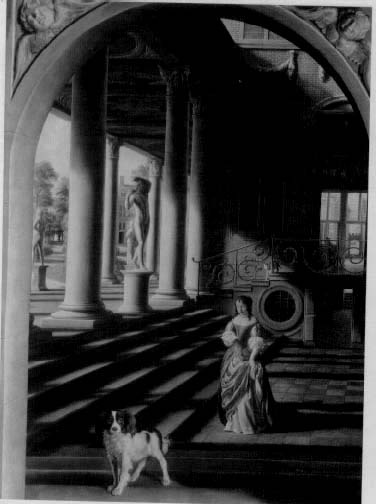
Anne Conway Quotes

Anne Conway was an English philosopher of the Enlightenment, whose work, in the tradition of the Cambridge Platonists, was an influence on Gottfried Leibniz. Conway's thought is a deeply original form of rationalist philosophy, with hallmarks of gynocentric concerns and patterns that lead some to think of it as unique among seventeenth-century systems. Hugh Trevor-Roper called her "England's greatest female philosopher." Wikipedia  

✵ 14. December 1631 – 18. February 1679
Anne Conway photo
Anne Conway: 2 quotes1 like

Anne Conway Quotes

“I say, life and figure are distinct attributes of one substance, and as one and the same body may be transmuted into all kinds of figures; and as the perfecter figure comprehends that which is more imperfect; so one and the same body may be transmuted from one degree of life to another more perfect, which always comprehends in it the inferior.”

Anne Conway

The Principles of the Most Ancient and Modern Philosophy (1690)
Context: I say, life and figure are distinct attributes of one substance, and as one and the same body may be transmuted into all kinds of figures; and as the perfecter figure comprehends that which is more imperfect; so one and the same body may be transmuted from one degree of life to another more perfect, which always comprehends in it the inferior. We have an example of figure in a triangular prism, which is the first figure of all right lined solid triangular prism, which is the first figure of all right lined solid bodies, where into a body is convertible; and from this into a cube, which is a perfecter figure, and comprehends in it a prism; from a cube it may be turned into a more perfect figure, which comes nearer to a globe, and from this into another, which is yet nearer; and so it ascends from one figure, more imperfect to another more perfect, ad infinitum; for here are no bounds; nor can it be said, this body cannot be changed into a perfecter figure: But the meaning is that that body consists of plane right lines; and this is always chageablee into a perfecter figure, and yet can never reach to the perfection of a globe, although it always approaches nearer unto it; the case is the same in diverse degrees of life, which have indeed a beginning, but no end; so that the creature is always capable of a farther and perfecter degree of life, ad infinitum, and yet can never attain to be equal with God; for he is still infinitely more perfect than a creature, in its highest elevation or perfection, even as a globe is the most perfect of all other figures, unto which none can approach.

“I say, life and figure are distinct attributes of one substance, and as one and the same body may be transmuted into all kinds of figures; and as the perfecter figure comprehends that which is more imperfect; so one and the same body may be transmuted from one degree of life to another more perfect, which always comprehends in it the inferior. We have an example of figure in a triangular prism, which is the first figure of all right lined solid triangular prism, which is the first figure of all right lined solid bodies, where into a body is convertible; and from this into a cube, which is a perfecter figure, and comprehends in it a prism; from a cube it may be turned into a more perfect figure, which comes nearer to a globe, and from this into another, which is yet nearer; and so it ascends from one figure, more imperfect to another more perfect, ad infinitum; for here are no bounds; nor can it be said, this body cannot be changed into a perfecter figure: But the meaning is that that body consists of plane right lines; and this is always chageablee into a perfecter figure, and yet can never reach to the perfection of a globe, although it always approaches nearer unto it; the case is the same in diverse degrees of life, which have indeed a beginning, but no end; so that the creature is always capable of a farther and perfecter degree of life, ad infinitum, and yet can never attain to be equal with God; for he is still infinitely more perfect than a creature, in its highest elevation or perfection, even as a globe is the most perfect of all other figures, unto which none can approach.”

Anne Conway

The Principles of the Most Ancient and Modern Philosophy (1690)

Similar authors

Claude Adrien Helvétius photo
Claude Adrien Helvétius8
French philosopher None
Baruch Spinoza photo
Baruch Spinoza210
Dutch philosopher None
John Locke photo
John Locke144
English philosopher and physician None
Jeremy Bentham photo
Jeremy Bentham30
British philosopher, jurist, and social reformer None
David Hume photo
David Hume138
Scottish philosopher, economist, and historian None
Immanuel Kant photo
Immanuel Kant200
German philosopher None
Jean Jacques Rousseau photo
Jean Jacques Rousseau91
Genevan philosopher None
Jean de La Bruyère photo
Jean de La Bruyère65
17th-century French writer and philosopher None
Friedrich Schiller photo
Friedrich Schiller111
German poet, philosopher, historian, and playwright None
Marquis de Sade photo
Marquis de Sade30
French novelist and philosopher None