
“Some things are of that nature as to make
One's fancy chuckle, while his heart doth ache.”
John Bunyan The Pilgrim's Progress
The Author's Way of sending forth his Second Part of the Pilgrim
The Pilgrim's Progress (1678), Part II
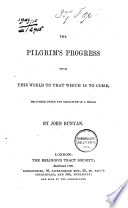
The Pilgrim's Progress from This World, to That Which Is to Come is a 1678 Christian allegory written by John Bunyan. It is regarded as one of the most significant works of religious, theological fiction in English literature. It has been translated into more than 200 languages, and has never been out of print. It has also been cited as the first novel written in English.Bunyan began his work while in the Bedfordshire county prison for violations of the Conventicle Act of 1664, which prohibited the holding of religious services outside the auspices of the established Church of England. Early Bunyan scholars such as John Brown believed The Pilgrim's Progress was begun in Bunyan's second, shorter imprisonment for six months in 1675, but more recent scholars such as Roger Sharrock believe that it was begun during Bunyan's initial, more lengthy imprisonment from 1660 to 1672 right after he had written his spiritual autobiography Grace Abounding to the Chief of Sinners.The English text comprises 108,260 words and is divided into two parts, each reading as a continuous narrative with no chapter divisions. The first part was completed in 1677 and entered into the Stationers' Register on 22 December 1677. It was licensed and entered in the "Term Catalogue" on 18 February 1678, which is looked upon as the date of first publication. After the first edition of the first part in 1678, an expanded edition, with additions written after Bunyan was freed, appeared in 1679. The Second Part appeared in 1684. There were eleven editions of the first part in John Bunyan's lifetime, published in successive years from 1678 to 1685 and in 1688, and there were two editions of the second part, published in 1684 and 1686.
“Some things are of that nature as to make
One's fancy chuckle, while his heart doth ache.”
John Bunyan The Pilgrim's Progress
The Author's Way of sending forth his Second Part of the Pilgrim
The Pilgrim's Progress (1678), Part II
John Bunyan The Pilgrim's Progress
Part II, Ch. XIII <!-- Sect. 4 -->
The Pilgrim's Progress (1678), Part II
Context: Then Mr. Honest called for his friends, and said unto them, I die, but shall make no will. As for my honesty, it shall go with me; let him that comes after be told of this. When the day that he was to be gone was come, he addressed himself to go over the river. Now the river at that time over-flowed its banks in some places; but Mr. Honest, in his lifetime, had spoken to one Good-conscience to meet him there, the which he also did, and lent him his hand, and so helped him over. The last words of Mr. Honest were, Grace reigns! So he left the world.After this it was noised abroad that Mr. Valiant-for-truth was taken with a summons by the same post as the other, and had this for a token that the summons was true, "That his pitcher was broken at the fountain." When he understood it, he called for his friends, and told them of it. Then said he, I am going to my Father’s; and though with great difficulty I have got hither, yet now I do not repent me of all the trouble I have been at to arrive where I am. My sword I give to him that shall succeed me in my pilgrimage, and my courage and skill to him that can get it. My marks and scars I carry with me, to be a witness for me that I have fought His battles who will now be my rewarder. When the day that he must go hence was come, many accompanied him to the river-side, into which as he went, he said, "Death, where is thy sting?" And as he went down deeper, he said, "Grave, where is thy victory?"
So he passed over, and all the trumpets sounded for him on the other side.
“a man there was, though some did count him mad, the more he cast away the more he had.”
John Bunyan The Pilgrim's Progress
Source: The Pilgrim's Progress
“Dark clouds bring waters, when the bright bring none.”
John Bunyan The Pilgrim's Progress
Source: The Pilgrim's Progress
“The name of the slough was Despond.”
John Bunyan The Pilgrim's Progress
Part I, Ch. II : The Slough of Despond
The Pilgrim's Progress (1678), Part I
“They came to the Delectable Mountains.”
John Bunyan The Pilgrim's Progress
Part I, Ch. XVI : The Delectable Mountains
The Pilgrim's Progress (1678), Part I
John Bunyan The Pilgrim's Progress
Part II, Ch. XI : Mr. Valiant-For-Truth
The Pilgrim's Progress (1678), Part II
John Bunyan The Pilgrim's Progress
Part II, Ch. VIII : The Guests of Gaius
The Pilgrim's Progress (1678), Part II
John Bunyan The Pilgrim's Progress
Source: The Pilgrim's Progress (1678), Part I, Ch. IX : Apollyon<!-- (London, Edinburgh, Glasgow, New York and Toronto: Henry Frowde, 1904) -->
“It beareth the name of Vanity Fair, because the town where 't is kept is lighter than vanity.”
John Bunyan The Pilgrim's Progress
Part I, Ch XIII : Vanity Fair
The Pilgrim's Progress (1678), Part I
“Every fat must stand upon its own bottom.”
John Bunyan The Pilgrim's Progress
Part I, Ch. VI : The Cross and the Contrast; comparable to: "Every tub must stand upon its bottom", Charles Macklin, The Man of the World, act i. sc. 2
The Pilgrim's Progress (1678), Part I
John Bunyan The Pilgrim's Progress
Part II, Ch. XI : Mr. Valiant-For-Truth
The Pilgrim's Progress (1678), Part II
“The last words of Mr. Honest were, Grace reigns! So he left the world.”
John Bunyan The Pilgrim's Progress
Part II, Ch. XIII <!-- Sect. 4 -->
The Pilgrim's Progress (1678), Part II
Context: Then Mr. Honest called for his friends, and said unto them, I die, but shall make no will. As for my honesty, it shall go with me; let him that comes after be told of this. When the day that he was to be gone was come, he addressed himself to go over the river. Now the river at that time over-flowed its banks in some places; but Mr. Honest, in his lifetime, had spoken to one Good-conscience to meet him there, the which he also did, and lent him his hand, and so helped him over. The last words of Mr. Honest were, Grace reigns! So he left the world.After this it was noised abroad that Mr. Valiant-for-truth was taken with a summons by the same post as the other, and had this for a token that the summons was true, "That his pitcher was broken at the fountain." When he understood it, he called for his friends, and told them of it. Then said he, I am going to my Father’s; and though with great difficulty I have got hither, yet now I do not repent me of all the trouble I have been at to arrive where I am. My sword I give to him that shall succeed me in my pilgrimage, and my courage and skill to him that can get it. My marks and scars I carry with me, to be a witness for me that I have fought His battles who will now be my rewarder. When the day that he must go hence was come, many accompanied him to the river-side, into which as he went, he said, "Death, where is thy sting?" And as he went down deeper, he said, "Grave, where is thy victory?"
So he passed over, and all the trumpets sounded for him on the other side.
“There stood a man with his sword drawn, and his face all over with blood.”
John Bunyan The Pilgrim's Progress
Part II, Ch. XI : Mr. Valiant-For-Truth <!-- Sect. 4 -->
The Pilgrim's Progress (1678), Part II
Context: There stood a man with his sword drawn, and his face all over with blood. Then said Mr. Great-Heart, Who art thou? The man made answer, saying, I am one whose name is Valiant-for-truth. I am a pilgrim, and am going to the Celestial City.
“When he understood it, he called for his friends, and told them of it.”
John Bunyan The Pilgrim's Progress
Part II, Ch. XIII <!-- Sect. 4 -->
The Pilgrim's Progress (1678), Part II
Context: Then Mr. Honest called for his friends, and said unto them, I die, but shall make no will. As for my honesty, it shall go with me; let him that comes after be told of this. When the day that he was to be gone was come, he addressed himself to go over the river. Now the river at that time over-flowed its banks in some places; but Mr. Honest, in his lifetime, had spoken to one Good-conscience to meet him there, the which he also did, and lent him his hand, and so helped him over. The last words of Mr. Honest were, Grace reigns! So he left the world.After this it was noised abroad that Mr. Valiant-for-truth was taken with a summons by the same post as the other, and had this for a token that the summons was true, "That his pitcher was broken at the fountain." When he understood it, he called for his friends, and told them of it. Then said he, I am going to my Father’s; and though with great difficulty I have got hither, yet now I do not repent me of all the trouble I have been at to arrive where I am. My sword I give to him that shall succeed me in my pilgrimage, and my courage and skill to him that can get it. My marks and scars I carry with me, to be a witness for me that I have fought His battles who will now be my rewarder. When the day that he must go hence was come, many accompanied him to the river-side, into which as he went, he said, "Death, where is thy sting?" And as he went down deeper, he said, "Grave, where is thy victory?"
So he passed over, and all the trumpets sounded for him on the other side.


