
“Few things are impossible to diligence and skill.”
Samuel Johnson book The History of Rasselas, Prince of Abissinia
Source: The History of Rasselas, Prince of Abissinia (1759), Chapter 12
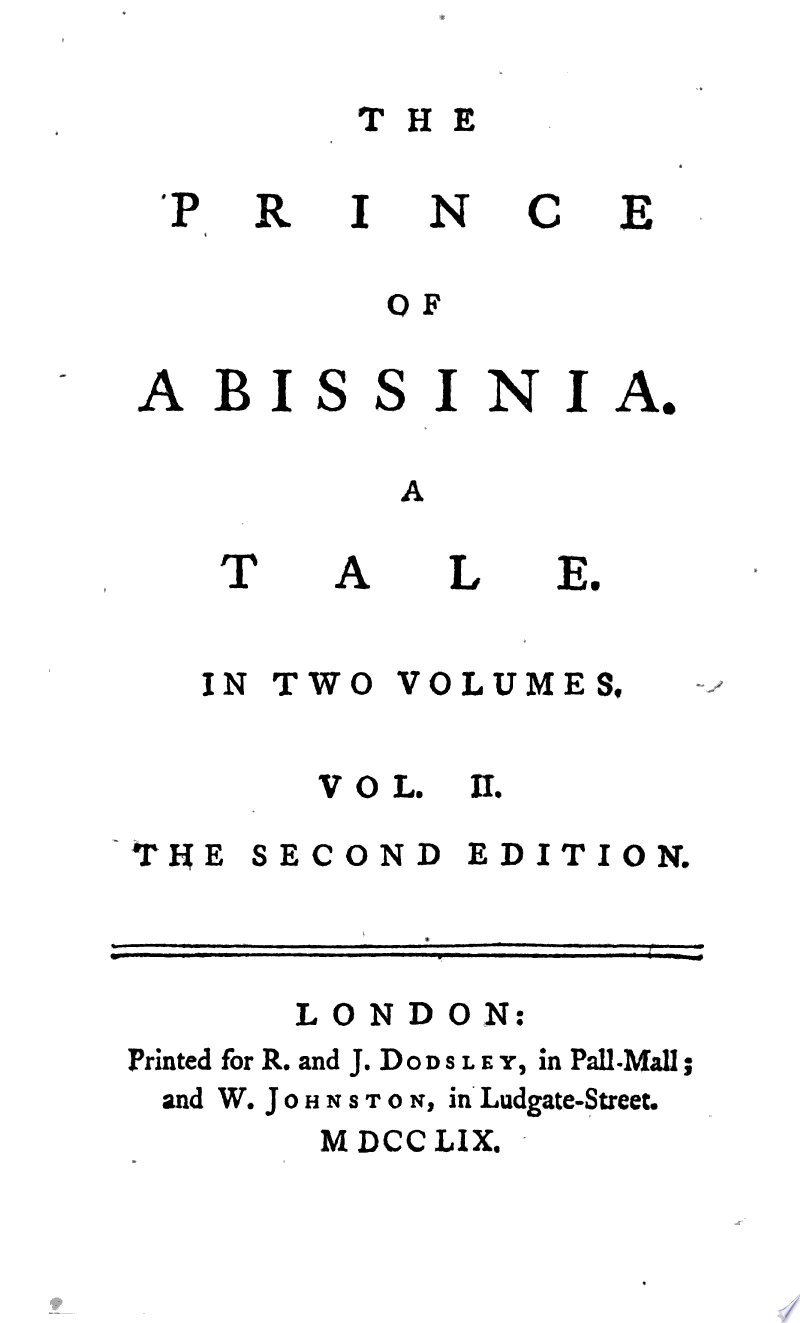
The History of Rasselas, Prince of Abissinia, originally titled The Prince of Abissinia: A Tale, though often abbreviated to Rasselas, is an apologue about bliss and ignorance by Samuel Johnson. The book's original working title was "The Choice of Life".At the age of fifty, he wrote the piece in only one week to help pay the costs of his mother's funeral, intending to complete it on 22 January 1759 . Though this is still popular belief, Wharton and Mayerson's book, "Samuel Johnson and the Theme of Hope," explains how James Boswell, the author of Johnson's biography-- "The Life of Johnson" -- was "entirely wrong in supposing that Rasselas was written soon after his mother's death" . It wasn't a way of "defraying" the expenses of the funeral. In fact, Johnson wrote Rasselas instead of going to see his mother while she still survived. It was written in anticipation of her funeral. Edward Tomarken writes in his book, “Johnson, Rasselas, and the Choice of Criticism”, that this belief was not questioned until 1927 as “...the tradition of the gloomy, funereal tone of the choice of life motif in Rasselas remained unopposed: the question of whether or not the genesis of Rasselas involved a literal funeral was not considered important. Moreover, the assumption of a gloomy genesis served to keep religion in the background, for any theological difficulty could be attributed to the fact that the author was mourning the death of his mother” .The book was first published in April 1759 in England. Johnson is believed to have received a total of £75 for the copyright. The first American edition followed in 1768. The title page of this edition carried a quotation, inserted by the publisher Robert Bell, from La Rochefoucauld: "The labour or Exercise of the Body, freeth Man from the Pains of the Mind; and this constitutes the Happiness of the Poor".Johnson was influenced by the vogue for exotic locations including Ethiopia. He had translated A Voyage to Abyssinia by Jerónimo Lobo in 1735 and used it as the basis for a "philosophical romance". Ten years prior to writing Rasselas he published The Vanity of Human Wishes in which he describes the inevitable defeat of worldly ambition. Early readers considered Rasselas to be a work of philosophical and practical importance and critics often remark on the difficulty of classifying it as a novel. Johnson was a staunch opponent of slavery, revered by abolitionists, and Rasselas became a name adopted by emancipated slaves.
“Few things are impossible to diligence and skill.”
Samuel Johnson book The History of Rasselas, Prince of Abissinia
Source: The History of Rasselas, Prince of Abissinia (1759), Chapter 12
Samuel Johnson book The History of Rasselas, Prince of Abissinia
Source: The History of Rasselas, Prince of Abissinia (1759), Chapter 41
“Distance has the same effect on the mind as on the eye.”
Samuel Johnson book The History of Rasselas, Prince of Abissinia
Source: The History of Rasselas, Prince of Abissinia
“Nothing … will ever be attempted, if all possible objections must be first overcome.”
Samuel Johnson book The History of Rasselas, Prince of Abissinia
Source: The History of Rasselas, Prince of Abissinia (1759), Chapter 6
“The world is not yet exhausted: let me see something to-morrow which I never saw before.”
Samuel Johnson book The History of Rasselas, Prince of Abissinia
Source: The History of Rasselas, Prince of Abissinia (1759), Chapter 47
“Marriage has many pains, but celibacy has no pleasures.”
Samuel Johnson book The History of Rasselas, Prince of Abissinia
Source: The History of Rasselas, Prince of Abissinia (1759), Chapter 26
“Knowledge is more than equivalent to force. The master of mechanicks laughs at strength.”
Samuel Johnson book The History of Rasselas, Prince of Abissinia
Source: The History of Rasselas, Prince of Abissinia (1759), Chapter 13; variant with modernized spelling: Knowledge is more than equivalent to force. The master of mechanics laughs at strength.
“Many things difficult to design prove easy to performance.”
Samuel Johnson book The History of Rasselas, Prince of Abissinia
Source: The History of Rasselas, Prince of Abissinia (1759), Chapter 26
“Example is always more efficacious than precept.”
Samuel Johnson book The History of Rasselas, Prince of Abissinia
Source: The History of Rasselas, Prince of Abissinia (1759), Chapter 29
Samuel Johnson book The History of Rasselas, Prince of Abissinia
Source: The History of Rasselas, Prince of Abissinia (1759), Chapter 1
“I live in the crowd of jollity, not so much to enjoy company as to shun myself.”
Samuel Johnson book The History of Rasselas, Prince of Abissinia
Source: The History of Rasselas, Prince of Abissinia (1759), Chapter 26
“The endearing elegance of female friendship.”
Samuel Johnson book The History of Rasselas, Prince of Abissinia
Source: The History of Rasselas, Prince of Abissinia (1759), Chapter 46
“Human life is everywhere a state in which much is to be endured and little to be enjoyed.”
Samuel Johnson book The History of Rasselas, Prince of Abissinia
Source: The History of Rasselas, Prince of Abissinia (1759), Chapter 11
“To a poet nothing can be useless.”
Samuel Johnson book The History of Rasselas, Prince of Abissinia
Source: The History of Rasselas, Prince of Abissinia (1759), Chapter 10
“The first years of man must make provision for the last.”
Samuel Johnson book The History of Rasselas, Prince of Abissinia
Source: The History of Rasselas, Prince of Abissinia (1759), Chapter 27
Samuel Johnson book The History of Rasselas, Prince of Abissinia
Source: The History of Rasselas, Prince of Abissinia (1759), Chapter 10
Samuel Johnson book The History of Rasselas, Prince of Abissinia
Source: The History of Rasselas, Prince of Abissinia (1759), Chapter 48
Samuel Johnson book The History of Rasselas, Prince of Abissinia
Source: The History of Rasselas, Prince of Abissinia (1759), Chapter 29
“A man used to vicissitudes is not easily dejected.”
Samuel Johnson book The History of Rasselas, Prince of Abissinia
Source: The History of Rasselas, Prince of Abissinia (1759), Chapter 12
Samuel Johnson book The History of Rasselas, Prince of Abissinia
Source: The History of Rasselas, Prince of Abissinia (1759), Chapter 3


