Quotes from book
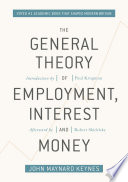
The General Theory of Employment, Interest and Money

The General Theory of Employment, Interest and Money

The General Theory of Employment, Interest and Money of 1936 is the last and most important book by the English economist John Maynard Keynes. It created a profound shift in economic thought, giving macroeconomics a central place in economic theory and contributing much of its terminology – the "Keynesian Revolution". It had equally powerful consequences in economic policy, being interpreted as providing theoretical support for government spending in general, and for budgetary deficits, monetary intervention and counter-cyclical policies in particular. It is pervaded with an air of mistrust for the rationality of free-market decision making.


John Maynard Keynes photo

“The ideas of economists and political philosophers, both when they are right and when they are wrong, are more powerful than is commonly understood. Indeed the world is ruled by little else. Practical men, who believe themselves to be quite exempt from any intellectual influence, are usually the slaves of some defunct economist.”

John Maynard Keynes book The General Theory of Employment, Interest and Money

Source: The General Theory of Employment, Interest and Money (1936), Ch. 24 "Concluding Notes" p. 383-384
Context: The ideas of economists and political philosophers, both when they are right and when they are wrong, are more powerful than is commonly understood. Indeed the world is ruled by little else. Practical men, who believe themselves to be quite exempt from any intellectual influence, are usually the slaves of some defunct economist. Madmen in authority, who hear voices in the air, are distilling their frenzy from some academic scribbler of a few years back. I am sure that the power of vested interests is vastly exaggerated compared with the gradual encroachment of ideas. Not, indeed, immediately, but after a certain interval; for in the field of economic and political philosophy there are not many who are influenced by new theories after they are twenty-five or thirty years of age, so that the ideas which civil servants and politicians and even agitators apply to current events are not likely to be the newest. But, soon or late, it is ideas, not vested interests, which are dangerous for good or evil.

Similar authors

John Maynard Keynes photo
John Maynard Keynes122
British economist 1883–1946
John Hicks photo
John Hicks14
British economist None
Ronald H. Coase photo
Ronald H. Coase19
British economist and author None
Bertil Ohlin photo
Bertil Ohlin11
Swedish economist and politician None
Jan Tinbergen photo
Jan Tinbergen21
Dutch economist None
Thomas J. Sargent photo
Thomas J. Sargent10
American economist None
Paul A. Samuelson photo
Paul A. Samuelson47
American economist None
Milton Friedman photo
Milton Friedman158
American economist, statistician, and writer None
Theodore Schultz photo
Theodore Schultz15
American economist None
Douglass C. North photo
Douglass C. North18
American Economist None