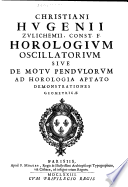
Horologium Oscillatorium: sive de motu pendulorum ad horologia aptato demonstrationes geometricae is a book published by Christiaan Huygens in 1673; it is his major work on pendulums and horology. This work is regarded as one of the three most important works done on mechanics in the 17th century, the other two being Galileo’s Discourses and Mathematical Demonstrations Relating to Two New Sciences and Isaac Newton’s Philosophiæ Naturalis Principia Mathematica .The book is divided into five parts, where the first part contains the descriptions of clock designs, while the rest of the book is devoted to the analysis of pendulum motion and a theory of curves. In the second part of the book, Huygens states three hypotheses on the motion of bodies. They are essentially the law of inertia and the law of composition of "motion". He uses these three rules to re-derive Galileo's original study of falling bodies, based on clearer logical framework. He then studies constrained fall, obtaining the solution to the tautochrone problem as given by a cycloid curve and not a circle as Galileo had conceived. In the third part of the book, he outlines a theory of evolutes and rectification of curves. The fourth part of the book is concerned with the study of the center of oscillation. The derivations of propositions in this part is based on a single assumption: that the center of gravity of heavy objects cannot lift itself, which Huygens used as a virtual work principle. In the process, Huygens obtained solutions to dynamical problems such as the period of an oscillating pendulum as well as a compound pendulum, center of oscillation and its interchangeability with the pivot point, and the concept of moment of inertia. The last part of the book gives propositions regarding bodies in uniform circular motion, without proof, and states the laws of centrifugal force for uniform circular motion.The book is also known for its strangely worded dedication to Louis XIV. The appearance of the book in 1673 was a political issue, since at that time the Netherlands was at war with France; Huygens was anxious to show his allegiance to his patron, which can be seen in the obsequious dedication to Louis XIV.