
Karl Marx book Grundrisse
Grundrisse (1857-1858)
Source: Notebook VII, The Chapter on Capital, pp. 628–629.
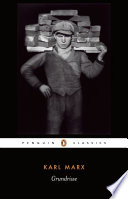
The Grundrisse der Kritik der Politischen Ökonomie is a lengthy, unfinished manuscript by the German philosopher Karl Marx. The series of seven notebooks was rough-drafted by Marx, chiefly for purposes of self-clarification, during the winter of 1857-8. Left aside by Marx in 1858, it remained unpublished until 1939.
Karl Marx book Grundrisse
Grundrisse (1857-1858)
Source: Notebook VII, The Chapter on Capital, pp. 628–629.
Karl Marx book Grundrisse
Notebook VII, The Chapter on Capital, pp. 628–629.
Grundrisse (1857/58)
Context: The development of fixed capital indicates in still another respect the degree of development of wealth generally, or of capital…
The creation of a large quantity of disposable time apart from necessary labour time for society generally and each of its members (i. e. room for the development of the individuals’ full productive forces, hence those of society also), this creation of not-labour time appears in the stage of capital, as of all earlier ones, as not-labour time, free time, for a few. What capital adds is that it increases the surplus labour time of the mass by all the means of art and science, because its wealth consists directly in the appropriation of surplus labour time; since value directly its purpose, not use value. It is thus, despite itself, instrumental in creating the means of social disposable time, in order to reduce labour time for the whole society to a diminishing minimum, and thus to free everyone’s time for their own development. But its tendency always, on the one side, to create disposable time, on the other, to convert it into surplus labour...
The mass of workers must themselves appropriate their own surplus labour. Once they have done so – and disposable time thereby ceases to have an antithetical existence – then, on one side, necessary labour time will be measured by the needs of the social individual, and, on the other, the development of the power of social production will grow so rapidly that, even though production is now calculated for the wealth of all, disposable time will grow for all. For real wealth is the developed productive power of all individuals. The measure of wealth is then not any longer, in any way, labour time, but rather disposable time. Labour time as the measure of value posits wealth itself as founded on poverty, and disposable time as existing in and because of the antithesis to surplus labour time; or, the positing of an individual’s entire time as labour time, and his degradation therefore to mere worker, subsumption under labour. The most developed machinery thus forces the worker to work longer than the savage does, or than he himself did with the simplest, crudest tools.
Karl Marx book Grundrisse
Notebook VII, The Chapter on Capital, pp. 628–629.
Grundrisse (1857/58)
Context: The development of fixed capital indicates in still another respect the degree of development of wealth generally, or of capital…
The creation of a large quantity of disposable time apart from necessary labour time for society generally and each of its members (i. e. room for the development of the individuals’ full productive forces, hence those of society also), this creation of not-labour time appears in the stage of capital, as of all earlier ones, as not-labour time, free time, for a few. What capital adds is that it increases the surplus labour time of the mass by all the means of art and science, because its wealth consists directly in the appropriation of surplus labour time; since value directly its purpose, not use value. It is thus, despite itself, instrumental in creating the means of social disposable time, in order to reduce labour time for the whole society to a diminishing minimum, and thus to free everyone’s time for their own development. But its tendency always, on the one side, to create disposable time, on the other, to convert it into surplus labour...
The mass of workers must themselves appropriate their own surplus labour. Once they have done so – and disposable time thereby ceases to have an antithetical existence – then, on one side, necessary labour time will be measured by the needs of the social individual, and, on the other, the development of the power of social production will grow so rapidly that, even though production is now calculated for the wealth of all, disposable time will grow for all. For real wealth is the developed productive power of all individuals. The measure of wealth is then not any longer, in any way, labour time, but rather disposable time. Labour time as the measure of value posits wealth itself as founded on poverty, and disposable time as existing in and because of the antithesis to surplus labour time; or, the positing of an individual’s entire time as labour time, and his degradation therefore to mere worker, subsumption under labour. The most developed machinery thus forces the worker to work longer than the savage does, or than he himself did with the simplest, crudest tools.
“The devil take this wrong arithmetic.”
Karl Marx book Grundrisse
Grundrisse (1857/58)
Variant: The devil take this wrong arithmetic. But never mind.
Source: Notebook IV, The Chapter on Capital, p. 297.
“But it cannot be its own or its own standard of comparison.”
Karl Marx book Grundrisse
Notebook I, The Chapter on Money, p. 93.
Grundrisse (1857/58)
Context: Money appears as measure (in Homer, e. g. oxen) earlier than as medium of exchange, because in barter each commodity is still its own medium of exchange. But it cannot be its own or its own standard of comparison.


