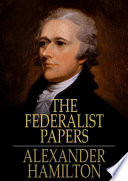
Quotes from work
Federalist Papers

Federalist Papers

The Federalist Papers is a collection of 85 articles and essays written by Alexander Hamilton, James Madison, and John Jay under the pseudonym "Publius" to promote the ratification of the United States Constitution. The collection was commonly known as The Federalist until the name The Federalist Papers emerged in the 20th century.


Alexander Hamilton photo

“When the sword is once drawn, the passions of men observe no bounds of moderation.”

Alexander Hamilton Federalist Papers

No. 16 http://www.constitution.org/fed/federa16.htm : The Insufficiency of the Present Confederation to Preserve the Union <br class="br">The Federalist Papers (1787–1788) <br class="br">Context: When the sword is once drawn, the passions of men observe no bounds of moderation. The suggestions of wounded pride, the instigations of irritated resentment, would be apt to carry the States against which the arms of the Union were exerted, to any extremes necessary to avenge the affront or to avoid the disgrace of submission. The first war of this kind would probably terminate in a dissolution of the Union.

Alexander Hamilton photo

“I never expect to see a perfect work from imperfect man. The result of the deliberations of all collective bodies must necessarily be a compound, as well of the errors and prejudices, as of the good sense and wisdom, of the individuals of whom they are composed.”

Alexander Hamilton Federalist Papers

No. 85
The Federalist Papers (1787–1788)
Context: I should esteem it the extreme of imprudence to prolong the precarious state of our national affairs, and to expose the Union to the jeopardy of successive experiments, in the chimerical pursuit of a perfect plan. I never expect to see a perfect work from imperfect man. The result of the deliberations of all collective bodies must necessarily be a compound, as well of the errors and prejudices, as of the good sense and wisdom, of the individuals of whom they are composed.

James Madison photo

“The accumulation of all powers, Legislative, Executive, and Judiciary, in the same hands, whether of one, a few, or many, and whether hereditary, self-appointed, or elective, may justly be pronounced the very definition of tyranny.”

James Madison Federalist Papers

Federalist No. 47 (30 January 1788) Federalist (Dawson)/46 Full text at Wikisource http://en.wikisource.org/wiki/The <br class="br">Source: 1780s, Federalist Papers (1787–1788) <br class="br">Context: One of the principal objections inculcated by the more respectable adversaries to the Constitution is its supposed violation of the political maxim, that the Legislative, Executive, and Judiciary departments ought to be separate and distinct. In the structure of the Fœderal Government, no regard, it is said, seems to have been paid to this essential precaution in favor of liberty. The several departments of power are distributed and blended in such a manner, as at once to destroy all symmetry and beauty of form, and to expose some of the essential parts of the edifice to the danger of being crushed by the disproportionate weight of other parts.<br>No political truth is certainly of greater intrinsic value, or is stamped with the authority of more enlightened patrons of liberty, than that on which the objection is founded. The accumulation of all powers, Legislative, Executive, and Judiciary, in the same hands, whether of one, a few, or many, and whether hereditary, self-appointed, or elective, may justly be pronounced the very definition of tyranny.

James Madison photo

“In framing a government which is to be administered by men over men, the great difficulty lies in this: you must first enable the government to control the governed; and in the next place oblige it to control itself.”

James Madison Federalist Papers

Federalist No. 51 (6 February 1788)
1780s, Federalist Papers (1787–1788)
Source: The Federalist Papers
Context: If men were angels, no government would be necessary. If angels were to govern men, neither external nor internal controls on government would be necessary. In framing a government which is to be administered by men over men, the great difficulty lies in this: you must first enable the government to control the governed; and in the next place oblige it to control itself. A dependence on the people is, no doubt, the primary control on the government; but experience has taught mankind the necessity of auxiliary precautions.

Alexander Hamilton photo
John Jay photo
Alexander Hamilton photo
John Jay photo
John Jay photo
Alexander Hamilton photo

Similar authors

Alexander Hamilton photo
Alexander Hamilton106
Founding Father of the United States 1757–1804
Thomas Jefferson photo
Thomas Jefferson456
3rd President of the United States of America None
George Washington photo
George Washington186
first President of the United States None
Montesquieu photo
Montesquieu34
French social commentator and political thinker None
Benjamin Franklin photo
Benjamin Franklin183
American author, printer, political theorist, politician, p… None
René Descartes photo
René Descartes47
French philosopher, mathematician, and scientist None
Galileo Galilei photo
Galileo Galilei70
Italian mathematician, physicist, philosopher and astronomer None
Thomas Paine photo
Thomas Paine262
English and American political activist None
John Locke photo
John Locke144
English philosopher and physician None
Immanuel Kant photo
Immanuel Kant200
German philosopher None