Quotes from book
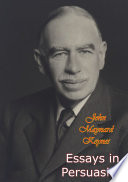
Essays in Persuasion

Essays in Persuasion

Essays In Persuasion, which was first published in 1931, was author John Maynard Keynes’ first volume of collected essays. In it he gathered together various writings on public affairs from 1919-1931, including some extracts from his published books. The essays taken as a whole embody forecasts and recommendations made by the author on a variety of subjects which can now be checked by the course of events. Essays In Persuasion is divided into five sections which deal respectively with (1) The Treaty of Peace, (2) Inflation and Deflation, (3) The Return to the Gold Standard, (4) Politics, and (5) The Future. Whilst a certain proportion of these essays deal with matters which now belong to the past, a considerable number relate to affairs the full course of which has not yet run and where the proposals and ideas set forth still have practical application.


John Maynard Keynes photo

“When the accumulation of wealth is no longer of high social importance, there will be great changes in the code of morals.”

John Maynard Keynes book Essays in Persuasion

as quoted in &quot;Keynes and the Ethics of Capitalism&quot; by Robert Skidelsy http://www.webcitation.org/query?id=1256603608595872&amp;url=www.geocities.com/monedem/keyn.html <br class="br">Essays in Persuasion (1931), Economic Possibilities for our Grandchildren (1930) <br class="br">Context: When the accumulation of wealth is no longer of high social importance, there will be great changes in the code of morals. We shall be able to rid ourselves of many of the pseudo-moral principles which have hag-ridden us for two hundred years, by which we have exalted some of the most distasteful of human qualities into the position of the highest virtues. We shall be able to afford to dare to assess the money-motive at its true value. The love of money as a possession — as distinguished from the love of money as a means to the enjoyments and realities of life — will be recognised for what it is, a somewhat disgusting morbidity, one of those semi-criminal, semi-pathological propensities which one hands over with a shudder to the specialists in mental disease … But beware! The time for all this is not yet. For at least another hundred years we must pretend to ourselves and to everyone that fair is foul and foul is fair; for foul is useful and fair is not. Avarice and usury and precaution must be our gods for a little longer still. For only they can lead us out of the tunnel of economic necessity into daylight.

John Maynard Keynes photo

“The love of money as a possession — as distinguished from the love of money as a means to the enjoyments and realities of life — will be recognised for what it is, a somewhat disgusting morbidity, one of those semi-criminal, semi-pathological propensities which one hands over with a shudder to the specialists in mental disease”

John Maynard Keynes book Essays in Persuasion

as quoted in &quot;Keynes and the Ethics of Capitalism&quot; by Robert Skidelsy http://www.webcitation.org/query?id=1256603608595872&amp;url=www.geocities.com/monedem/keyn.html <br class="br">Essays in Persuasion (1931), Economic Possibilities for our Grandchildren (1930) <br class="br">Context: When the accumulation of wealth is no longer of high social importance, there will be great changes in the code of morals. We shall be able to rid ourselves of many of the pseudo-moral principles which have hag-ridden us for two hundred years, by which we have exalted some of the most distasteful of human qualities into the position of the highest virtues. We shall be able to afford to dare to assess the money-motive at its true value. The love of money as a possession — as distinguished from the love of money as a means to the enjoyments and realities of life — will be recognised for what it is, a somewhat disgusting morbidity, one of those semi-criminal, semi-pathological propensities which one hands over with a shudder to the specialists in mental disease … But beware! The time for all this is not yet. For at least another hundred years we must pretend to ourselves and to everyone that fair is foul and foul is fair; for foul is useful and fair is not. Avarice and usury and precaution must be our gods for a little longer still. For only they can lead us out of the tunnel of economic necessity into daylight.

John Maynard Keynes photo

“How can I accept a doctrine which sets up as its bible, above and beyond criticism, an obsolete economic textbook which I know to be not only scientifically erroneous but without interest or application for the modern world? How can I adopt a creed which, preferring the mud to the fish, exalts the boorish proletariat above the bourgeois and the intelligentsia who, with whatever faults, are the quality in life and surely carry the seeds of all human advancement?”

John Maynard Keynes book Essays in Persuasion

"A Short View of Russia" (1925); Originally three essays for the Nation and Athenaeum, later published separately as A Short View of Russia (1925), then edited down for publication in Essays in Persuasion (1931)
Ref: en.wikiquote.org - John Maynard Keynes / Quotes / Essays in Persuasion (1931)
Essays in Persuasion (1931), A Short View of Russia (1925)

John Maynard Keynes photo

“If economists could manage to get themselves thought of as humble, competent people on a level with dentists, that would be splendid.”

John Maynard Keynes book Essays in Persuasion

Essays in Persuasion (1931), Economic Possibilities for our Grandchildren (1930)

John Maynard Keynes photo

“I do not know which makes a man more conservative — to know nothing but the present, or nothing but the past.”

John Maynard Keynes book Essays in Persuasion

Source: Essays in Persuasion (1931), The End of Laissez-faire (1926), Ch. 1

John Maynard Keynes photo

“A study of the history of opinion is a necessary preliminary to the emancipation of the mind.”

John Maynard Keynes book Essays in Persuasion

Source: Essays in Persuasion (1931), The End of Laissez-faire (1926), Ch. 1

John Maynard Keynes photo

Similar authors

John Maynard Keynes photo
John Maynard Keynes122
British economist 1883–1946
John Hicks photo
John Hicks14
British economist None
Ronald H. Coase photo
Ronald H. Coase19
British economist and author None
Bertil Ohlin photo
Bertil Ohlin11
Swedish economist and politician None
Jan Tinbergen photo
Jan Tinbergen21
Dutch economist None
Thomas J. Sargent photo
Thomas J. Sargent10
American economist None
Paul A. Samuelson photo
Paul A. Samuelson47
American economist None
Milton Friedman photo
Milton Friedman158
American economist, statistician, and writer None
Theodore Schultz photo
Theodore Schultz15
American economist None
Douglass C. North photo
Douglass C. North18
American Economist None