
“Man must be disciplined, for he is by nature raw and wild..”
Immanuel Kant book Critique of Pure Reason
Source: Critique of Pure Reason
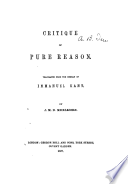
The Critique of Pure Reason is a book by the German philosopher Immanuel Kant, in which the author seeks to determine the limits and scope of metaphysics. Also referred to as Kant's "First Critique", it was followed by the Critique of Practical Reason and the Critique of Judgment . In the preface to the first edition, Kant explains that by a "critique of pure reason" he means a critique "of the faculty of reason in general, in respect of all knowledge after which it may strive independently of all experience" and that he aims to reach a decision about "the possibility or impossibility of metaphysics".
“Man must be disciplined, for he is by nature raw and wild..”
Immanuel Kant book Critique of Pure Reason
Source: Critique of Pure Reason
Immanuel Kant book Critique of Pure Reason
B 730; Variant translation: All our knowledge begins with the senses, proceeds then to the understanding, and ends with reason. There is nothing higher than reason.
Variant: All human knowledge begins with intuitions, proceeds from thence to concepts, and ends with ideas.
Source: Critique of Pure Reason (1781; 1787)
“Thoughts without content are empty, intuitions without concepts are blind.”
Immanuel Kant book Critique of Pure Reason
A 51, B 75
Source: Critique of Pure Reason (1781; 1787)
Context: Thoughts without content are empty, intuitions without concepts are blind. The understanding can intuit nothing, the senses can think nothing. Only through their unison can knowledge arise.
Immanuel Kant book Critique of Pure Reason
Introduction I. Of the Difference Between Pure and Empirical Knowledge
Critique of Pure Reason (1781; 1787)
Variant: That all our knowledge begins with experience there can be no doubt.
Context: That all our knowledge begins with experience there can be no doubt. For how is it possible that the faculty of cognition should be awakened into exercise otherwise than by means of objects which affect our senses, and partly of them selves produce representations, partly rouse our powers of understanding into activity, to compare, to connect, or to separate these, and so to convert the raw material of our sensuous impressions into a knowledge of objects, which is called experience? In respect of time, therefore, no knowledge of ours is antecedent to experience, but begins with it. But though all our knowledge begins with experience, it by no means follows, that all arises out of experience. For, on the contrary, it is quite possible that our empirical knowledge is a compound of that which we receive through impressions, and that which the faculty of cognition supplies from itself (sensuous impressions giving merely the occasion)... It is, therefore, a question which requires close investigation, and is not to be answered at first sight,—whether there exists a knowledge altogether independent of experience, and even of all sensuous impressions? Knowledge of this kind is called à priori, in contradistinction to empirical knowledge which has its sources à posteriori, that is, in experience.
“All our knowledge falls with the bounds of experience.”
Immanuel Kant book Critique of Pure Reason
A 146, B 185
Critique of Pure Reason (1781; 1787)
“Human reason is by nature architectonic.”
Immanuel Kant book Critique of Pure Reason
B 502
Critique of Pure Reason (1781; 1787)
Immanuel Kant book Critique of Pure Reason
A 747, B 775; as translated by F. Max Mueller
Critique of Pure Reason (1781; 1787)
Immanuel Kant book Critique of Pure Reason
Preface to the Second Edition [Tr. F. Max Müller], (New York, 1900), p. 690; as cited in: Robert Edouard Moritz, Memorabilia mathematica or, The philomath's quotation-book https://openlibrary.org/books/OL14022383M/Memorabilia_mathematica, Published 1914. p. 10 <br class="br">Critique of Pure Reason (1781; 1787)
“I have no knowledge of myself as I am, but merely as I appear to myself.”
Immanuel Kant book Critique of Pure Reason
B 158
Critique of Pure Reason (1781; 1787)
“It is precisely in knowing its limits that philosophy consists.”
Immanuel Kant book Critique of Pure Reason
A 727, B 755
Critique of Pure Reason (1781; 1787)


