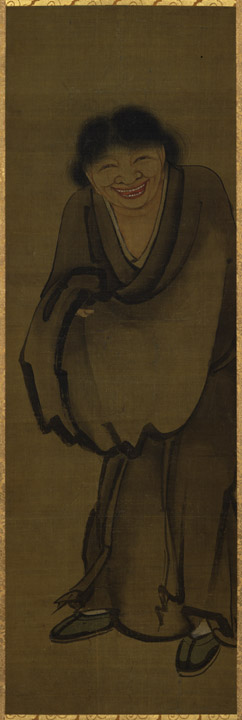
Hanshan cytaty
strona 2

Hanshan – znany buddysta i poeta chiński.

Niezwykły, legendarny pustelnik z czasów dynastii Tang. Żył w pustelni obok klasztoru Guoqing na górze Hanshan w pobliżu miasta Tangxing. Pustelnia znajdowała się w grocie i tam powstawały jego wiersze nauczające chanu. Pozostało po nim 314 wierszy, których Hanshan w ogóle nie obdarzał tytułami. Były one czytane w klasztorach chan, sŏn i zen.

Hanshan miał dwu przyjaciół; jednym był główny kapłan klasztoru Fenggan 豐干, a drugim – równie legendarny Shide 捨得. Hanshan i Shide byli bohaterami licznych opowieści oraz obrazów artystów chan Muqi i Liang Kaia .

Z niektórych źródeł wynika, że nie był mnichem i być może w ogóle nie był związany z chanem, ale jego postawa i zrozumienie były tak chanistyczne, że łączy się go z tą szkołą buddyzmu. Niemniej Hakuin Zenji w swoim komentarzu zen Senteikimon traktował wiersze Hanshana tak, jakby on był mistrzem chan.

Na jego cześć wybudowano na przedmieściu Suzhou Hanshan si, czyli świątynię Zimnej Góry.

Jia Jinhua po przeanalizowaniu charakterystycznych zwrotów w około 50 wierszach przypisywanych Hanshanowi, doszedł do wniosku, że ich autorem mógł być Caoshan Benji.

Występuje w gong’anach 34 z Biyan lu i 3 z Congrong lu. Wikipedia  

Hanshan Fotografia
Hanshan: 37   Cytatów 0   Polubień

Hanshan: Cytaty po angielsku

“Worry for others— it does no good in the end.
The great Dao, all amid joy, is reborn.
In a joyous state, ruler and subject accord,
In a joyous home, father and son get along.
If brothers increase their joy, the world will flourish.
If husband and wife have joy, it's worthy of song.
What guest and host can bear a lack of joy?
Both high and low, in joy, lose their woe before long.
Ha ha ha.”

Translated by Mary Jacob[citation needed]
It is unlikely that this poem, translated by Mary Jacob, is authored by Han-shan. In comparing it with every poem in the corpus it will be found that there is not a close match. Moreover, neither the language nor the content of this poem is that of Han-shan. Most importantly, this poem does not have the appropriate number of lines for a Han-shan poem. Jacob's poem has 9 lines; there is not a single example of a 9 line poem in all of Han-shan's poetry. All of Han-shan's poems are 4, 8, 10 or 14 lines, with a few that have more than 14. Further, Jacob's poem has an odd number of lines; there is not a single example of a poem with an odd number of lines in all of Han-shan's poetry. Finally, the 9th and final line in Jacob's poem has the words “ha ha ha.” Not a single Han-shan poem has those words as a final line. Perhaps someone is having a joke?
Disputed

“Cold Mountain Son
Forever not change
I live alone
Beyond life death”

Cold Mountain Transcendental Poetry