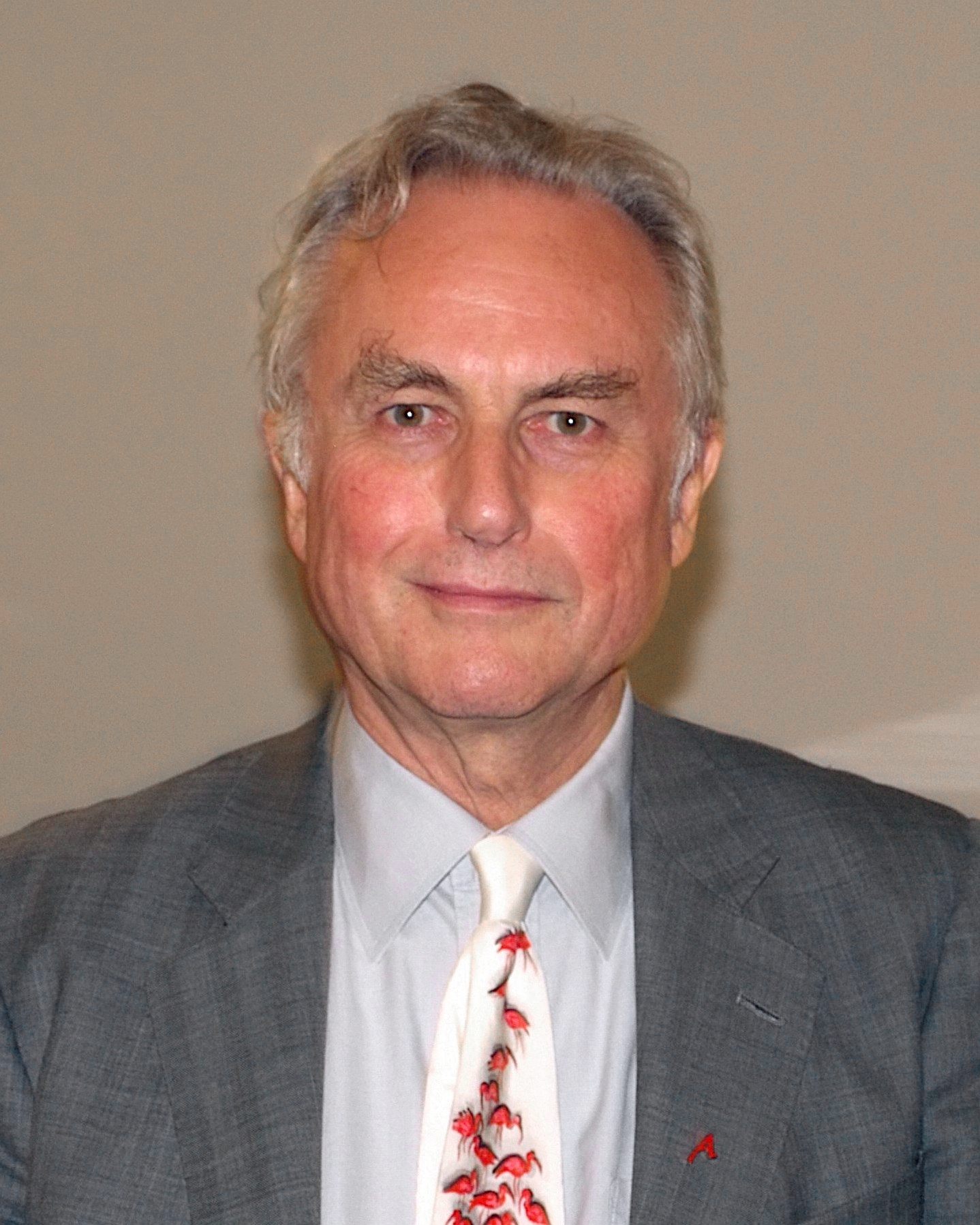
Richard Dawkins citations
Page 6

Richard Dawkins, né le 26 mars 1941 à Nairobi, est un biologiste et éthologiste britannique, vulgarisateur et théoricien de l'évolution, membre de la Royal Society. Professeur émérite au New College de l'université d'Oxford, Richard Dawkins est l'un des académiciens britanniques les plus célèbres.

Il acquiert la consécration avec son livre de 1976 intitulé Le Gène égoïste, qui popularise la théorie de l'évolution centrée sur les gènes et introduit le terme de « mème ». En 1982, il développe cette théorie dans son ouvrage Phénotype étendu puis publie en 2006 Pour en finir avec Dieu, vendu à plus de deux millions d'exemplaires et traduit en trente et une langues.

Vice-président de la British Humanist Association, il est reconnu comme un ardent défenseur du rationalisme, de la pensée scientifique et de l'athéisme. Il est résolument anticlérical et est aussi l'un des principaux critiques anglo-saxons du créationnisme, du dessein intelligent et des pseudo-sciences. Il s'est rendu célèbre aussi pour sa controverse amicale, mais ferme, avec son collègue Stephen Jay Gould sur la question des équilibres ponctués.

En plus de ses nombreux ouvrages scientifiques, Dawkins promeut sa vision rationnelle au travers de films et documentaires, de conférences et de débats télévisés sur les grandes radios ou chaînes nationales du monde entier. Il complète son action sur le terrain associatif en créant et dirigeant la Fondation Richard Dawkins pour la raison et la science. Wikipedia  

✵ 26. mars 1941
Richard Dawkins photo
Richard Dawkins: 330   citations 2   J'aime

Richard Dawkins citations célèbres

“Nous allons mourir, et cela fait de nous les veinards. La plupart des gens ne mourront jamais parce qu’il ne naîtront jamais. Les personnes potentielles qui auraient pu être là à ma place mais en fait ne verront jamais la lumière du jour sont plus nombreuses que les grains de sable du Sahara. Ces fantômes non nés comprennent certainement des poètes plus grands que Keats, des scientifiques plus grands que Newton. Nous savons cela parce que l’ensemble des personnes possibles permises par notre ADN dépassent si massivement l’ensemble des personnes réelles. En dépit de ces probabilités stupéfiantes c’est vous et moi, dans notre banalité, qui sommes là. Nous les quelques privilégiés qui avons gagné la loterie de la vie contre toutes les probabilités, comment osons-nous nous plaindre de notre inévitable retour à cet état précédent dont la majorité d’entre nous ne s’éveillera jamais?”

en
We are going to die, and that makes us the lucky ones. Most people are never going to die because they are never going to be born. The potential people who could have been here in my place but who will in fact never see the light of day outnumber the sand grains of Sahara. Certainly those unborn ghosts include greater poets than Keats, scientists greater than Newton. We know this because the set of possible people allowed by our DNA so massively outnumbers the set of actual people. In the teeth of these stupefying odds it is you and I, in our ordinariness, that are here. We privileged few, who won the lottery of birth against all odds, how dare we whine at our inevitable return to that prior state from which the vast majority have never stirred?
Les Mystères de l'arc-en-ciel (Unweaving the Rainbow), 1998

Richard Dawkins: Citations en anglais

“All the world's Muslims have fewer Nobel Prizes than Trinity College, Cambridge. They did great things in the Middle Ages, though.”

https://twitter.com/RichardDawkins/status/365473573768400896 (8 August 2013)
Twitter

“It is often said, mainly by the 'no-contests', that although there is no positive evidence for the existence of God, nor is there evidence against his existence. So it is best to keep an open mind and be agnostic. At first sight that seems an unassailable position, at least in the weak sense of Pascal's wager. But on second thoughts it seems a cop-out, because the same could be said of Father Christmas and tooth fairies. There may be fairies at the bottom of the garden. There is no evidence for it, but you can't prove that there aren't any, so shouldn't we be agnostic with respect to fairies?”

From speech at the Edinburgh International Science Festival, . Frequently misattributed to The God Delusion.
quoted in [EDITORIAL: A scientist's case against God, The Independent (London), April 20, 1992, 17] and [2011-05-27, What Should I Believe?: Philosophical Essays for Critical Thinking, Paul Gomberg, Broadview Press, 9781554810130, 146, http://books.google.com/books?id=76WxxHN9I0kC&pg=PA146&dq=%22Faith+is+the+great+cop-out%22]

“I'm not clever enough to be a physicist.”

When asked about why he chose to become a biologist. UR Samtiden - Verklighetens magi http://urplay.se/172258 2012-10-27.

“Suggest always put Islamic "scholar" in quotes, to avoid insulting true scholars. True scholars have read more than one book.”

https://twitter.com/RichardDawkins/status/492729120418430976 (25 July 2014)
Twitter

“To an atheist […], there is no all-seeing all-loving god to keep us free from harm. But atheism is not a recipe for despair. I think the opposite. By disclaiming the idea of the next life, we can take more excitement in this one. The here and now is not something to be endured before eternal bliss or damnation. The here and now is all we have, an inspiration to make the most of it. So atheism is life-affirming, in a way religion can never be. Look around you. Nature demands our attention, begs us to explore, to question. Religion can provide only facile, ultimately unsatisfying answers. Science, in constantly seeking real explanations, reveals the true majesty of our world in all its complexity. People sometimes say "There must be more than just this world, than just this life". But how much more do you want? We are going to die, and that makes us the lucky ones. Most people are never going to die because they’re never going to be born. The number of people who could be here, in my place, outnumber the sand grains of Sahara. If you think about all the different ways in which our genes could be permuted, you and I are quite grotesquely lucky to be here, the number of events that had to happen in order for you to exist, in order for me to exist. We are privileged to be alive and we should make the most of our time on this world.”

End of the part 2: "The Virus of Faith" https://www.youtube.com/watch?v=aMUG6qd98wc
The Root of All Evil? (January 2006)

“Islam needs a feminist revolution. It will be hard. What can we do to help?”

https://twitter.com/RichardDawkins/status/624104581253963776 (22 July 2015)
Twitter

“It is grindingly, creakingly, crashingly obvious that, if Darwinism were really a theory of chance, it couldn't work.”

Richard Dawkins livre Climbing Mount Improbable

Source: Climbing Mount Improbable (2006), p.77

“Our ethics and our politics assume, largely without question or serious discussion, that the division between human and 'animal' is absolute. 'Pro-life', to take just one example, is a potent political badge, associated with a gamut of ethical issues such as opposition to abortion and euthanasia.
What it really means is pro-human-life. Abortion clinic bombers are not known for their veganism, nor do Roman Catholics show any particular reluctance to have their suffering pets 'put to sleep'. In the minds of many confused people, a single-celled human zygote, which has no nerves and cannot suffer, is infinitely sacred, simply because it is 'human'. No other cells enjoy this exalted status.
But such 'essentialism' is deeply un-evolutionary. If there were a heaven in which all the animals who ever lived could frolic, we would find an interbreeding continuum between every species and every other. For example I could interbreed with a female who could interbreed with a male who could… fill in a few gaps, probably not very many in this case… who could interbreed with a chimpanzee.
We could construct longer, but still unbroken chains of interbreeding individuals to connect a human with a warthog, a kangaroo, a catfish. This is not a matter of speculative conjecture; it necessarily follows from the fact of evolution.
A successful hybridisation between a human and a chimpanzee. Even if the hybrid were infertile like a mule, the shock waves that would be sent through society would be salutary. This is why a distinguished biologist described this possibility as the most immoral scientific experiment he could imagine: it would change everything! It cannot be ruled out as impossible, but it would be surprising.”

Richard Dawkins Chimpanzee Hybrid? The Guardian, Jan 2009 https://www.theguardian.com/science/blog/2009/jan/02/richard-dawkins-chimpanzee-hybrid?commentpage=2

“Imagine you are God. You’re all-powerful, nothing is beyond you. You’re all-loving. So it is really, really important to you that humans are left in no doubt about your existence and your loving nature, and exactly what they need to do in order to get to heaven and avoid eternity in the fires of hell. It’s really important to you to get that across. So what do you do? Well, if you’re Jehovah, apparently this is what you do. You talk in riddles. You tell stories which on the surface have a different message from the one you apparently want us to understand. You expect us to hear X, and instinctively understand that it needs to be interpreted in the light of Y, which you happen to have said in the course of a completely different story 500-1,000 years earlier. Instead of speaking directly into our heads - which God has presumed the capability of doing so - simply, clearly and straightforwardly in terms which the particular individual being addressed will immediately understand and respond to positively - you steep your messages in symbols, in metaphors. In fact, you choose to convey the most important message in the history of creation in code, as if you aspired to be Umberto Eco or Dan Brown. Anyone would think your top priority was to keep generation after generation after generation of theologians in meaningless employment, rather than communicate an urgent life-or-death message to the creatures you love more than any other.”

FFRF 2012 National Convention, http://www.youtube.com/watch?v=dJTQiChzTNI?t=43m19s

“To explain the origin of the DNA/protein machine by invoking a supernatural Designer is to explain precisely nothing, for it leaves unexplained the origin of the Designer.”

Richard Dawkins livre The Blind Watchmaker

Source: The Blind Watchmaker (1986), Chapter 6 “Origins and Miracles” (p. 141)

“Eugenics was not inspired by Darwin's natural selection but by ancient agricultural ARTIFICIAL selection. Eugenics is UNnatural selection.”

https://twitter.com/richarddawkins/status/566866395540246528 (15 February 2015)
Twitter

Auteurs similaires

Terry Pratchett photo
Terry Pratchett 82
écrivain britannique
George Orwell photo
George Orwell 27
écrivain britannique
John Maynard Keynes photo
John Maynard Keynes 12
économiste britannique
Elias Canetti photo
Elias Canetti 8
écrivain britannique germanophone
Aldous Huxley photo
Aldous Huxley 43
Romancier et essayiste britannique
Winston Churchill photo
Winston Churchill 23
homme d'État britannique
Audrey Hepburn photo
Audrey Hepburn 6
actrice britannique
John Lennon photo
John Lennon 10
auteur-compositeur-interprète britannique
Ludwig Wittgenstein photo
Ludwig Wittgenstein 28
philosophe et logicien autrichien, puis britannique
Arthur Conan Doyle photo
Arthur Conan Doyle 15
écrivain et médecin écossais