Norbert Wiener livre The Human Use of Human Beings
XI. Language, Confusion, and Jam. p. 193
The Human Use of Human Beings (1950)
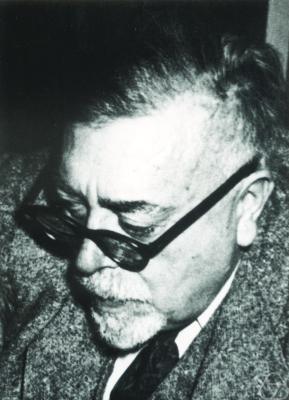
Norbert Wiener est un mathématicien américain, théoricien et chercheur en mathématiques appliquées, surtout connu comme le père fondateur de la cybernétique.
Il fut un pionnier dans l'étude de la stochastique et du bruit, contribuant ainsi par ses travaux à l'électrotechnique, les télécommunications et les systèmes de contrôle. En fondant la cybernétique, Wiener introduit en science la notion de feedback , notion qui a des implications dans les domaines de l'ingénierie, des contrôles de système, l'informatique, la biologie, la psychologie, la philosophie et l'organisation de la société.
Il exposa ses théories sur la cybernétique dans son livre Cybernetics or Control and Communication in the Animal and the Machine, parution qui bouscula durablement jusqu'au scandale, le monde des idées, traversant la pensée scientifique et philosophique de la deuxième moitié du XXe siècle, dont il est à ce titre, un des grands penseurs. Wikipedia
Norbert Wiener livre The Human Use of Human Beings
XI. Language, Confusion, and Jam. p. 193
The Human Use of Human Beings (1950)
Norbert Wiener livre Cybernetics: Or Control and Communication in the Animal and the Machine
Source: Cybernetics: Or Control and Communication in the Animal and the Machine (1948), p. 2-4; As cited in: George Klir (2001) Facets of Systems Science, p. 47-48
“To live effectively is to live with adequate information.”
Norbert Wiener livre The Human Use of Human Beings
Source: The Human Use of Human Beings (1950), p. 17-18
"A Scientist Rebels" Atlantic Monthly (Jan, 1947)
Contexte: The measures taken during the war by our military agencies, in restricting the free intercourse among scientists on related projects or even on the same project have gone so far that it is clear that if continued in time of peace, this policy will lead to the total irresponsibility of the scientist, and, ultimately, to the death of science.... The interchange of ideas, which is one of the greatest traditions of science, must of course receive certain limitations when the scientist becomes an arbiter of life and death.... I do not expect to publish any future work of mine which may do damage in the hands of irresponsible militarists...
Source: I am a mathematician, the later life of a prodigy (1953), p. 266
Contexte: We mathematicians who operate with nothing more expensive than paper and possibly printers' ink are quite reconciled to the fact that, if we are working in an active field, our discoveries will commence to be obsolete at the moment that they are written down or even at the moment they are conceived. We know that for a long time everything we do will be nothing more than the jumping off point for those who have the advantage of already being aware of our ultimate results. This is the meaning of the famous apothegm of Newton, when he said, "If I have seen further than other men, it is because I have stood on the shoulders of giants".
Ex-Prodigy: My Childhood and Youth (1964)
Contexte: The Advantage is that mathematics is a field in which one's blunders tend to show very clearly and can be corrected or erased with a stroke of the pencil. It is a field which has often been compared with chess, but differs from the latter in that it is only one's best moments that count and not one's worst. A single inattention may lose a chess game, whereas a single successful approach to a problem, among many which have been relegated to the wastebasket, will make a mathematician's reputation.
Norbert Wiener livre God & Golem, Inc.
Source: God & Golem, Inc. (1964), p. 69
Source: The Human Use Of Human Beings: Cybernetics And Society
Contexte: [T]he future offers very little hope for those who expect that our new mechanical slaves will offer us a world in which we may rest from thinking. Help us they may, but at the cost of supreme demands upon our honesty and our intelligence. The world of the future will be an ever more demanding struggle against the limitations of our intelligence, not a comfortable hammock in which we can lie down to be waited upon by our robot slaves.
Source: I am a mathematician, the later life of a prodigy (1953), p. 109
Norbert Wiener livre Cybernetics: Or Control and Communication in the Animal and the Machine
V. Computing Machines and the Nervous System. p. 121.
Cybernetics: Or Control and Communication in the Animal and the Machine (1948)
Norbert Wiener livre The Human Use of Human Beings
II. Progress and Entropy. p. 46-47
The Human Use of Human Beings (1950)
“The best material model of a cat is another, or preferably the same, cat.”
Philosophy of Science (1945) (with A. Rosenblueth)
Source: Ex-Prodigy: My Childhood and Youth (1964), p. 89; partly cited in: Herman E. Daly. Steady-State Economics: Second Edition With New Essays. 1977/1991 p. 4
Norbert Wiener livre The Human Use of Human Beings
V. Organization as the Message. p. 96
The Human Use of Human Beings (1950)
Source: I am a mathematician, the later life of a prodigy (1953), p. 322; Cited in: Walter F. Buckley (1967) Sociology and modern systems theory. p. 82
Norbert Wiener livre The Human Use of Human Beings
VIII. Role of the Intellectual and the Scientist. p. 135
The Human Use of Human Beings (1950)
Norbert Wiener livre Cybernetics: Or Control and Communication in the Animal and the Machine
Preface. page xi. (Footnote 1)
Cybernetics: Or Control and Communication in the Animal and the Machine (1948)
Norbert Wiener livre The Human Use of Human Beings
II. Progress and Entropy. p. 47
The Human Use of Human Beings (1950)
Norbert Wiener livre The Human Use of Human Beings
X. Some Communication Machines and Their Future. p. 184
The Human Use of Human Beings (1950)
Norbert Wiener livre The Human Use of Human Beings
Source: The Human Use of Human Beings (1950), p. 16
Norbert Wiener livre The Human Use of Human Beings
VII. Communication, Secrecy, and Social Policy. p. 129
The Human Use of Human Beings (1950)
Norbert Wiener livre The Human Use of Human Beings
II. Progress and Entropy. p. 46
The Human Use of Human Beings (1950)
“There are no answers, only cross-references.”
Norbert Wiener 1894-1964 (Vita Mathematica, 1990, p. 337)
Wiener's Law of Libraries
As quoted in Comic Sections (1993) by D MacHale
Norbert Wiener livre Cybernetics: Or Control and Communication in the Animal and the Machine
Source: Cybernetics: Or Control and Communication in the Animal and the Machine (1948), p. 2
Norbert Wiener livre The Human Use of Human Beings
Source: The Human Use of Human Beings (1950), p. 26-27 as cited in: Felix Geyer, Johannes van der Zouwen, (1994) " Norbert Wiener and the Social Sciences http://www.critcrim.org/redfeather/chaos/024Weiner.htm", Kybernetes, Vol. 23 Iss: 6/7, pp.46 - 61
Norbert Wiener livre Cybernetics: Or Control and Communication in the Animal and the Machine
Introduction. p. 24.
Cybernetics: Or Control and Communication in the Animal and the Machine (1948)
Ex-Prodigy: My Childhood and Youth (1964)
Norbert Wiener livre The Human Use of Human Beings
VI. Law and Communication. p. 110
The Human Use of Human Beings (1950)
Norbert Wiener livre Cybernetics: Or Control and Communication in the Animal and the Machine
VIII. Information, Language, and Society. p. 158.
Cybernetics: Or Control and Communication in the Animal and the Machine (1948)
Norbert Wiener livre Cybernetics: Or Control and Communication in the Animal and the Machine
VIII. Information, Language, and Society. p. 157.
Cybernetics: Or Control and Communication in the Animal and the Machine (1948)


