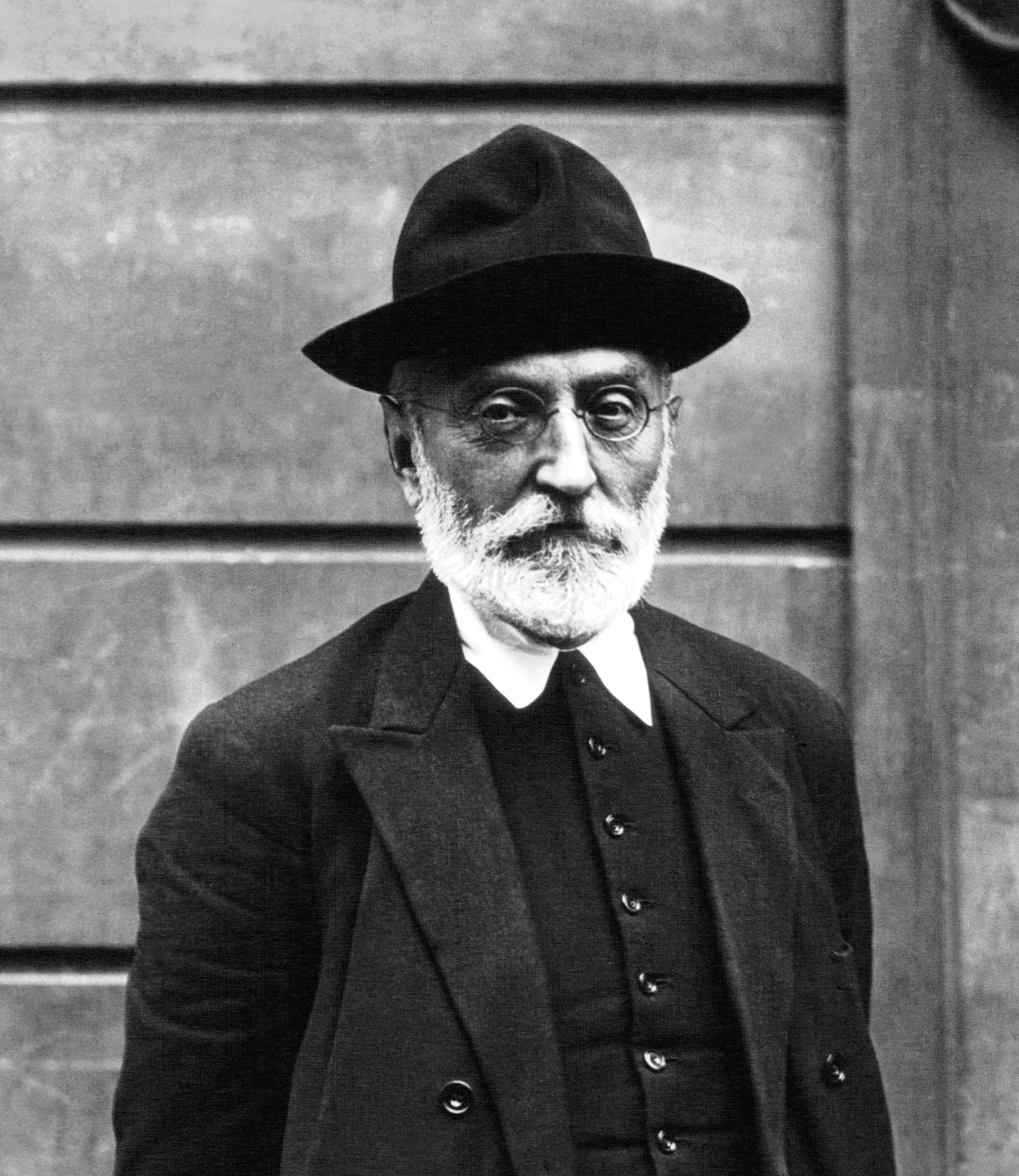
Miguel de Unamuno citations
Page 7

Miguel de Unamuno, né le 29 septembre 1864 à Bilbao et mort le 31 décembre 1936 à Salamanque, est un poète, romancier, dramaturge, critique littéraire et philosophe espagnol appartenant à la génération de 98.

Miguel de Unamuno figure parmi les plus grands écrivains de l'Espagne de son époque, dont il est particulièrement représentatif : il est décrit comme un homme de passions animé par de multiples contradictions, ce qui en fait un personnage assez typique de l'Espagne de la fin du XIXe siècle et du début du XXe siècle. Wikipedia  

✵ 29. septembre 1864 – 31. décembre 1936
Miguel de Unamuno photo
Miguel de Unamuno: 200 citations0 J'aime

Miguel de Unamuno Citations

“La raison répète : vanité des vanités, et tout est vanité! Et l’imagination réplique : plénitude des plénitudes, et tout est plénitude! Et nous vivons ainsi la vanité de la plénitude, ou la plénitude de la vanité.”

Miguel de Unamuno Le Sentiment tragique de la vie

La razón repite: ¡vanidad de vanidades, y todo vanidad! Y la imaginación replica: ¡plenitud de plenitudes, y todo plenitud! Y así vivimos la vanidad de la plenitud, o la plenitud de la vanidad.
es
Le Sentiment tragique de la vie (Del sentimiento trágico de la vida), 1913

Miguel de Unamuno: Citations en anglais

“Windelband, the historian of philosophy, in his essay on the meaning of philosophy (Was ist Philosophie? in the first volume of his Präludien) tells us that "the history of the word 'philosophy' is the history of the cultural significance of science." He continues: "When scientific thought attains an independent existence as a desire for knowledge, it takes the name of philosophy; when subsequently knowledge as a whole divides into its various branches, philosophy is the general knowledge of the world that embraces all other knowledge. As soon as scientific thought stoops again to becoming a means to ethics or religious contemplation, philosophy is transformed into an art of life or into a formulation of religious beliefs. And when afterwards the scientific life regains its liberty, philosophy acquires once again its character as an independent knowledge of the world, and in so far as it abandons the attempt to solve this problem, it is changed into a theory of knowledge itself." Here you have a brief recapitulation of the history of philosophy from Thales to Kant, including the medieval scholasticism upon which it endeavored to establish religious beliefs. But has philosophy no other office to perform, and may not its office be to reflect upon the tragic sense of life itself, such as we have been studying it, to formulate this conflict between reason and faith, between science and religion, and deliberately to perpetuate this conflict?”

Miguel de Unamuno

The Tragic Sense of Life (1913), Conclusion : Don Quixote in the Contemporary European Tragi-Comedy

“I would say that teleology is theology, and that God is not a "because," but rather an "in order to."”

Miguel de Unamuno livre San Manuel Bueno, Mártir

San Manuel Bueno, Mártir (1933), Prologue

“But as far as our own world is concerned, its gradual leveling-down — or, we might say, its death — appears to be proved. And how will this process affect the fate of our spirit? Will it wane with the degradation of the energy of our world and return to unconsciousness, or will it grow according as the utilizable energy diminishes and by virtue of the very efforts that it makes to retard this degradation and to dominate Nature?”

Miguel de Unamuno livre The Tragic Sense of Life

for this it is that constitutes the life of the spirit. May it be that consciousness and its extended support are two powers in contraposition, the one growing at the expense of the other?
The Tragic Sense of Life (1913), X : Religion, the Mythology of the Beyond and the Apocatastasis

Auteurs similaires

Camilo José Cela photo
Camilo José Cela5
écrivain espagnol None
Paul Valéry photo
Paul Valéry97
écrivain, poète et philosophe français None
Mario Vargas Llosa photo
Mario Vargas Llosa14
écrivain péruvien et espagnol, auteur de romans et d'essais… None
Martin Heidegger photo
Martin Heidegger16
philosophe allemand None
Simone Weil photo
Simone Weil77
philosophe française None
Hannah Arendt photo
Hannah Arendt27
philosophe américaine d'origine allemande None
Jean-Paul Sartre photo
Jean-Paul Sartre119
philosophe, dramaturge, romancier, nouvelliste et essayiste… None
Albert Camus photo
Albert Camus92
écrivain et journaliste français None
Emil Cioran photo
Emil Cioran70
philosophe et écrivain roumain, d'expression roumaine initi… None
Ludwig Wittgenstein photo
Ludwig Wittgenstein28
philosophe et logicien autrichien, puis britannique None