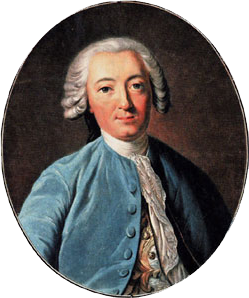
Claude-Adrien Helvétius citations

Claude-Adrien Schweitzer, latinisé en Helvétius, né le 26 janvier 1715 à Paris et mort le 26 décembre 1771 à Paris, est un philosophe, franc-maçon et poète français. Wikipedia  

✵ 26. janvier 1715 – 26. décembre 1771
Claude-Adrien Helvétius photo
Claude-Adrien Helvétius: 9 citations0 J'aime

Claude-Adrien Helvétius Citations

“En anéantissant les désirs, on anéantit l'âme, & tout homme sans passion n'a en lui ni principe d'action, ni motif pour se mouvoir.”

Claude-Adrien Helvétius

A Treatise on Man: His Intellectual Faculties & His Education, Vol. I (1773)

Claude-Adrien Helvétius: Citations en anglais

“All men have an equal disposition for understanding.”

Claude Adrien Helvétius

Source: De l'esprit or, Essays on the Mind, and Its Several Faculties (1758), p. 286

“Discipline is, in a manner, nothing else but the art of inspiring the soldiers with greater fear of their officers than of the enemy.”

Claude Adrien Helvétius

De l'esprit or, Essays on the Mind, and Its Several Faculties (1758)
Contexte: Discipline is, in a manner, nothing else but the art of inspiring the soldiers with greater fear of their officers than of the enemy. This fear has often the effect of courage: but it cannot prevail against the fierce and obstinate valor of people animated by fanaticism, or warm love of their country.

“The degree of genius necessary to please us is pretty nearly the same proportion that we ourselves have.”

Claude Adrien Helvétius

Essay II, Chapter X, note.
De l'esprit or, Essays on the Mind, and Its Several Faculties (1758)

“No nation has reason to regard itself superior to others by virtue of its innate endowment.”

Claude Adrien Helvétius

Source: De l'esprit or, Essays on the Mind, and Its Several Faculties (1758), p. 21

“By annihilating the desires, you annihilate the mind. Every man without passions has within him no principle of action, nor motive to act.”

Claude Adrien Helvétius

En anéantissant les désirs, on anéantit l'âme, & tout homme sans passion n'a en lui ni principe d'action, ni motif pour se mouvoir.
A Treatise on Man: His Intellectual Faculties & His Education, Vol. I (1773)

“Most events spring from causes equally small: we are unacquainted with them because most historians have been themselves ignorant of them, or have not had eyes capable of perceiving them. It is true, that, in this respect, the mind may repair their omissions; for the knowledge of certain principles easily compensates the lack of knowledge of certain facts.”

Claude Adrien Helvétius

La plupart des évènements ont des causes aussi petites. Nous les ignorons, parce que la plupart des historiens les ont ignorées eux-mêmes, ou parce qu’ils n’ont pas eu d’yeux pour les appercevoir. Il est vrai qu’à cet égard l’esprit peut réparer leurs omissions : la connoissance de certains principes supplée facilement à la connoissance de certains faits.
Essay III, Chapter I
De l'esprit or, Essays on the Mind, and Its Several Faculties (1758)

Auteurs similaires

Sébastien-Roch Nicolas de Chamfort photo
Sébastien-Roch Nicolas de Chamfort45
poète, journaliste et moraliste français None
Voltaire photo
Voltaire149
écrivain et philosophe français None
Montesquieu photo
Montesquieu17
écrivain et philosophe français None
Denis Diderot photo
Denis Diderot41
écrivain, philosophe et encyclopédiste français None
Novalis photo
Novalis12
poète et romancier allemand None
Nicolas Machiavel photo
Nicolas Machiavel53
philosophe florentin None
Joseph Joubert photo
Joseph Joubert107
philosophe et essayiste français None
Emmanuel Kant photo
Emmanuel Kant12
philosophe allemand None
Paul Henri Thiry d'Holbach photo
Paul Henri Thiry d'Holbach9
savant français et philosophe matérialiste, d'origine allem… None
John Locke photo
John Locke3
philosophe britannique None