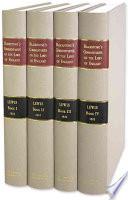
William Blackstone book Commentaries on the Laws of England
Introduction, Section II http://avalon.law.yale.edu/18th_century/blackstone_intro.asp: Of the Nature of Laws in General <br class="br">Commentaries on the Laws of England (1765–1769)
Sir William Blackstone was an English jurist, judge and Tory politician of the eighteenth century. He is most noted for writing the Commentaries on the Laws of England. Born into a middle-class family in London, Blackstone was educated at Charterhouse School before matriculating at Pembroke College, Oxford in 1738. After switching to and completing a Bachelor of Civil Law degree, he was made a Fellow of All Souls, Oxford on 2 November 1743, admitted to Middle Temple, and called to the Bar there in 1746. Following a slow start to his career as a barrister, Blackstone became heavily involved in university administration, becoming accountant, treasurer and bursar on 28 November 1746 and Senior Bursar in 1750. Blackstone is considered responsible for completing the Codrington Library and Warton Building, and simplifying the complex accounting system used by the college. On 3 July 1753 he formally gave up his practice as a barrister and instead embarked on a series of lectures on English law, the first of their kind. These were massively successful, earning him a total of £453 , and led to the publication of An Analysis of the Laws of England in 1756, which repeatedly sold out and was used to preface his later works.
On 20 October 1758 Blackstone was confirmed as the first Vinerian Professor of English Law, immediately embarking on another series of lectures and publishing a similarly successful second treatise, titled A Discourse on the Study of the Law. With his growing fame, Blackstone successfully returned to the bar and maintained a good practice, also securing election as Tory Member of Parliament for the rotten borough of Hindon on 30 March 1761. In November 1765 he published the first of four volumes of Commentaries on the Laws of England, considered his magnum opus; the completed work earned Blackstone £14,000 . After repeated failures, he successfully gained appointment to the judiciary as a Justice of the Court of King's Bench on 16 February 1770, leaving to replace Edward Clive as a Justice of the Common Pleas on 25 June. He remained in this position until his death, on 14 February 1780.
Blackstone's four-volume Commentaries were designed to provide a complete overview of English law and were repeatedly republished in 1770, 1773, 1774, 1775, 1778 and in a posthumous edition in 1783. Reprints of the first edition, intended for practical use rather than antiquary interest, were published until the 1870s in England and Wales, and a working version by Henry John Stephen, first published in 1841, was reprinted until after the Second World War. Legal education in England had stalled; Blackstone's work gave the law "at least a veneer of scholarly respectability". William Searle Holdsworth, one of Blackstone's successors as Vinerian Professor, argued that "If the Commentaries had not been written when they were written, I think it very doubtful that the United States, and other English speaking countries would have so universally adopted the common law." In the United States, the Commentaries influenced Alexander Hamilton, John Marshall, James Wilson, John Jay, John Adams, James Kent and Abraham Lincoln, and remain frequently cited in Supreme Court decisions. Wikipedia

William Blackstone book Commentaries on the Laws of England
Introduction, Section II http://avalon.law.yale.edu/18th_century/blackstone_intro.asp: Of the Nature of Laws in General <br class="br">Commentaries on the Laws of England (1765–1769)
William Blackstone book Commentaries on the Laws of England
Book II, ch. 1 http://avalon.law.yale.edu/18th_century/blackstone_bk2ch1.asp: Of Property in General. <br class="br">Commentaries on the Laws of England (1765–1769)
“Man was formed for society and is neither capable of living alone, nor has the courage to do it.”
William Blackstone book Commentaries on the Laws of England
Commentaries on the Laws of England (1765–1769)
Source: Introduction, Section II: Of the Nature of Laws in General
William Blackstone book Commentaries on the Laws of England
Book I, ch. 1 http://avalon.law.yale.edu/18th_century/blackstone_bk1ch1.asp: Of the Absolute Rights of Individuals. <br class="br">Commentaries on the Laws of England (1765–1769)
William Blackstone book Commentaries on the Laws of England
Introduction, Section II: Of the Nature of Laws in General
Commentaries on the Laws of England (1765–1769)
William Blackstone book Commentaries on the Laws of England
Book IV, ch. 14 http://avalon.law.yale.edu/18th_century/blackstone_bk4ch14.asp: Of Homicide. <br class="br">Commentaries on the Laws of England (1765–1769)
William Blackstone book Commentaries on the Laws of England
Book I, ch. 7 http://avalon.law.yale.edu/18th_century/blackstone_bk1ch7.asp: Of the King's Prerogative. <br class="br">Commentaries on the Laws of England (1765–1769) <br class="br">Context: In this distinct and separate existence of the judicial power, in a peculiar body of men, nominated indeed, but not removable at pleasure, by the crown, consists one main preservative of the public liberty; which cannot subsist long in any state, unless the administration of common justice be in some degree separated both from the legislative and the also from the executive power. Were it joined with the legislative, the life, liberty, and property of the subject would be in the hands of arbitrary judges, whose decisions would be then regulated only by their own opinions, and not by any fundamental principles of law; which, though legislators may depart from, yet judges are bound to observe. Were it joined with the executive, this union might soon be an overbalance for the legislative. For which reason... effectual care is taken to remove all judicial power out of the hands of the king's privy council; who, as then was evident from recent instances might soon be inclined to pronounce that for law, which was most agreeable to the prince or his officers. Nothing therefore is to be more avoided, in a free constitution, than uniting the provinces of a judge and a minister of state.
William Blackstone book Commentaries on the Laws of England
Book I, ch. 7 http://avalon.law.yale.edu/18th_century/blackstone_bk1ch7.asp: Of the King's Prerogative. <br class="br">Commentaries on the Laws of England (1765–1769) <br class="br">Context: In this distinct and separate existence of the judicial power, in a peculiar body of men, nominated indeed, but not removable at pleasure, by the crown, consists one main preservative of the public liberty; which cannot subsist long in any state, unless the administration of common justice be in some degree separated both from the legislative and the also from the executive power. Were it joined with the legislative, the life, liberty, and property of the subject would be in the hands of arbitrary judges, whose decisions would be then regulated only by their own opinions, and not by any fundamental principles of law; which, though legislators may depart from, yet judges are bound to observe. Were it joined with the executive, this union might soon be an overbalance for the legislative. For which reason... effectual care is taken to remove all judicial power out of the hands of the king's privy council; who, as then was evident from recent instances might soon be inclined to pronounce that for law, which was most agreeable to the prince or his officers. Nothing therefore is to be more avoided, in a free constitution, than uniting the provinces of a judge and a minister of state.
“Time whereof the memory of man runneth not to the contrary.”
William Blackstone book Commentaries on the Laws of England
Book I, ch. 18 http://avalon.law.yale.edu/18th_century/blackstone_bk1ch18.asp: Of Corporations. <br class="br">Commentaries on the Laws of England (1765–1769)
William Blackstone book Commentaries on the Laws of England
Book I, ch. 13 http://avalon.law.yale.edu/18th_century/blackstone_bk1ch13.asp: Of the Military and Maritime States. <br class="br">Commentaries on the Laws of England (1765–1769)
“It is better that ten guilty persons escape, than that one innocent suffer.”
William Blackstone book Commentaries on the Laws of England
Book IV, ch. 27.
Commentaries on the Laws of England (1765–1769)
William Blackstone book Commentaries on the Laws of England
Book IV, ch. 2 http://avalon.law.yale.edu/18th_century/blackstone_bk4ch2.asp: Of the Persons Capable of Committing Crimes. <br class="br">Commentaries on the Laws of England (1765–1769)
William Blackstone book Commentaries on the Laws of England
Book IV, ch. 27 http://avalon.law.yale.edu/18th_century/blackstone_bk4ch27.asp: Of Trial, And Conviction. <br class="br">Commentaries on the Laws of England (1765–1769)
William Blackstone book Commentaries on the Laws of England
Book III, ch. 17 http://avalon.law.yale.edu/18th_century/blackstone_bk3ch17.asp: Of Injuries Proceeding from, or Affecting, the Crown. <br class="br">Commentaries on the Laws of England (1765–1769)
“What they do, no authority upon earth can undo.”
William Blackstone book Commentaries on the Laws of England
Commentaries on the Laws of England (1765–1769) <br class="br">Context: Book I, ch. 2 https://lonang.com/library/reference/tucker-blackstone-notes-reference/tuck-202/: Of the Parliament.


