“I can't imagine a person becoming a success who doesn't give this game of life everything hes got.”
Source: Free the Airwaves! (2002)
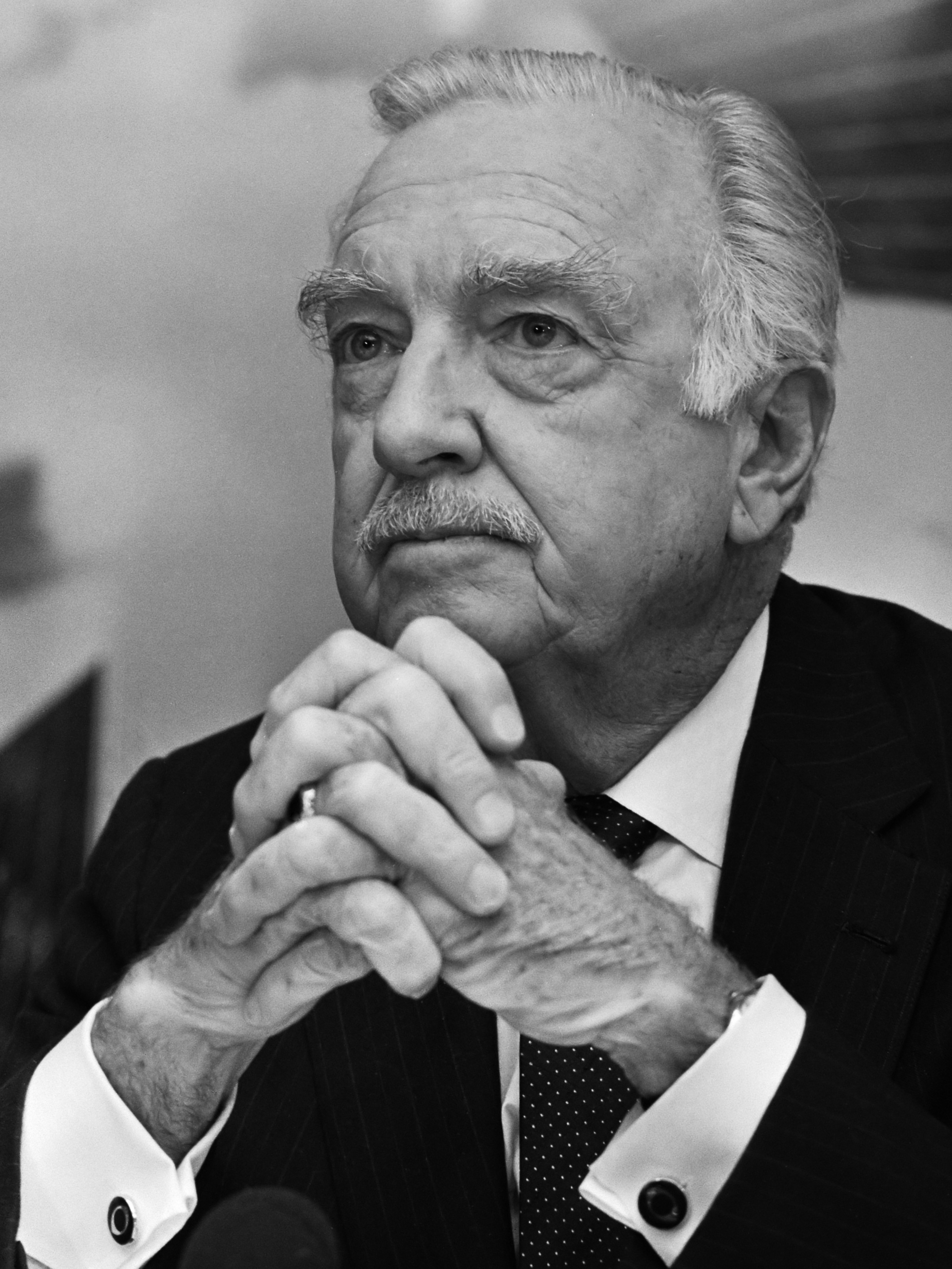
Walter Leland Cronkite Jr. was an American broadcast journalist who served as anchorman for the CBS Evening News for 19 years . During the 1960s and 1970s, he was often cited as "the most trusted man in America" after being so named in an opinion poll.He reported many events from 1937 to 1981, including bombings in World War II; the Nuremberg trials; combat in the Vietnam War; the Dawson's Field hijackings; Watergate; the Iran Hostage Crisis; and the assassinations of President John F. Kennedy, civil rights pioneer Martin Luther King Jr., and Beatles musician John Lennon.
He was also known for his extensive coverage of the U.S. space program, from Project Mercury to the Moon landings to the Space Shuttle. He was the only non-NASA recipient of an Ambassador of Exploration award.Cronkite is known for his departing catchphrase, "And that's the way it is," followed by the date of the broadcast. Wikipedia
“I can't imagine a person becoming a success who doesn't give this game of life everything hes got.”
Source: Free the Airwaves! (2002)
“I am in a position to speak my mind. And that is what I propose to do.”
UN Address (1999)
Context: For many years, I did my best to report on the issues of the day in as objective a manner as possible. When I had my own strong opinions, as I often did, I tried not to communicate them to my audience.
Now, however, my circumstances are different. I am in a position to speak my mind. And that is what I propose to do.
Those of us who are living today can influence the future of civilization. We can influence whether our planet will drift into chaos and violence, or whether through a monumental educational and political effort we will achieve a world of peace under a system of law where individual violators of that law are brought to justice.
“In seeking truth you have to get both sides of a story.”
Source: Free the Airwaves! (2002)
“America's health care system is neither healthy, caring, nor a system.”
Source: Free the Airwaves! (2002)
UN Address (1999)
“And that's the way it is…. [reads date]. This is Walter Cronkite, CBS News; good night.”
His nightly sign-off line on CBS News (1962 - 1981)
UN Address (1999)
Newseum interview (1996) http://www.newseum.org/news/news.aspx?item=nh_CRON090714_2, accessed 2009-07-21
On Chet Huntley's retirement (1970)
CBS Evening News Farewell (1981)
Context: This is my last broadcast as the anchorman of The CBS Evening News; for me, it's a moment for which I long have planned, but which, nevertheless, comes with some sadness. For almost 2 decades, after all, we've been meeting like this in the evenings, and I'll miss that. But those who have made anything of this departure, I'm afraid have made too much. This is but a transition, a passing of the baton. A great broadcaster and gentleman, Doug Edwards, preceded me in this job, and another, Dan Rather, will follow. And anyway, the person who sits here is but the most conspicuous member of a superb team of journalists — writers, reporters, editors, producers—and none of that will change. Furthermore, I'm not even going away! I'll be back from time to time with special news reports and documentaries, and, beginning in June, every week, with our science program, Universe. Old anchormen, you see, don't fade away; they just keep coming back for more. And that's the way it is: Friday, March 6, 1981. I'll be away on assignment, and Dan Rather will be sitting in here for the next few years. Good night.
On Eric Sevareid's retirement (1977)
“Our forefathers believed that the closer the laws are to the people, the better.”
UN Address (1999)
Context: I suppose I'm preaching to the choir here. So let's not talk generalities but focus tonight on a few specifics of what the leadership of the World Federalist Movement believe must be done now to advance the rule of world law.
For starters, we can draw on the wisdom of the framers of the US Constitution in 1787. The differences among the American states then were as bitter as differences among the nation-states in the world today.
In their almost miraculous insight, the founders of our country invented "federalism," a concept that is rooted in the rights of the individual. Our federal system guarantees a maximum of freedom but provides it in a framework of law and justice.
Our forefathers believed that the closer the laws are to the people, the better. Cities legislate on local matters; states make decisions on matters within their borders; and the national government deals with issues that transcend the states, such as interstate commerce and foreign relations. That is federalism.
Today we must develop federal structures on a global level. We need a system of enforceable world law — a democratic federal world government — to deal with world problems.
“There's a little more ego involved in these jobs than people might realize.”
Free the Airwaves! (2002)
On the JFK Assassination (1963)
Context: From Dallas, Texas, the flash apparently official: President Kennedy died at 1 p. m. Central Standard Time, 2:00 Eastern Standard Time, some 38 minutes ago. [pause as Cronkite fights back tears, then regains his composure] Vice President Johnson has left the hospital in Dallas, but we do not know to where he has proceeded; presumably, he will be taking the oath of office shortly and become the 36th President of the United States...
UN Address (1999)
Context: Our country today is at a stage in our foreign policy similar to that crucial point in our nation's early history when our Constitution was produced in Philadelphia.
Let us hear the peal of a new international liberty bell that calls us all to the creation of a system of enforceable world law in which the universal desire for peace can place its hope and prayers.
As Carl Van Doren has written, "History is now choosing the founders of the World Federation. Any person who can be among that number and fails to do so has lost the noblest opportunity of a lifetime."
On the Tet Offensive (1968)
Context: To say that we are closer to victory today is to believe, in the face of the evidence, the optimists who have been wrong in the past. To suggest we are on the edge of defeat is to yield to unreasonable pessimism. To say that we are mired in stalemate seems the only realistic, yet unsatisfactory, conclusion. On the off chance that military and political analysts are right, in the next few months we must test the enemy's intentions, in case this is indeed his last big gasp before negotiations. But it is increasingly clear to this reporter that the only rational way out then will be to negotiate, not as victors, but as an honorable people who lived up to their pledge to defend democracy, and did the best they could. This is Walter Cronkite; good night.
“We cannot defer this responsibility to posterity. Time will not wait.”
UN Address (1999)
Context: We cannot defer this responsibility to posterity. Time will not wait. Democracy, civilization itself, is at stake. Within the next few years we must change the basic structure of our global community from the present anarchic system of war and ever more destructive weaponry to a new system governed by a democratic UN federation.
“Those impractical dreamers are entitled to ask their critics what is so practical about war.”
UN Address (1999)
Context: For how many thousands of years now have we humans been what we insist on calling "civilized?" And yet, in total contradiction, we also persist in the savage belief that we must occasionally, at least, settle our arguments by killing one another.
While we spend much of our time and a great deal of our treasure in preparing for war, we see no comparable effort to establish a lasting peace. Meanwhile, emphasizing the sloth in this regard, those advocates who work for world peace by urging a system of world government are called impractical dreamers. Those impractical dreamers are entitled to ask their critics what is so practical about war.
UN Address (1999)
Context: I suppose I'm preaching to the choir here. So let's not talk generalities but focus tonight on a few specifics of what the leadership of the World Federalist Movement believe must be done now to advance the rule of world law.
For starters, we can draw on the wisdom of the framers of the US Constitution in 1787. The differences among the American states then were as bitter as differences among the nation-states in the world today.
In their almost miraculous insight, the founders of our country invented "federalism," a concept that is rooted in the rights of the individual. Our federal system guarantees a maximum of freedom but provides it in a framework of law and justice.
Our forefathers believed that the closer the laws are to the people, the better. Cities legislate on local matters; states make decisions on matters within their borders; and the national government deals with issues that transcend the states, such as interstate commerce and foreign relations. That is federalism.
Today we must develop federal structures on a global level. We need a system of enforceable world law — a democratic federal world government — to deal with world problems.
Free the Airwaves! (2002)
Context: The battle for the airwaves cannot be limited to only those who have the bank accounts to pay for the battle and win it. Democracy is in danger. Seats in Congress, seats in the state legislature, that big seat in the White House itself, can be purchased by those who have the greatest campaign resources, who have the largest bank accounts or own riches.
That, I submit to you, is no democracy. It is an oligarchy of the already powerful. It is no less than a conspiracy of the powerful to deny access to government to those who literally cannot afford to run for public office with any realistic hope of getting elected.
“Today we must develop federal structures on a global level.”
UN Address (1999)
Context: I suppose I'm preaching to the choir here. So let's not talk generalities but focus tonight on a few specifics of what the leadership of the World Federalist Movement believe must be done now to advance the rule of world law.
For starters, we can draw on the wisdom of the framers of the US Constitution in 1787. The differences among the American states then were as bitter as differences among the nation-states in the world today.
In their almost miraculous insight, the founders of our country invented "federalism," a concept that is rooted in the rights of the individual. Our federal system guarantees a maximum of freedom but provides it in a framework of law and justice.
Our forefathers believed that the closer the laws are to the people, the better. Cities legislate on local matters; states make decisions on matters within their borders; and the national government deals with issues that transcend the states, such as interstate commerce and foreign relations. That is federalism.
Today we must develop federal structures on a global level. We need a system of enforceable world law — a democratic federal world government — to deal with world problems.
Free the Airwaves! (2002)
Context: In our country, third-party candidates throughout the years have said there is not a dime's worth of difference between the candidates from the major parties. Well, that is clearly a campaign canard. But it may appear to be true if the public's knowledge of the important differences between candidates is limited to what the public sees and hears on television.
Putting it as strongly as I can, the failure to give free airtime for our political campaigns endangers our democracy.
UN Address (1999)
Context: Ours will neither be a perfect world, nor a world without disagreement and occasional violence. But it will be a world where the overwhelming majority of national leaders will consistently abide by the rule of world law, and those who won't will be dealt with effectively and with due process by the structures of that same world law. We will never have a city without crime, but we would never want to live in a city that had no system of law to deal with the criminals who will always be with us.
UN Address (1999)
Context: For how many thousands of years now have we humans been what we insist on calling "civilized?" And yet, in total contradiction, we also persist in the savage belief that we must occasionally, at least, settle our arguments by killing one another.
While we spend much of our time and a great deal of our treasure in preparing for war, we see no comparable effort to establish a lasting peace. Meanwhile, emphasizing the sloth in this regard, those advocates who work for world peace by urging a system of world government are called impractical dreamers. Those impractical dreamers are entitled to ask their critics what is so practical about war.
UN Address (1999)
Free the Airwaves! (2002)
On the JFK Assassination (1963)
Free the Airwaves! (2002)
“There is no such thing as a little freedom.Either you are all free,or you are not free.”
Free the Airwaves! (2002)
“The perils of duck hunting are great - especially for the duck.”
Free the Airwaves! (2002)
“I have never voted a party line.I vote on the individual and the issues.”
Free the Airwaves! (2002)
“I think the whole policy of pre-emptive war is a serious,serious mistake.”
Free the Airwaves! (2002)


.jpg)