“I found it as alluring as a wayward woman and determined to tame it.”
Of the music of Frederick Delius
Conductors by John L. Holmes (1988) pp 31-37 ISBN 0-575-04088-2
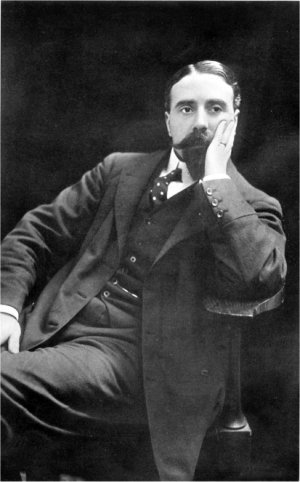
Sir Thomas Beecham, 2nd Baronet, CH was an English conductor and impresario best known for his association with the London Philharmonic and the Royal Philharmonic orchestras. He was also closely associated with the Liverpool Philharmonic and Hallé orchestras. From the early 20th century until his death, Beecham was a major influence on the musical life of Britain and, according to the BBC, was Britain's first international conductor.
Born to a rich industrial family, Beecham began his career as a conductor in 1899. He used his access to the family fortune to finance opera from the 1910s until the start of the Second World War, staging seasons at Covent Garden, Drury Lane and His Majesty's Theatre with international stars, his own orchestra and a wide repertoire. Among the works he introduced to England were Richard Strauss's Elektra, Salome and Der Rosenkavalier and three operas by Frederick Delius.
Together with his younger colleague Malcolm Sargent, Beecham founded the London Philharmonic, and he conducted its first performance at the Queen's Hall in 1932. In the 1940s he worked for three years in the United States where he was music director of the Seattle Symphony and conducted at the Metropolitan Opera. After his return to Britain, he founded the Royal Philharmonic in 1946 and conducted it until his death in 1961.
Beecham's repertoire was eclectic, sometimes favouring lesser-known composers over famous ones. His specialities included composers whose works were neglected in Britain before he became their advocate, such as Delius and Berlioz. Other composers with whose music he was frequently associated were Haydn, Schubert, Sibelius and the composer he revered above all others, Mozart. Wikipedia
“I found it as alluring as a wayward woman and determined to tame it.”
Of the music of Frederick Delius
Conductors by John L. Holmes (1988) pp 31-37 ISBN 0-575-04088-2
“What can you do with it? It's like a lot of yaks jumping about.”
On Beethoven's Seventh Symphony
Quoted in Atkins and Newman, Beecham Stories, 1978
“The function of music is to release us from the tyranny of conscious thought.”
Quoted in Atkins and Newman, Beecham Stories, 1978
“Too much counterpoint; what is worse, Protestant counterpoint.”
Of J. S. Bach; quoted by Neville Cardus, Guardian, 8 March 1971
“The musical equivalent of the towers of St Pancras Station”
Of Edward Elgar's 1st symphony
Neville Cardus: Sir Thomas Beecham, A Memoir, (1961)
“Asked if he had ever conducted any Stockhausen, he said, "No, but I once trod in some."”
http://www.paulcarey.net/Quotes.htm http://www.stockhausen.org/licht_by_malcolm_ball.html
“If I cannot sing a work, I cannot conduct it.”
Conductors by John L. Holmes (1988) pp 31-37 ISBN 0-575-04088-2
Of Ralph Vaughan Williams' Pastoral Symphony
Conductors by John L. Holmes (1988) pp 31-37 ISBN 0-575-04088-2
“The grand tune is the only thing in music that the great public really understands.”
Conductors by John L. Holmes (1988) pp 31-37 ISBN 0-575-04088-2
“No composer has written as much as 100 bars of worthwhile music since 1925.”
Conductors by John L. Holmes (1988) pp 31-37 ISBN 0-575-04088-2
[Beecham admitted to Neville Cardus that he had made this up on the spur of the moment to satisfy an importunate journalist; he acknowledged that it was an oversimplification. (Neville Cardus: 'Sir Thomas Beecham, A Memoir', 1961)]
“A musicologist is a man who can read music but can't hear it.”
Quoted by H. Proctor-Gregg, Beecham Remembered (1976), p. 154


