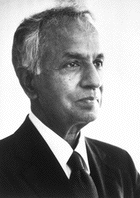
Subrahmanyan Chandrasekhar FRS was an Indian American astrophysicist who spent his professional life in the United States. He was awarded the 1983 Nobel Prize for Physics with William A. Fowler for "...theoretical studies of the physical processes of importance to the structure and evolution of the stars". His mathematical treatment of stellar evolution yielded many of the best current theoretical models of the later evolutionary stages of massive stars and black holes. The Chandrasekhar limit is named after him.
Chandrasekhar worked on a wide variety of physical problems in his lifetime, contributing to the contemporary understanding of stellar structure, white dwarfs, stellar dynamics, stochastic process, radiative transfer, the quantum theory of the hydrogen anion, hydrodynamic and hydromagnetic stability, turbulence, equilibrium and the stability of ellipsoidal figures of equilibrium, general relativity, mathematical theory of black holes and theory of colliding gravitational waves. At the University of Cambridge, he developed a theoretical model explaining the structure of white dwarf stars that took into account the relativistic variation of mass with the velocities of electrons that comprise their degenerate matter. He showed that the mass of a white dwarf could not exceed 1.44 times that of the Sun – the Chandrasekhar limit. Chandrasekhar revised the models of stellar dynamics first outlined by Jan Oort and others by considering the effects of fluctuating gravitational fields within the Milky Way on stars rotating about the galactic centre. His solution to this complex dynamical problem involved a set of twenty partial differential equations, describing a new quantity he termed 'dynamical friction', which has the dual effects of decelerating the star and helping to stabilize clusters of stars. Chandrasekhar extended this analysis to the interstellar medium, showing that clouds of galactic gas and dust are distributed very unevenly.
Chandrasekhar studied at Presidency College, Madras and the University of Cambridge. A long-time professor at the University of Chicago, he did some of his studies at the Yerkes Observatory, and served as editor of The Astrophysical Journal from 1952 to 1971. He was on the faculty at Chicago from 1937 until his death in 1995 at the age of 84, and was the Morton D. Hull Distinguished Service Professor of Theoretical Astrophysics.Chandrasekhar married Lalitha Doraiswamy in September 1936. He had met her as a fellow student at Presidency College, Madras. Chandrasekhar was the nephew of C. V. Raman, who was awarded the Nobel Prize for Physics in 1930. He became a naturalized citizen of the U.S. in 1953. Others considered him as warm, positive, generous, unassuming, meticulous, and open to debate, as well as private, intimidating, impatient and stubborn regarding non-scientific matters, and unforgiving to those who ridiculed his work.
✵ 19. October 1910 – 21. August 1995