Marguerite de Navarre book Heptaméron
Fifth Day, Novel XLVIII (trans. W. K. Kelly)
L'Heptaméron (1558)
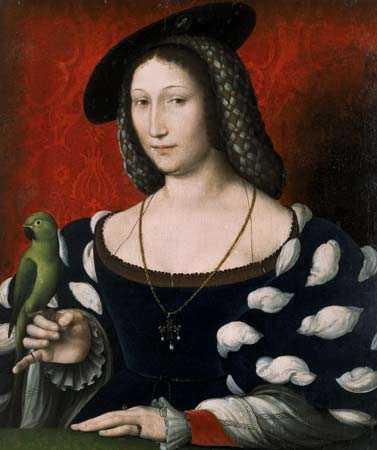
Marguerite de Navarre , also known as Marguerite of Angoulême and Margaret of Navarre, was the princess of France, Queen of Navarre, and Duchess of Alençon and Berry. She was married to Henry II of Navarre. Her brother became King of France, as Francis I, and the two siblings were responsible for the celebrated intellectual and cultural court and salons of their day in France.
Marguerite is the ancestress of the Bourbon kings of France, being the mother of Jeanne d'Albret, whose son, Henry of Navarre, succeeded as Henry IV of France, the first Bourbon king.
As an author and a patron of humanists and reformers, she was an outstanding figure of the French Renaissance. Samuel Putnam called her "The First Modern Woman". Wikipedia
Marguerite de Navarre book Heptaméron
Fifth Day, Novel XLVIII (trans. W. K. Kelly)
L'Heptaméron (1558)
“God always helps madmen, lovers, and drunkards.”
Marguerite de Navarre book Heptaméron
Fourth Day, Novel XXXVIII (trans. W. K. Kelly)
L'Heptaméron (1558)
“Man is wise … when he recognises no greater enemy than himself.”
Marguerite de Navarre book Heptaméron
Third Day, Novel XXX
L'Heptaméron (1558)
“Some there are who are much more ashamed of confessing a sin than of committing it.”
Marguerite de Navarre book Heptaméron
Sixth Day, Novel LX (trans. W. K. Kelly)
L'Heptaméron (1558)
“No one ever perfectly loved God who did not perfectly love some of his creatures in this world.”
Marguerite de Navarre book Heptaméron
Second Day, Novel XIX (trans. W. K. Kelly)
Variant translation by Samuel Putnam in Marguerite of Navarre (1935), p. 53:
Never shall a man attain to the perfect love of God who has not loved to perfection some creature in this world.
L'Heptaméron (1558)
Marguerite de Navarre book Heptaméron
Mariage est un état de si longue durée, qu'il ne doit être commencé légèrement, ne sans l'opinion de nos meilleurs amis et parents.
Fourth Day, Novel XL (trans. P. A. Chilton)
L'Heptaméron (1558)
“As two unhappy people often will, the one sought out the other.”
Marguerite de Navarre book Heptaméron
Un malheureux cherche l'autre.
Third Day, Novel XXI (trans. P. A. Chilton)
Variant translation: Misery loves company.
L'Heptaméron (1558)
Marguerite de Navarre book Heptaméron
Sixth Day, Novel LI (trans. W. K. Kelly)
L'Heptaméron (1558)
“I have heard much of these languishing lovers, but I never yet saw one of them die for love.”
Marguerite de Navarre book Heptaméron
First Day, Novel VIII (trans. W. K. Kelly)
L'Heptaméron (1558)
“Blessed, unquestionably, is he who has it in his power to do evil, yet does it not.”
Marguerite de Navarre book Heptaméron
Fifth Day, Novel XLII (trans. W. K. Kelly)
L'Heptaméron (1558)
Marguerite de Navarre book Heptaméron
Second Day, Novel XII (trans. W. K. Kelly)
L'Heptaméron (1558)
“He who knows his own incapacity, knows something, after all.”
Marguerite de Navarre book Heptaméron
Third Day, Novel XXVIII (trans. W. K. Kelly)
L'Heptaméron (1558)
“They cry sour grapes when the object of their desires is beyond their grasp.”
Marguerite de Navarre book Heptaméron
Ilz font semblant de n'aymer poinct les raisins quand ilz sont si haults, qu'ilz ne les peuvent cueillir.
Sixth Day, Novel LIII (trans. P. A. Chilton)
L'Heptaméron (1558)
“When one has one good day in the year, one is not wholly unfortunate.”
Marguerite de Navarre book Heptaméron
Fourth Day, Novel XL
L'Heptaméron (1558)


