Works

Into the Wild
Jon Krakauer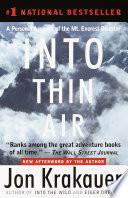
Into Thin Air
Jon KrakauerEiger Dreams: Ventures Among Men and Mountains
Jon KrakauerInto the Wild
Jon KrakauerInto Thin Air
Jon KrakauerEiger Dreams: Ventures Among Men and Mountains
Jon KrakauerFamous Jon Krakauer Quotes
Author's Remarks.
Under the Banner of Heaven: A Story of Violent Faith (2003)
Context: I don't know what God is, or what God had in mind when the universe was set in motion. In fact, I don't know if God even exists, although I confess that I sometimes find myself praying in times of great fear, or despair, or astonishment at a display of unexpected beauty. There are some ten thousand religious sects — each with its own cosmology, each with its own answer for the meaning of life and death. Most assert that the other 9,999 not only have it completely wrong but are instruments of evil, besides. None of the ten thousand has yet persuaded me to make the requisite leap of faith. In the absence of conviction, I've come to terms with the fact that uncertainty is an inescapable corollary of life. An abundance of mystery is simply part of the bargain — which doesn't strike me as something to lament. Accepting the essential inscrutability of existence, in any case, is surely preferable to its opposite: capitulating to the tyranny of intransigent belief. And if I remain in the dark about our purpose here, and the meaning of eternity, I have nevertheless arrived at an understanding of a few modest truths: Most of us fear death. Most of us yearn to comprehend how we got here, and why — which is to say, most of us ache to know the love of our creator. And we will no doubt feel that ache, most of us, for as long as we happen to be alive.
Jon Krakauer book Eiger Dreams: Ventures Among Men and Mountains
Source: Eiger Dreams: Ventures Among Men and Mountains
“Mr. Franz, I think careers are a 20th century invention and I don't want one.”
Jon Krakauer book Into the Wild
Source: Into the Wild
Source: Into Thin Air: A Personal Account of the Mount Everest Disaster
Jon Krakauer Quotes about people
Jon Krakauer Quotes about life
Jon Krakauer: Trending quotes
“That's what was great about him. He tried. Not many do.”
Jon Krakauer book Into the Wild
Source: Into the Wild
“It's not always necessary to be strong, but to feel strong.”
Jon Krakauer book Into the Wild
Source: Into the Wild
Jon Krakauer Quotes
“When you forgive, you love. And when you love, God’s light shines upon you.”
Jon Krakauer book Into the Wild
Source: Into the Wild
Author's Remarks.
Under the Banner of Heaven: A Story of Violent Faith (2003)
Context: I don't know what God is, or what God had in mind when the universe was set in motion. In fact, I don't know if God even exists, although I confess that I sometimes find myself praying in times of great fear, or despair, or astonishment at a display of unexpected beauty. There are some ten thousand religious sects — each with its own cosmology, each with its own answer for the meaning of life and death. Most assert that the other 9,999 not only have it completely wrong but are instruments of evil, besides. None of the ten thousand has yet persuaded me to make the requisite leap of faith. In the absence of conviction, I've come to terms with the fact that uncertainty is an inescapable corollary of life. An abundance of mystery is simply part of the bargain — which doesn't strike me as something to lament. Accepting the essential inscrutability of existence, in any case, is surely preferable to its opposite: capitulating to the tyranny of intransigent belief. And if I remain in the dark about our purpose here, and the meaning of eternity, I have nevertheless arrived at an understanding of a few modest truths: Most of us fear death. Most of us yearn to comprehend how we got here, and why — which is to say, most of us ache to know the love of our creator. And we will no doubt feel that ache, most of us, for as long as we happen to be alive.
Jon Krakauer book Into the Wild
Source: Into the Wild (1996), Ch. 14.
Context: Early on a difficult climb, especially a difficult solo climb, you constantly feel the abyss pulling at your back. To resist takes a tremendous conscious effort; you don't dare let your guard down for an instant. The siren song of the void puts you on edge; it makes your movements tentative, clumsy, herky-jerky. But as the climb goes on, you grow accustomed to the exposure, you get used to rubbing shoulders with doom, you come to believe in the reliability of your hands and feet and head. You learn to trust your self-control. By and by your attention becomes so intensely focused that you no longer notice the raw knuckles, the cramping thighs, the strain of maintaining nonstop concentration. A trancelike state settles over your efforts; the climb becomes a clear-eyed dream. Hours slide by like minutes. The accumulated clutter of day-to-day existence — the lapses of conscience, the unpaid bills, the bungled opportunities, the dust under the couch, the inescapable prison of your genes — all of it is temporarily forgotten, crowded from your thoughts by an overpowering clarity of purpose and by the seriousness of the task at hand. At such moments something resembling happiness actually stirs in your chest, but it isn't the sort of emotion you want to lean on very hard. In solo climbing the whole enterprise is held together with little more than chutzpah, not the most reliable adhesive.
Jon Krakauer book Into Thin Air
Source: Into Thin Air (1997), Ch. 1.
Context: Straddling the top of the world, one foot in China and the other in Nepal, I cleared the ice from my oxygen mask, hunched a shoulder against the wind, and stared absently down at the vastness of Tibet. I understood on some dim, detached level that the sweep of earth beneath my feet was a spectacular sight. I'd been fantasizing about this moment, and the release of emotion that would accompany it, for many months. But now that I was finally here, actually standing on the summit of Mount Everest, I just couldn't summon the energy to care.
Jon Krakauer book Into Thin Air
Source: Into Thin Air (1997), Ch. 1.
Context: Straddling the top of the world, one foot in China and the other in Nepal, I cleared the ice from my oxygen mask, hunched a shoulder against the wind, and stared absently down at the vastness of Tibet. I understood on some dim, detached level that the sweep of earth beneath my feet was a spectacular sight. I'd been fantasizing about this moment, and the release of emotion that would accompany it, for many months. But now that I was finally here, actually standing on the summit of Mount Everest, I just couldn't summon the energy to care.
Jon Krakauer book Into the Wild
Source: Into the Wild (1996), Ch. 14.
Context: Early on a difficult climb, especially a difficult solo climb, you constantly feel the abyss pulling at your back. To resist takes a tremendous conscious effort; you don't dare let your guard down for an instant. The siren song of the void puts you on edge; it makes your movements tentative, clumsy, herky-jerky. But as the climb goes on, you grow accustomed to the exposure, you get used to rubbing shoulders with doom, you come to believe in the reliability of your hands and feet and head. You learn to trust your self-control. By and by your attention becomes so intensely focused that you no longer notice the raw knuckles, the cramping thighs, the strain of maintaining nonstop concentration. A trancelike state settles over your efforts; the climb becomes a clear-eyed dream. Hours slide by like minutes. The accumulated clutter of day-to-day existence — the lapses of conscience, the unpaid bills, the bungled opportunities, the dust under the couch, the inescapable prison of your genes — all of it is temporarily forgotten, crowded from your thoughts by an overpowering clarity of purpose and by the seriousness of the task at hand. At such moments something resembling happiness actually stirs in your chest, but it isn't the sort of emotion you want to lean on very hard. In solo climbing the whole enterprise is held together with little more than chutzpah, not the most reliable adhesive.
Author's Remarks.
Under the Banner of Heaven: A Story of Violent Faith (2003)
Context: I don't know what God is, or what God had in mind when the universe was set in motion. In fact, I don't know if God even exists, although I confess that I sometimes find myself praying in times of great fear, or despair, or astonishment at a display of unexpected beauty. There are some ten thousand religious sects — each with its own cosmology, each with its own answer for the meaning of life and death. Most assert that the other 9,999 not only have it completely wrong but are instruments of evil, besides. None of the ten thousand has yet persuaded me to make the requisite leap of faith. In the absence of conviction, I've come to terms with the fact that uncertainty is an inescapable corollary of life. An abundance of mystery is simply part of the bargain — which doesn't strike me as something to lament. Accepting the essential inscrutability of existence, in any case, is surely preferable to its opposite: capitulating to the tyranny of intransigent belief. And if I remain in the dark about our purpose here, and the meaning of eternity, I have nevertheless arrived at an understanding of a few modest truths: Most of us fear death. Most of us yearn to comprehend how we got here, and why — which is to say, most of us ache to know the love of our creator. And we will no doubt feel that ache, most of us, for as long as we happen to be alive.
“A trancelike state settles over your efforts; the climb becomes a clear-eyed dream.”
Jon Krakauer book Into the Wild
Source: Into the Wild (1996), Ch. 14.
Context: Early on a difficult climb, especially a difficult solo climb, you constantly feel the abyss pulling at your back. To resist takes a tremendous conscious effort; you don't dare let your guard down for an instant. The siren song of the void puts you on edge; it makes your movements tentative, clumsy, herky-jerky. But as the climb goes on, you grow accustomed to the exposure, you get used to rubbing shoulders with doom, you come to believe in the reliability of your hands and feet and head. You learn to trust your self-control. By and by your attention becomes so intensely focused that you no longer notice the raw knuckles, the cramping thighs, the strain of maintaining nonstop concentration. A trancelike state settles over your efforts; the climb becomes a clear-eyed dream. Hours slide by like minutes. The accumulated clutter of day-to-day existence — the lapses of conscience, the unpaid bills, the bungled opportunities, the dust under the couch, the inescapable prison of your genes — all of it is temporarily forgotten, crowded from your thoughts by an overpowering clarity of purpose and by the seriousness of the task at hand. At such moments something resembling happiness actually stirs in your chest, but it isn't the sort of emotion you want to lean on very hard. In solo climbing the whole enterprise is held together with little more than chutzpah, not the most reliable adhesive.
“The core of mans' spirit comes from new experiences.”
Jon Krakauer book Into the Wild
Source: Into the Wild
Source: Into Thin Air: A Personal Account of the Mount Everest Disaster
“Common sense is no match for the voice of God.”
Source: Under the Banner of Heaven: A Story of Violent Faith
Source: Into Thin Air: A Personal Account of the Mount Everest Disaster
Source: Under the Banner of Heaven: A Story of Violent Faith


