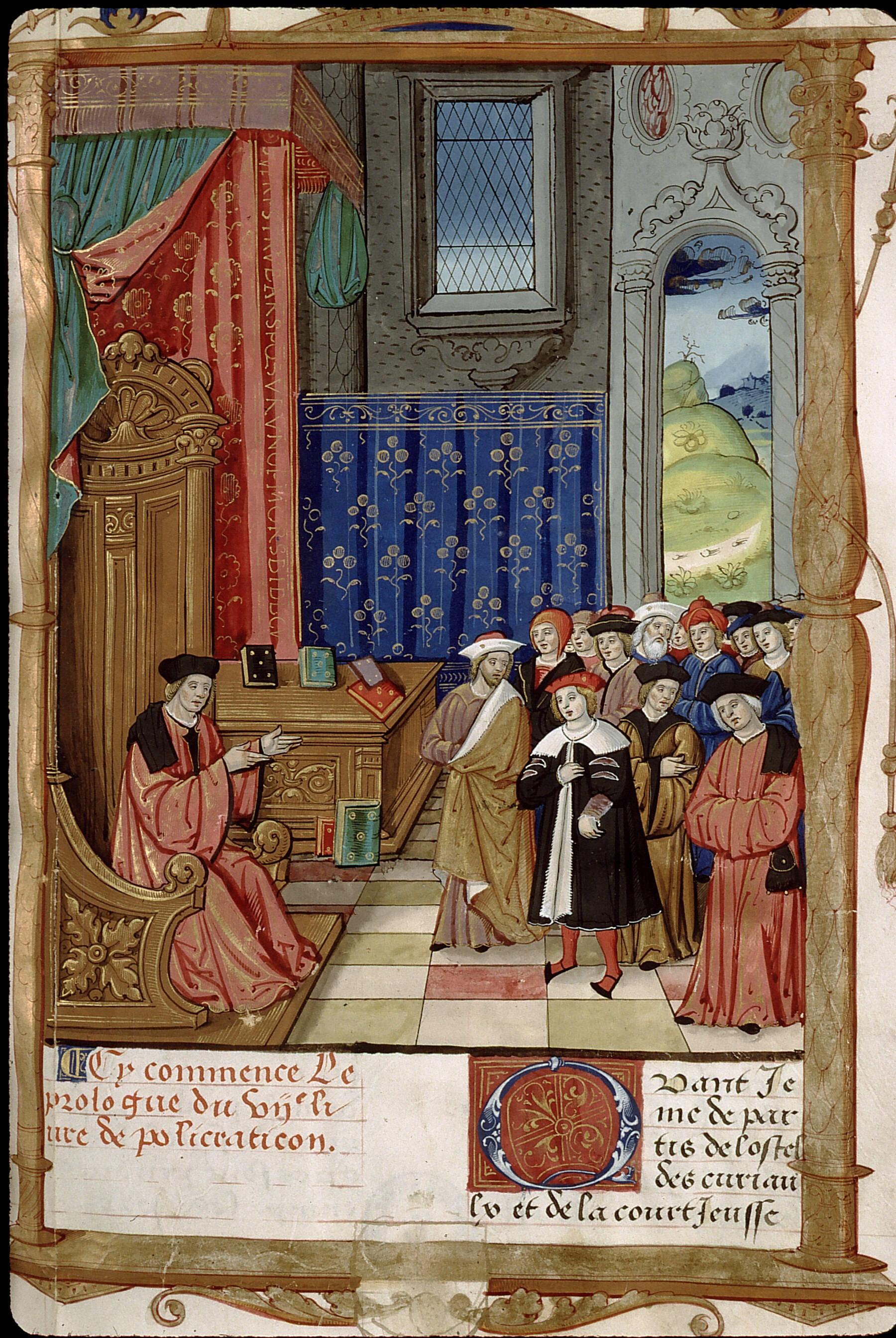
John of Salisbury Quotes

John of Salisbury , who described himself as Johannes Parvus , was an English author, philosopher, educationalist, diplomat and bishop of Chartres.


Wikipedia  

✵ – 25. October 1180
John of Salisbury photo

Works

Policraticus
John of Salisbury
Metalogicon
John of Salisbury
Policraticus
John of Salisbury
Metalogicon
John of Salisbury
John of Salisbury: 8 quotes0 likes

Famous John of Salisbury Quotes

“Bernard of Chartres used to say that we were like dwarfs seated on the shoulders of giants. If we see more and further than they, it is not due to our own clear eyes or tall bodies, but because we are raised on high and upborne by their gigantic bigness.”
Dicebat Bernardus Carnotensis nos esse quasi nanos gigantium humeris insidentes, ut possimus plura eis et remotiora videre, non utique proprii visus acumine, aut eminentia corporis, sed quia in altum subvehimur et extollimur magnitudine gigantea

John of Salisbury book Metalogicon

Metalogicon (1159) bk. 3, ch. 4. Translation from Henry Osborn Taylor The Mediaeval Mind ([1911] 1919) vol. 2, p. 159; such similes were available to Isaac Newton, when he humbly made use of them in comparing his progress in scientific ideas to those whose ideas he drew upon, in his famous statement to Robert Hooke in a letter of 15 February 1676: If I have seen further it is by standing on the shoulders of Giants.

“Between a tyrant and a prince there is this single or chief difference, that the latter obeys the law and rules the people by its dictates, accounting himself as but their servant.”
Est ergo tyranni et principis hæc differentia sola, quod hic legi obtemperat, et ejus arbitrio populum regit, cujus se credit ministrum.

John of Salisbury Policraticus

Bk. 4, ch. 1
Policraticus (1159)

“Accurate reading on a wide range of subjects makes the scholar; careful selection of the better makes the saint.”
Exquisita lectio singulorum, doctissimum; cauta electio meliorum, optimum facit.

John of Salisbury Policraticus

Bk. 7, ch. 10
Policraticus (1159)

“Law is the gift of God, the model of equity, a standard of justice, a likeness of the divine will, the guardian of well-being, a bond of union and solidarity between peoples, a rule defining duties, a barrier against the vices and the destroyer thereof, a punishment of violence and all wrongdoing.”
Lex donum Dei est, æquitatis forma, norma justitiæ, divinæ voluntatis imago, salutis custodia, unio et consolidatio populorum, regula officiorum, exclusio et exterminatio vitiorum, violentiæ et totius injuriæ pœna.

John of Salisbury Policraticus

Bk. 8, ch. 17
Policraticus (1159)

“A man is free in proportion to the measure of his virtues, and the extent to which he is free determines what his virtues can accomplish.”
Et pro virtutum habitu quilibet et liber est, et, quatenus est liber, eatenus virtutibus pollet.

John of Salisbury Policraticus

Bk. 7, ch. 25
Policraticus (1159)

Similar authors

Peter Abelard photo
Peter Abelard20
French scholastic philosopher, theologian and preeminent lo… None
Julian of Norwich photo
Julian of Norwich372
English theologian and anchoress None
Thomas Aquinas photo
Thomas Aquinas104
Italian Dominican scholastic philosopher of the Roman Catho… None
Roger Bacon photo
Roger Bacon21
medieval philosopher and theologian None
Meister Eckhart photo
Meister Eckhart69
German theologian None
Albertus Magnus photo
Albertus Magnus5
Dominican friar None
Bonaventure photo
Bonaventure6
franciscan, bishop, cardinal, Doctor of the Church, catholi… None
Omar Khayyám photo
Omar Khayyám94
Persian poet, philosopher, mathematician, and astronomer None
Anicius Manlius Severinus Boethius photo
Anicius Manlius Severinus Boethius22
philosopher of the early 6th century None
Isaac of Nineveh photo
Isaac of Nineveh9
Eastern Orthodox saint None