Works
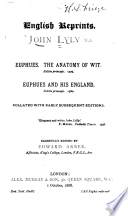
Euphues
John LylyEuphues
John LylyFamous John Lyly Quotes
Poem: Cupid and Campaspe.
“Lette me stande to the maine chance.”
Source: Euphues (Arber [1580]), P. 104. Compare: "The main chance", William Shakespeare, 1 Henry VI, act i, sc. 1.; Samuel Butler, Hudibras, part ii' canto ii.; John Dryden, Persius, satire vi.
“How at heaven's gates she claps her wings,
The morne not waking til she sings.”
Cupid and Campaspe, Act v, Sc. 1. Compare: "Hark, hark! the lark at heaven's gat sings,/And Phœbus 'gins arise", William Shakespeare, Cymbeline, act ii, sc. 3.
“It seems to me (said she) that you are in some brown study.”
Source: Euphues (Arber [1580]), P. 80. Compare: "A brown study", Jonathan Swift, Polite Conversation.
“There can no great smoke arise, but there must be some fire.”
Euphues and his Euphœbus, p. 153, reported in Bartlett's Familiar Quotations, 10th ed. (1919). Compare: "There is no fire without some smoke", John Heywood, Proverbes, Part ii, Chap. v.
John Lyly Quotes about bees
“Be valyaunt, but not too venturous. Let thy attyre bee comely, but not costly.”
Source: Euphues (Arber [1580]), P. 39. Compare: "Costly thy habit as thy purse can buy,/ But not express'd in fancy; rich, not gaudy", William Shakespeare, Hamlet, act i, sc. 3.
“Maydens, be they never so foolyshe, yet beeing fayre they are commonly fortunate.”
Source: Euphues and his England, P. 279.
John Lyly Quotes
“A clere conscience is a sure carde.”
Euphues, p. 207, reported in Bartlett's Familiar Quotations, 10th ed. (1919). Compare: "This is a sure card", Thersytes, circa 1550.
Source: Euphues (Arber [1580]), P. 93. Compare: "Jupiter himself was turned into a satyr, a shepherd, a bull, a swan, a golden shower, and what not for love", Robert Burton, Anatomy of Melancholy, part iii, sec ii, mem. i, subs. 1.
“Where the streame runneth smoothest, the water is deepest.”
Source: Euphues and his England, P. 287. Compare: "Passions are likened best to floods and streams: The shallow murmur, but the deep are dumb", Sir Walter Raleigh, The Silent Lover.
Source: Euphues (Arber [1580]), P. 112.
“I mean not to run with the Hare and holde with the Hounde.”
Source: Euphues (Arber [1580]), P. 107. Compare: "To hold with the hare and run with the hound", John Heywood, Proverbes, Part i, Chap. x.
“I am glad that my Adonis hath a sweete tooth in his head.”
Source: Euphues and his England, P. 308.
“Goe to bed with the Lambe, and rise with the Larke.”
Source: Euphues and his England, P. 229. Compare: "To rise with the lark and go to bed with the lamb", Breton, Court and Country, 1618 (reprint, page 182); "Rise with the lark, and with the lark to bed", James Hurdis, The Village Curate.
Source: Euphues and his England, P. 289.
Source: Euphues (Arber [1580]), P. 86.
“The soft droppes of rain perce the hard marble; many strokes overthrow the tallest oaks.”
Source: Euphues (Arber [1580]), P. 81. Compare: "Water continually dropping will wear hard rocks hollow", Plutarch, Of the Training of Children; "Stillicidi casus lapidem cavat" (translation: "Continual dropping wears away a stone"), Lucretius, i. 314; "Many strokes, though with a little axe,/ Hew down and fell the hardest-timber'd oak", William Shakespeare, 3 Henry VI, act ii, sc. 1.
“Though the Camomill, the more it is trodden and pressed downe the more it spreadeth.”
Source: Euphues (Arber [1580]), P. 46. Compare: "The camomile, the more it is trodden on the faster it grows", William Shakespeare, 1 Henry IV, act ii, sc. 4.
“A Rose is sweeter in the budde than full blowne.”
Source: Euphues and his England, P. 314. Compare: "The rose is fairest when 't is budding new", Sir Walter Scott, Lady of the Lake, canto iii. st. 1.
“For experience teacheth me that straight trees have crooked roots.”
P. 311 http://books.google.com/books?id=3xRbAAAAMAAJ&q=&quot;for+experience+teacheth+me+that+straight+trees+have+crooked+roots&quot;&pg=PA311#v=onepage <br class="br">Euphues and his England
“As lyke as one pease is to another.”
Euphues, p. 215, reported in Bartlett's Familiar Quotations, 10th ed. (1919).
“He reckoneth without his Hostesse. Love knoweth no lawes.”
Source: Euphues (Arber [1580]), P. 84. Compare: "Reckeners without their host must recken twice", John Heywood, Proverbes, Part i, Chap. viii.
“Rather fast then surfette, rather starue then striue to exceede.”
Source: Euphues (Arber [1580]), P. 108.
“The finest edge is made with the blunt whetstone.”
Source: Euphues (Arber [1580]), P. 47.
Source: Euphues (Arber [1580]), P. 116. Compare: "'T is a world to see", William Shakespeare, Taming of the Shrew, act ii, sc. 1.
Source: Euphues (Arber [1580]), P. 78. Compare: "Feare may force a man to cast beyond the moone", John Heywood, Proverbes, Part i, Chap. iv.


