Henry St John, 1st Viscount Bolingbroke
Letter to Alexander Pope; compare: "Slave to no sect, who takes no private road, But looks through Nature up to Nature’s God", Alexander Pope, Essay on Man, epistle iv. line 331.
Henry St John, 1st Viscount Bolingbroke was an English politician, government official and political philosopher. He was a leader of the Tories, and supported the Church of England politically despite his antireligious views and opposition to theology. He supported the Jacobite rebellion of 1715 which sought to overthrow the new king George I. Escaping to France he became foreign minister for the Pretender. He was attainted for treason, but reversed course and was allowed to return to England in 1723. According to Ruth Mack, "Bolingbroke is best known for his party politics, including the ideological history he disseminated in The Craftsman by adopting the formerly Whig theory of the Ancient Constitution and giving it new life as an anti-Walpole Tory principle." Wikipedia
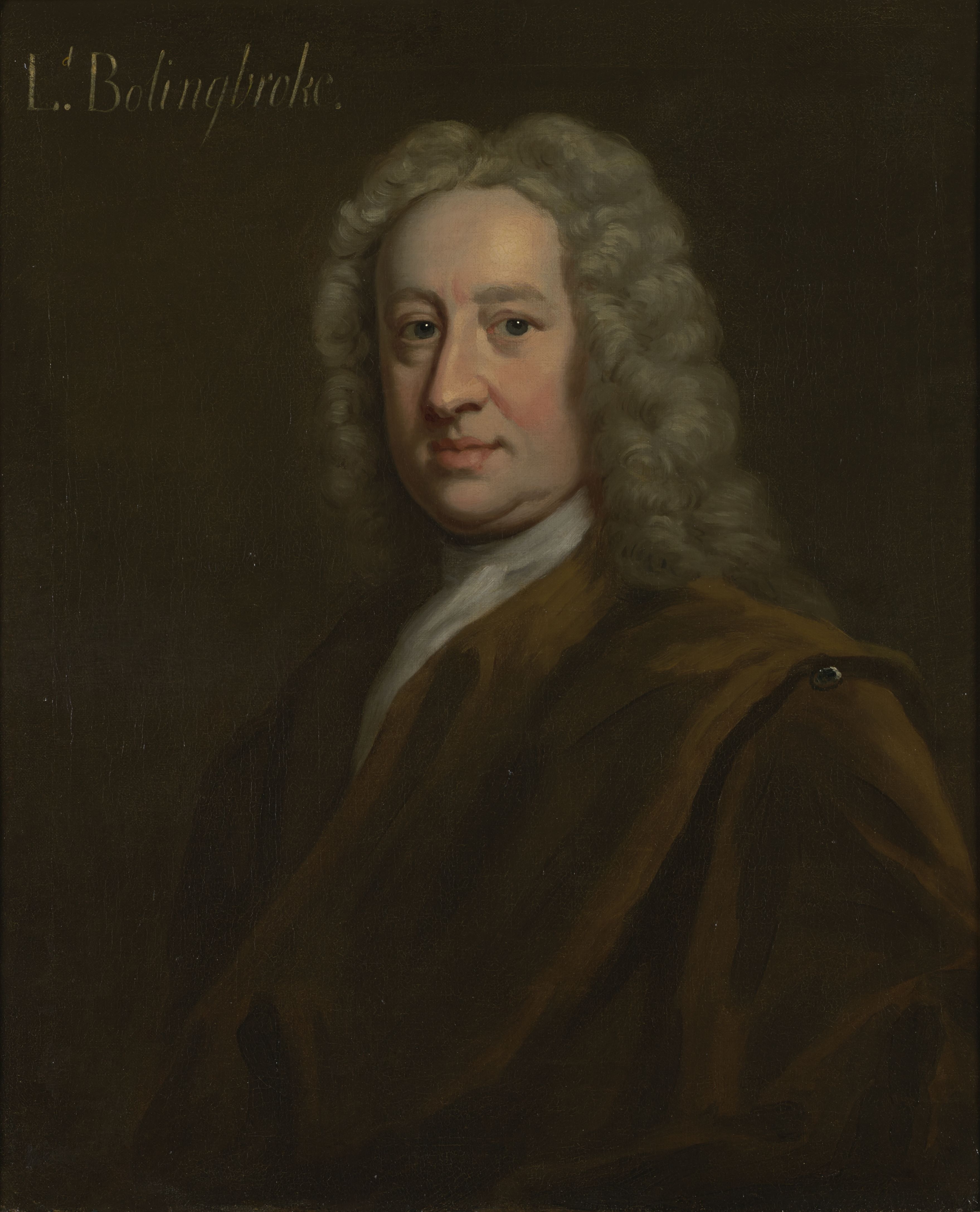
Henry St John, 1st Viscount Bolingbroke
Letter to Alexander Pope; compare: "Slave to no sect, who takes no private road, But looks through Nature up to Nature’s God", Alexander Pope, Essay on Man, epistle iv. line 331.
Henry St John, 1st Viscount Bolingbroke
On the Study and Use of History, letter 2; in fact this relates to a third-century CE treatise on rhetoric, wrongly attributed to Dionysius of Halicarnassus, which says (xi. 2): "The contact with manners then is education; and this Thucydides appears to assert when he says history is philosophy learned from examples". The line is not found in Thucydides.
“Truth lies within a little and certain compass, but error is immense.”
Henry St John, 1st Viscount Bolingbroke
Reflections upon Exile (1716)
Henry St John, 1st Viscount Bolingbroke
Lord Bolingbroke's Philosophical Works http://books.google.com/books?id=E6ATAAAAQAAJ (1754) Vol.III, Essay IV, Sect XVI
“They (Thucydides and Xenophon) maintained the dignity of history.”
Henry St John, 1st Viscount Bolingbroke
On the Study and Use of History, letter 5 (1752); compare Henry Fielding, Tom Jones, book xi. chap. ii.; Horace Walpole, Advertisement to Letter to Sir Horace Mann; Thomas Babington Macaulay, History of England, vol. i. chap. i.
Henry St John, 1st Viscount Bolingbroke
Some Reflections on the Present State of the Nation (1753)
Henry St John, 1st Viscount Bolingbroke
As quoted in Treasury of Wisdom, Wit and Humor, Odd Comparisons and Proverbs (1891) by Adam Woolever
“Nations, like men, have their infancy.”
Henry St John, 1st Viscount Bolingbroke
On the Study and Use of History, letter 4 (1752)
Henry St John, 1st Viscount Bolingbroke
Letter to Mr. Drummond (10 November 1710), quoted in Gilbert Parke, Letters and Correspondence, Public and Private, of The Right Honourable Henry St. John, Lord Visc. Bolingbroke; during the Time he was Secretary of State to Queen Anne; with State Papers, Explanatory Notes, and a Translation of the Foreign Letters, &c.: Vol. I (1798), pp. 16–17


