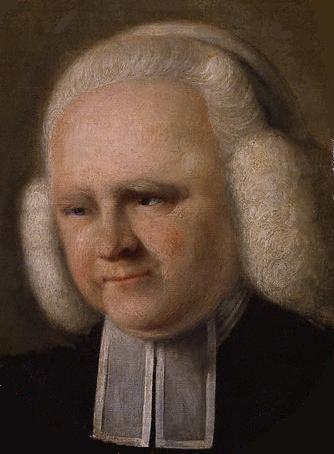
George Whitefield Quotes

George Whitefield , also spelled Whitfield, was an English Anglican cleric and evangelist who was one of the founders of Methodism and the evangelical movement.Born in Gloucester, he matriculated at Pembroke College at the University of Oxford in 1732. There he joined the "Holy Club" and was introduced to the Wesley brothers, John and Charles, with whom he would work closely in his later ministry. Whitefield was ordained after receiving his Bachelor of Arts degree. He immediately began preaching, but he did not settle as the minister of any parish. Rather he became an itinerant preacher and evangelist. In 1740, Whitefield traveled to North America, where he preached a series of revivals that became part of the "Great Awakening". His methods were controversial and he engaged in numerous debates and disputes with other clergymen.

Whitefield received widespread recognition during his ministry; he preached at least 18,000 times to perhaps 10 million listeners in Great Britain and the American colonies. Whitefield could enthrall large audiences through a potent combination of drama, religious rhetoric, and imperial pride. Wikipedia  

✵ 16. December 1714 – 29. September 1770
George Whitefield: 4 quotes2 likes

Famous George Whitefield Quotes

“I have just put my soul as a blank into the hand of Jesus, my Redeemer, and desired Him to write on it what He pleases; I know it will be His image.”

George Whitefield

Reported in Josiah Hotchkiss Gilbert, Dictionary of Burning Words of Brilliant Writers (1895), p. 543.

“Come poor, lost, undone sinner, come just as you are to Christ.”

George Whitefield

Reported in Ernest Bormann, Force of Fantasy: Restoring the American Dream (Carbondale: Southern Illinois University Press, 1985), p. 73. ISBN 978-0-80932-369-2.

“Why should the Devil have all the best tunes?”

George Whitefield

Attributed to Whitefield, in The Monthly Review, or, Literary Journal, Vol. 49 (June 1773 - January 1774), p. 430; this has also been reported as a remark made by Rowland Hill, when he arranged an Easter hymn to the tune of "Pretty, Pretty Polly Hopkins, in The Rambler, Vol. 9 (1858), p. 191; it has also attributed to Charles Wesley, and sometimes his brother John, as well as William Booth, who popularized it as an addage in promoting his The Salvation Army.
Disputed

“Lord Jesus, I am weary in Thy work, but not of it. If I have not yet finished my course, let me go and speak for Thee once more in the field, seal Thy truth, and come home to die.”

George Whitefield

Reported in Josiah Hotchkiss Gilbert, Dictionary of Burning Words of Brilliant Writers (1895), p. 518.

Similar authors

Samuel Johnson photo
Samuel Johnson362
English writer None
Thomas Fuller photo
Thomas Fuller35
English churchman and historian None
John Milton photo
John Milton190
English epic poet None
John Donne photo
John Donne115
English poet None
Daniel Defoe photo
Daniel Defoe43
English trader, writer and journalist None
Henry Fielding photo
Henry Fielding70
English novelist and dramatist None
William Shakespeare photo
William Shakespeare699
English playwright and poet None
Alexander Pope photo
Alexander Pope158
eighteenth century English poet None
Thomas Cranmer photo
Thomas Cranmer2
leader of the English Reformation and Archbishop of Canterb… None
Thomas More photo
Thomas More26
English Renaissance humanist None