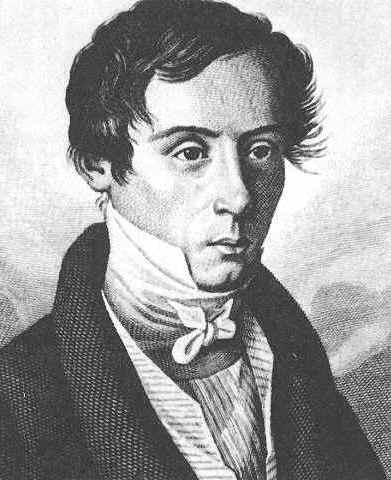
Augustin-Jean Fresnel Quotes

Augustin-Jean Fresnel was a French civil engineer and physicist whose research in optics led to the almost unanimous acceptance of the wave theory of light, excluding any remnant of Newton's corpuscular theory, from the late 1830s  until the end of the 19th century. He is perhaps better known for inventing the catadioptric Fresnel lens and for pioneering the use of "stepped" lenses to extend the visibility of lighthouses, saving countless lives at sea. The simpler dioptric stepped lens, first proposed by Count Buffon  and independently reinvented by Fresnel, is used in screen magnifiers and in condenser lenses for overhead projectors.

By expressing Huygens' principle of secondary waves and Young's principle of interference in quantitative terms, and supposing that simple colors consist of sinusoidal waves, Fresnel gave the first satisfactory explanation of diffraction by straight edges, including the first satisfactory wave-based explanation of rectilinear propagation. Part of his argument was a proof that the addition of sinusoidal functions of the same frequency but different phases is analogous to the addition of forces with different directions. By further supposing that light waves are purely transverse, Fresnel explained the nature of polarization, the mechanism of chromatic polarization, and the transmission and reflection coefficients at the interface between two transparent isotropic media. Then, by generalizing the direction-speed-polarization relation for calcite, he accounted for the directions and polarizations of the refracted rays in doubly-refractive crystals of the biaxial class . The period between the first publication of his pure-transverse-wave hypothesis and the submission of his first correct solution to the biaxial problem was less than a year.

Later, he coined the terms linear polarization, circular polarization, and elliptical polarization, explained how optical rotation could be understood as a difference in propagation speeds for the two directions of circular polarization, and accounted for the change in polarization due to total internal reflection, as exploited in the Fresnel rhomb. Defenders of the established corpuscular theory could not match his quantitative explanations of so many phenomena on so few assumptions.

Fresnel had a lifelong battle with tuberculosis, to which he succumbed at the age of 39. Although he did not become a public celebrity in his lifetime, he lived just long enough to receive due recognition from his peers, including the Rumford Medal of the Royal Society of London, and his name is ubiquitous in the modern terminology of optics and waves. After the wave theory of light was subsumed by Maxwell's electromagnetic theory in the 1860s, some attention was diverted from the magnitude of Fresnel's contribution. In the period between Fresnel's unification of physical optics and Maxwell's wider unification, a contemporary authority, Humphrey Lloyd, described Fresnel's transverse-wave theory as "the noblest fabric which has ever adorned the domain of physical science, Newton's system of the universe alone excepted."  Wikipedia  

✵ 10. May 1788 – 14. July 1827
Augustin-Jean Fresnel photo
Augustin-Jean Fresnel: 4 quotes0 likes

Famous Augustin-Jean Fresnel Quotes

“If nature has offered to produce the maximum effect with minimum causes, it is in all of its laws that it had to solve this major problem.”

Augustin-Jean Fresnel

in
Context: If one was sometimes led astray by trying to simplify the elements of a science, it is because one has established systems before putting together a fairly large number of facts. Some assumption, which would be very simple when one considers only a class of phenomena, requires many other assumptions if one wants to leave the narrow circle in which we had initially withdrawn. If nature has offered to produce the maximum effect with minimum causes, it is in all of its laws that it had to solve this major problem. It is without doubt difficult to discover the foundations of this wonderful economy, i. e. the simplest causes of phenomena considered from such a wide point of view. But if this general principle of the philosophy of physics does not lead immediately to the knowledge of truth, it can direct the efforts of the human spirit, by leading it away from theories which relate the phenomena to too many different causes, and by adopting preferably those based on the smallest number of assumptions, which show to be more fruitful in consequences.

“Nature is not embarrassed by difficulties of analysis. She avoids complication only in means.”

Augustin-Jean Fresnel

in
Context: In choosing a theory, one should pay attention to simplicity in hypotheses only. Simplicity in computation can be of no weight in the balance of probabilities. Nature is not embarrassed by difficulties of analysis. She avoids complication only in means. Nature seems to be proposed to do much with little: it is a principle that the development of physics constantly supports by new evidence.

“It's not observation but theory that led me to this result that experience has confirmed afterwards.”

Augustin-Jean Fresnel

Ce n'est point l'observation mais la théorie qui m'a conduit à ce résultat que l'expérience a ensuite confirmé.
explaining how he was led to discover the law characterizing interference fringes, in [Œuvres complètes d'Augustin Fresnel, Imprimerie impériale, 1866, http://books.google.com/books?id=3QgAAAAAMAAJ, 61]

“I find nothing so painful as having to lead men.”

Augustin-Jean Fresnel

Je ne trouve rien de si pénible que d'avoir à mener des hommes.
in his December 29 1816 letter to his uncle Léonor Mérimée, in [Œuvres complètes d'Augustin Fresnel, Imprimerie impériale, 1866, http://books.google.com/books?id=3QgAAAAAMAAJ, xviii]

Similar authors

Pierre Curie photo
Pierre Curie1
French physicist None
Wilhelm Röntgen photo
Wilhelm Röntgen6
German physicist None
Anatole France photo
Anatole France122
French writer None
Sarah Bernhardt photo
Sarah Bernhardt11
French actress None
Alfred de Musset photo
Alfred de Musset4
French writer None
Claude Debussy photo
Claude Debussy34
French composer None
Napoleon I of France photo
Napoleon I of France259
French general, First Consul and later Emperor of the French None
Stendhal photo
Stendhal50
French writer None
Auguste Comte photo
Auguste Comte23
French philosopher None