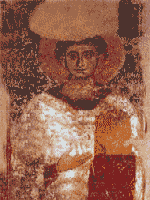
Arius was a Christian presbyter and ascetic of Berber origin, and priest in Baucalis in Alexandria, Egypt. His teachings about the nature of the Godhead in Christianity, which emphasized the Father's divinity over the Son, and his opposition to what would become the dominant Christology, Homoousian Christology, made him a primary topic of the First Council of Nicaea, which was convened by Emperor Constantine the Great in 325.
After Emperors Licinius and Constantine legalized and formalized the Christianity of the time in the Roman Empire, Constantine sought to unify and remove theological division within the newly recognized Church. The Christian Church was divided over disagreements on Christology, or, the nature of the relationship between Jesus and God. Homoousian Christians, including Athanasius of Alexandria, used Arius and Arianism as epithets to describe those who disagreed with their doctrine of coequal Trinitarianism, a Homoousian Christology representing God the Father and Jesus Christ the Son as "of one essence" and coeternal.
Negative writings describe Arius' theology as one in which there was a time before the Son of God, when only God the Father existed. Despite concerted opposition, 'Arian' Christian churches persisted throughout Europe, the Middle East, and North Africa and also in various Germanic kingdoms, until suppressed by military conquest or voluntary royal conversion between the fifth and seventh centuries.
Even though "Arianism" might suggest that Arius was the originator of the teaching that bears his name, the debate over the Son's precise relationship to the Father did not begin with him. This subject had been discussed for decades before his advent; Arius merely intensified the controversy and carried it to a Church-wide audience, where other "Arians" such as Eusebius of Nicomedia proved much more influential in the long run. In fact, some later "Arians" disavowed the name, claiming not to have been familiar with the man or his specific teachings. However, because the conflict between Arius and his foes brought the issue to the theological forefront, the doctrine he proclaimed—though not originated—is generally labeled as "his".