“It was not seemly to raise your flags on the minarets.”
Fiction, Napoleon Symphony (1974)
John Anthony Burgess Wilson, – who published under the pen name Anthony Burgess – was an English writer and composer. From relatively modest beginnings in a Catholic family in Manchester, he eventually became one of the best known English literary figures of the latter half of the twentieth century.
Although Burgess was predominantly a comic writer, his dystopian satire A Clockwork Orange remains his best known novel. In 1971 it was adapted into a highly controversial film by Stanley Kubrick, which Burgess said was chiefly responsible for the popularity of the book. Burgess produced numerous other novels, including the Enderby quartet, and Earthly Powers, regarded by most critics as his greatest novel. He wrote librettos and screenplays, including for the 1977 TV mini-series Jesus of Nazareth. He worked as a literary critic for several publications, including The Observer and The Guardian, and wrote studies of classic writers, notably James Joyce. A versatile linguist, Burgess lectured in phonetics, and translated Cyrano de Bergerac, Oedipus Rex and the opera Carmen, among others.
Burgess also composed over 250 musical works; he sometimes claimed to consider himself as much a composer as an author, although he enjoyed considerably more success in writing.
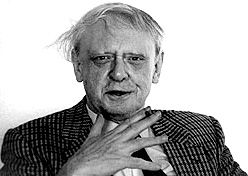
“It was not seemly to raise your flags on the minarets.”
Fiction, Napoleon Symphony (1974)
“Well-fed and liquored, I responded with ardour.”
Fiction, The Right to an Answer (1960)
“I decide that the East has definitely spoiled me for women.”
Fiction, The Enemy in the Blanket (1958)
“It was all a matter of a Goddess – dark, hidden, deadly, horribly desirable.”
Fiction, Nothing Like the Sun (1964)
“The dog now slept, occasionally farting very gently.”
Fiction, The Right to an Answer (1960)
Byrne
Poetry
Pop Music
Fiction, The Kingdom of the Wicked (1985)
Fiction, A Clockwork Orange (1962)
“…death came so easily, hardly announced, without apparent cause, often greeted with smiles.”
Fiction, Beds in the East (1959)
“Chickaks or geckos chirp on the walls….”
Non-Fiction, Homage to QWERT YUIOP: Selected Journalism 1978-1985 (1986)
Fiction, The Right to an Answer (1960)
Fiction, The Right to an Answer (1960)
Fiction, Napoleon Symphony (1974)
Fiction, The Doctor is Sick (1960)
Non-Fiction, "Novel, The"
Fiction, Earthly Powers (1980)
Non-Fiction, English Literature: A Survey for Students (1958, revised 1974)
Fiction, The Right to an Answer (1960)
“In Lady Chatterley’s Lover we meet the ancient honest word fuck.”
Lawrence believed that it could be cleansed of its centuries of accumulated filth and stalk nakedly through his pages like Connie and Mellors themselves, standing for an act of love which had been too long swaddled in euphemisms. There are many people who cherish the fallacy of a golden age of Anglo-Saxon candour in which lovers invited each other to fuck or be fucked….This was never so. The word has always been taboo. You will find no Anglo-Saxon document which contains it. True, it is old, cognate with the German ficken, but it stands for a brutal act unsuitable for the marriage bed. It connotes impersonality and aggression. When Dr Johnson said that drinking and fucking were the only things worth doing…he was referring to getting drunk and going to brothels. A man can fuck a whore but, unless his wife is a whore, he cannot fuck his wife….fuck is a…dysphemism….there is no love in it. Lawrence made an aesthetic rather than a moral gaffe….
Non-Fiction, Flame Into Being: The Life and Work of D. H. Lawrence (1985)
spring from a kind of mother fixation as well as a terror of the cold. He was a bull of a man much given to boats and riparian dalliance, but he had bad circulation. He had other things too, including a Chinese-style priapism which enabled him to copulate, usually in public, six times in a row, the secret being his failure to detumesce. This, of course, like acne and the common cold, can be a symptom of tertiary syphilis, which Maupassant certainly had.
Non-Fiction, Homage to QWERT YUIOP: Selected Journalism 1978-1985 (1986)
Fiction, Napoleon Symphony (1974)
Fiction, Tremor of Intent (1966)
He waved his hand wildly into the black night. 'Out there, west. You wasn’t there, so you wouldn’t know. Now I was. Palestine Police from the end of the war till we packed up. That was the East. You was in India, and that’s not the East any more than this is. So you know nothing about it either. So you needn’t be talking.'
Fiction, Time for a Tiger (1956)


