
Daniel Kahneman book Thinking, Fast and Slow
Source: Thinking, Fast and Slow (2011), Chapter 23, "The outside view", page 254 (ISBN 9780141033570).
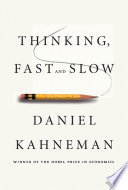
Thinking, Fast and Slow is a best-selling book published in 2011 by Nobel Memorial Prize in Economic Sciences laureate Daniel Kahneman. It was the 2012 winner of the National Academies Communication Award for best creative work that helps the public understanding of topics in behavioral science, engineering and medicine.The book summarizes research that Kahneman conducted over decades, often in collaboration with Amos Tversky. It covers all three phases of his career: his early days working on cognitive biases, his work on prospect theory, and his later work on happiness.The central thesis is a dichotomy between two modes of thought: "System 1" is fast, instinctive and emotional; "System 2" is slower, more deliberative, and more logical. The book delineates cognitive biases associated with each type of thinking, starting with Kahneman's own research on loss aversion. From framing choices to people's tendency to replace a difficult question with one which is easy to answer, the book highlights several decades of academic research to suggest that people place too much confidence in human judgement.The book also shares many insights from Kahneman's work with the Israel Defense Forces and with the various departments and collaborators that have contributed to his growth as a thinker and researcher.
Daniel Kahneman book Thinking, Fast and Slow
Source: Thinking, Fast and Slow (2011), Chapter 23, "The outside view", page 254 (ISBN 9780141033570).
Daniel Kahneman book Thinking, Fast and Slow
Source: Thinking, Fast and Slow (2011), Chapter 38, "Thinking about life", pages 400-401 (ISBN 9780141033570).
Daniel Kahneman book Thinking, Fast and Slow
Source: Thinking, Fast and Slow (2011), Chapter 20, "The illusion of validity", page 212 (ISBN 9780141033570).
“There is a deep gap between our thinking about statistics and our thinking about individual cases.”
Daniel Kahneman book Thinking, Fast and Slow
Source: Thinking, Fast and Slow (2011), Chapter 15, "Causes trump statistics", page 174 (ISBN 9780141033570).
Daniel Kahneman book Thinking, Fast and Slow
Source: Thinking, Fast and Slow (2011), Chapter 29, "The fourfold pattern", pages 318-319 (ISBN 9780141033570).
Daniel Kahneman book Thinking, Fast and Slow
Introduction, page 9 (ISBN 9780141033570).
Thinking, Fast and Slow (2011)
Daniel Kahneman book Thinking, Fast and Slow
Source: Thinking, Fast and Slow (2011), Chapter 37, "Experienced well-being", page 397 (ISBN 9780141033570).
Daniel Kahneman book Thinking, Fast and Slow
Conclusions, pages 411-413 (ISBN 9780141033570).
Thinking, Fast and Slow (2011)
Daniel Kahneman book Thinking, Fast and Slow
Source: Thinking, Fast and Slow (2011), Chapter 34, "Frames and reality", page 367 (ISBN 9780141033570).
Daniel Kahneman book Thinking, Fast and Slow
Source: Thinking, Fast and Slow (2011), Chapter 13, "Availability, emotion, and risk", page 138 (ISBN 9780141033570).
“He weights losses about twice as much as gains, which is normal.”
Daniel Kahneman book Thinking, Fast and Slow
Source: Thinking, Fast and Slow (2011), Chapter 26, "Prospect theory", page 288 (ISBN 9780141033570).
Daniel Kahneman book Thinking, Fast and Slow
Source: Thinking, Fast and Slow (2011), Chapter 17, "Regression to the mean", page 181 (ISBN 9780141033570).
Daniel Kahneman book Thinking, Fast and Slow
Source: Thinking, Fast and Slow (2011), Chapter 7, "A machine for jumping to conclusions", page 87 (ISBN 9780141033570).
Daniel Kahneman book Thinking, Fast and Slow
Source: Thinking, Fast and Slow (2011), Chapter 30, "Rare events", page 333 (ISBN 9780141033570).
Daniel Kahneman book Thinking, Fast and Slow
Source: Thinking, Fast and Slow (2011), Chapter 24, "The engine of capitalism", page 263 (ISBN 9780141033570).


