Quotes from book
The Sacred Depths of Nature

The Sacred Depths of Nature

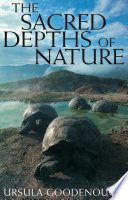
The Sacred Depths of Nature is a 1998 book by biologist Ursula W. Goodenough on the history of life on earth within the context of religious naturalism. It has recently been translated into Persian as Minoo-ye Tabi'at .


Ursula Goodenough photo

“Sex without death gets you single-celled algae and fungi; sex with a mortal soma gets you the rest of the eukaryotic creatures.”

Source: The Sacred Depths of Nature (1998), p. 151
Context: Sex without death gets you single-celled algae and fungi; sex with a mortal soma gets you the rest of the eukaryotic creatures. Death is the price paid to have trees, and clams and birds and grasshoppers, and death is the price paid to have human consciousness, to be aware of all that shimmering awareness and all that love.

Ursula Goodenough photo

“The role of religion is to integrate the Cosmology and the Morality, to render the cosmological narrative so rich and compelling that it elicits our allegiance and our commitment to its emergent moral understandings.”

Source: The Sacred Depths of Nature (1998), p. xiv
Context: The role of religion is to integrate the Cosmology and the Morality, to render the cosmological narrative so rich and compelling that it elicits our allegiance and our commitment to its emergent moral understandings. As each culture evolves, a unique Cosmos and Ethos appear in its co-evolving religion. For billions of us, back to the first humans, the stories, ceremonies, and art associated with our religions-of-origin are central to our matrix.
I stand in awe of these religions. I am deeply enmeshed in one of them myself. I have no need to take on the contradictions or immiscibilities between them, any more that I would quarrel with the fact that Scottish bagpipes coexist with Japanese tea ceremonies.

Ursula Goodenough photo

“Throughout the ages, the weaving of our religious weft has been the province of our prophets and gurus and liturgists and poets.”

Source: The Sacred Depths of Nature (1998), p. 173
Context: The tapestry maker first strings the warp, long strong fibers anchored firmly to the loom, and then interweaves the weft, the patterns, the color, the art. The epic of evolution is our warp, destined to endure, commanding our universal gratitude and reverence and commitment. And then, after that, we are all free to be artists, to render in language and painting and song and dance our ultimate hopes and concerns and understandings of human nature. Throughout the ages, the weaving of our religious weft has been the province of our prophets and gurus and liturgists and poets. The texts and art and ritual that come to us from these revered ancestors include claims about Nature and Agency that are no longer plausible. They use a different warp. But for me at least, this is just one of those historical facts, something that can be absorbed, appreciated, and then put aside as I encounter the deep wisdom embedded in these traditions and the abundant opportunities that they offer to experience transcendence and clarity.
Ursula Goodenough photo

“I have no choice but to pour these capacities and needs into earthly relationships, fragile and mortal and difficult as they often are.”

Source: The Sacred Depths of Nature (1998), p. 139
Context: For me, and probably for all of us, the concept of a personal, interested god can be appealing, often deeply so. In times of sorrow or despair, I often wonder what it would be like to be able to pray to God or Allah or Jehovah or Mary and believe that I was heard, believe that my petition might be answered. When I sing the hymns of faith in Jesus' love, I am drawn to their intimacy, their allure, their poetry. But in the end, such faith is simply not available to me. I can’t do it. I lack the resources to render my capacity for love and my need to be loved to supernatural Beings. And so I have no choice but to pour these capacities and needs into earthly relationships, fragile and mortal and difficult as they often are.

Ursula Goodenough photo

“The words in the traditional texts may sound different to us than they did to their authors, but they continue to resonate with our religious selves. We know what they are intended to mean.”

Source: The Sacred Depths of Nature (1998), p. 173
Context: I love traditional religions. Whenever I wander into distinctive churches or mosques or temples, or visit museums of religious art, or hear performances of sacred music, I am enthralled by the beauty and solemnity and power they offer. Once we have our feelings about Nature in place, then I believe that we can also find important ways to call ourselves Jews, or Muslims, or Taoists, or Hopi, or Hindus, or Christians, or Buddhists. Or some of each. The words in the traditional texts may sound different to us than they did to their authors, but they continue to resonate with our religious selves. We know what they are intended to mean.

Ursula Goodenough photo

“Humans need stories — grand compelling stories — that help to orient us in our lives in the cosmos. The Epic of Evolution is such a story, beautifully suited to anchor our search for planetary consensus, telling us of our nature, our place, our context.”

Source: The Sacred Depths of Nature (1998), p. 174
Context: Humans need stories — grand compelling stories — that help to orient us in our lives in the cosmos. The Epic of Evolution is such a story, beautifully suited to anchor our search for planetary consensus, telling us of our nature, our place, our context. Moreover, responses to this story — what we are calling religious naturalism — can yield deep and abiding spiritual experiences. And then, after that, we need other stories as well, human-centered stories, a mythos that embodies our ideals and our passions. This mythos comes to us, often in experiences called revelation, from the sages and the artists of past and present times.

Ursula Goodenough photo

“I have come to understand that the self, my self, is inherently sacred. By virtue of its own improbability, its own miracle, its own emergence”

Source: The Sacred Depths of Nature (1998), p. 60
Context: I have come to understand that the self, my self, is inherently sacred. By virtue of its own improbability, its own miracle, its own emergence … And so I lift up my head, and I bear my own witness, with affection and tenderness and respect. And in so doing, I sanctify myself with my own grace.

Ursula Goodenough photo

“The tapestry maker first strings the warp, long strong fibers anchored firmly to the loom, and then interweaves the weft, the patterns, the color, the art.”

Source: The Sacred Depths of Nature (1998), p. 173
Context: The tapestry maker first strings the warp, long strong fibers anchored firmly to the loom, and then interweaves the weft, the patterns, the color, the art. The epic of evolution is our warp, destined to endure, commanding our universal gratitude and reverence and commitment. And then, after that, we are all free to be artists, to render in language and painting and song and dance our ultimate hopes and concerns and understandings of human nature. Throughout the ages, the weaving of our religious weft has been the province of our prophets and gurus and liturgists and poets. The texts and art and ritual that come to us from these revered ancestors include claims about Nature and Agency that are no longer plausible. They use a different warp. But for me at least, this is just one of those historical facts, something that can be absorbed, appreciated, and then put aside as I encounter the deep wisdom embedded in these traditions and the abundant opportunities that they offer to experience transcendence and clarity.

Ursula Goodenough photo

“We nurture our children selflessly. But we also recognize them as our most tangible sources of renewal — for a child, the world is always new.”

Source: The Sacred Depths of Nature (1998), p. 129
Context: We nurture our children selflessly. But we also recognize them as our most tangible sources of renewal — for a child, the world is always new. Renewal has been a religious theme throughout the ages … All of us see in children — our own and all children — the hope and promise of what we humans can become. As the forbears of our children we are called to transmit to them a joyous and sustainable vision of their future — meaning that we are each called to develop such a vision.

Ursula Goodenough photo

“We are, each one of us, ordained to live out our lives in the context of ultimate questions, such as:
Why is there anything at all, rather than nothing?”

Source: The Sacred Depths of Nature (1998), p. 167
Context: We are, each one of us, ordained to live out our lives in the context of ultimate questions, such as:
Why is there anything at all, rather than nothing?
Where did the laws of physics come from?
Why does the universe seem so strange?
My response to such questions has been to articulate a covenant with Mystery. Others, of course, prefer to respond with answers, answers that often include a concept of god. These answers are by definition beliefs since they can neither be proven nor refuted. They may be gleaned from existing faith traditions or from personal search. God may be apprehended as a remote Author without present-day agency, or as an interested Presence with whom one can form a relationship, or as pantheistic — Inherent in All Things.
The opportunity to develop personal beliefs in response to questions of ultimacy, including the active decision to hold no Beliefs at all, is central to the human experience. The important part, I believe, is that the questions be openly encountered. To take the universe on — to ask Why Are Things As They Are? — is to generate the foundation for everything else.

Ursula Goodenough photo

“When I sing the hymns of faith in Jesus' love, I am drawn to their intimacy, their allure, their poetry. But in the end, such faith is simply not available to me.”

Source: The Sacred Depths of Nature (1998), p. 139
Context: For me, and probably for all of us, the concept of a personal, interested god can be appealing, often deeply so. In times of sorrow or despair, I often wonder what it would be like to be able to pray to God or Allah or Jehovah or Mary and believe that I was heard, believe that my petition might be answered. When I sing the hymns of faith in Jesus' love, I am drawn to their intimacy, their allure, their poetry. But in the end, such faith is simply not available to me. I can’t do it. I lack the resources to render my capacity for love and my need to be loved to supernatural Beings. And so I have no choice but to pour these capacities and needs into earthly relationships, fragile and mortal and difficult as they often are.