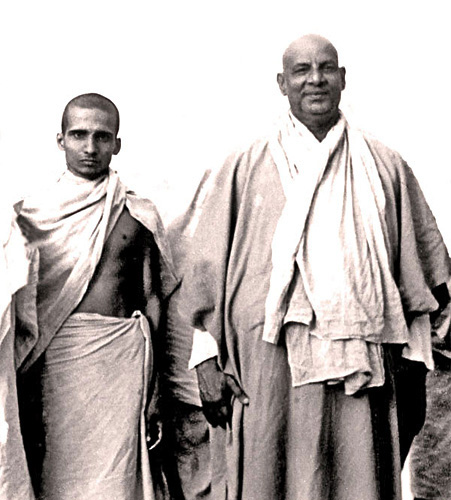
Shivananda citations

Swami Shivananda Saraswati est un maître spirituel hindou enseignant du Yoga et du Vedānta.

Shivananda est né sous le nom de Kuppuswami à Pattamadai dans l'État du Tamil Nadu en Inde dans une famille de brahmane orthodoxe. Après avoir été plusieurs années médecin en Malaisie, sa femme et ses deux enfants meurent. Il renonce alors au monde et commence une vie monastique en 1923. Il a vécu la plus grande partie de la fin de sa vie à Rishikesh, dans le nord de l'Inde. Il a fondé en 1936 la Divine Life Society , qui a pour objet d'œuvrer à la paix et la formation de citoyens pratiquant un yoga intégral ; il est le précurseur de l'ouverture de l'hindouisme aux occidentaux sur la base d'un principe : « Servir, aimer, purifier, donner, méditer et réaliser. »

Il est l'auteur de plus de 200 livres, notamment sur le Yoga et le Vedanta. Il a eu comme disciple swami Satchitananda et Vishnou Devananda qui, à sa demande, quittèrent l'Inde pour diffuser l'enseignement du Yoga intégral dans le reste du monde.

Il a créé le Shivananda Ashram sur la rive du Gange à Shivanandanagar, à 3 kilomètres de la ville de Rishikesh, . Wikipedia  

✵ 8. septembre 1887 – 14. juillet 1963
Shivananda photo
Shivananda: 41 citations0 J'aime

Shivananda: Citations en anglais

“With a smile I faced all hardships.”

Swami Sivananda

As quoted by Swami Sadananda Saraswati in his Introduction to Autobiography of Swami Sivananda (2000 web edition) http://www.dlshq.org/download/autobio.htm <br class="br">Contexte: The life of a mendicant during pilgrimages helped me to develop in a great measure forbearance, equal vision and a balanced mind in pleasure and pain. I met many Mahatmas and learnt wonderful lessons. On some days I had to go without food and walk mile after mile. With a smile I faced all hardships.

“There is no physical world for me. What I see I see as the glorious manifestation of the Almighty.”

Swami Sivananda

"What Life Has Taught Me"
Autobiography of Swami Sivananda
Contexte: I consider that goodness of being and doing constitute the rock-bottom of one’s life. By goodness I mean the capacity to feel with others and to live and feel as others do, and be in a position to act so that no one is hurt by the act. Goodness is the face of Godliness. I think that to be good in reality, in the innermost recesses of one’s heart, is not easy, though it may appear to be simple as a teaching. It is one of the hardest things on earth, if only one would be honest with oneself.
There is no physical world for me. What I see I see as the glorious manifestation of the Almighty.

“I consider that goodness of being and doing constitute the rock-bottom of one’s life.”

Swami Sivananda

"What Life Has Taught Me"
Autobiography of Swami Sivananda
Contexte: I consider that goodness of being and doing constitute the rock-bottom of one’s life. By goodness I mean the capacity to feel with others and to live and feel as others do, and be in a position to act so that no one is hurt by the act. Goodness is the face of Godliness. I think that to be good in reality, in the innermost recesses of one’s heart, is not easy, though it may appear to be simple as a teaching. It is one of the hardest things on earth, if only one would be honest with oneself.
There is no physical world for me. What I see I see as the glorious manifestation of the Almighty.

“The life of a mendicant during pilgrimages helped me to develop in a great measure forbearance, equal vision and a balanced mind in pleasure and pain.”

Swami Sivananda

As quoted by Swami Sadananda Saraswati in his Introduction to Autobiography of Swami Sivananda (2000 web edition) http://www.dlshq.org/download/autobio.htm <br class="br">Contexte: The life of a mendicant during pilgrimages helped me to develop in a great measure forbearance, equal vision and a balanced mind in pleasure and pain. I met many Mahatmas and learnt wonderful lessons. On some days I had to go without food and walk mile after mile. With a smile I faced all hardships.

“Be Good, Do Good.
Do thou always without attachment perform action which should be done, for by performing action without attachment, man reaches the Supreme.”

Swami Sivananda

Light, Power and Wisdom (1959), p. 6; note that the short phrase "Be good, do good" had occurred in spiritual teachings of others in the 19th century, usually in conjunction with other injunctions. "Be Good, Do Good" became a prominent motto of the Divine Life Society.
Light, Power and Wisdom (1959), p. 207
Variante: Be good, do good, be kind, be compassionate.

Auteurs similaires

Martin Heidegger photo
Martin Heidegger16
philosophe allemand None
Hannah Arendt photo
Hannah Arendt27
philosophe américaine d'origine allemande None
Ludwig Wittgenstein photo
Ludwig Wittgenstein28
philosophe et logicien autrichien, puis britannique None
Simone Weil photo
Simone Weil77
philosophe française None
Paul Valéry photo
Paul Valéry97
écrivain, poète et philosophe français None
Simone de Beauvoir photo
Simone de Beauvoir76
philosophe, romancière, épistolière, mémorialiste et essayi… None
Bertrand Russell photo
Bertrand Russell20
mathématicien, logicien, philosophe, épistémologue, homme p… None
Michel Foucault photo
Michel Foucault64
philosophe français None
Friedrich Hayek photo
Friedrich Hayek24
philosophe et économiste autrichien None
Jean-Paul Sartre photo
Jean-Paul Sartre119
philosophe, dramaturge, romancier, nouvelliste et essayiste… None