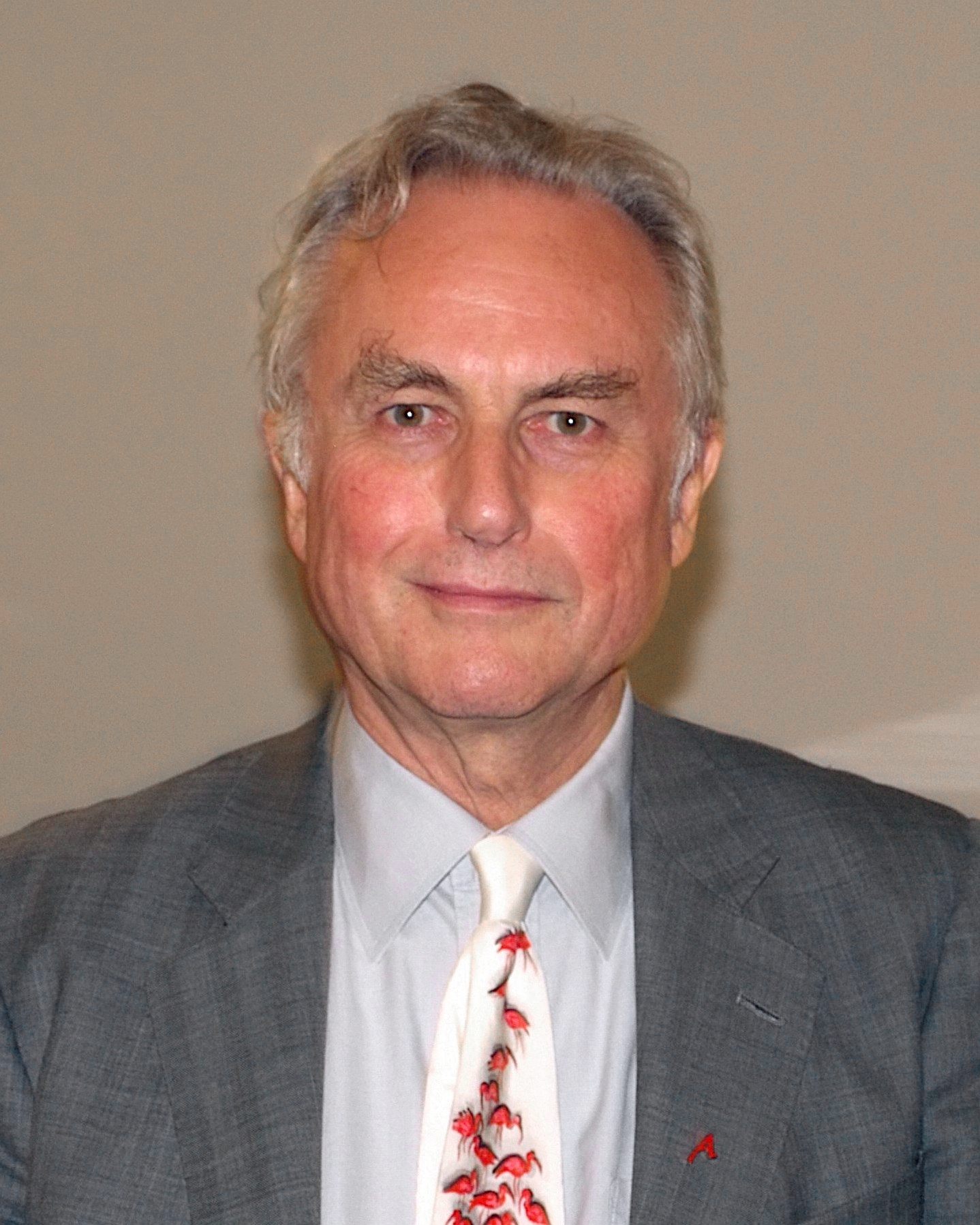
Richard Dawkins citations célèbres
Richard Dawkins livre Pour en finir avec Dieu
Pour en finir avec Dieu (The God Delusion), 2006
Richard Dawkins livre Pour en finir avec Dieu
S'ils ne sont pas extrémistes en soi, les enseignements de la religion « modérée » sont une invitation ouverte à l'extrémisme.
Pour en finir avec Dieu (The God Delusion), 2006
), 2006
Richard Dawkins livre Pour en finir avec Dieu
Pour en finir avec Dieu (The God Delusion), 2006
), 2006
en
We are going to die, and that makes us the lucky ones. Most people are never going to die because they are never going to be born. The potential people who could have been here in my place but who will in fact never see the light of day outnumber the sand grains of Sahara. Certainly those unborn ghosts include greater poets than Keats, scientists greater than Newton. We know this because the set of possible people allowed by our DNA so massively outnumbers the set of actual people. In the teeth of these stupefying odds it is you and I, in our ordinariness, that are here. We privileged few, who won the lottery of birth against all odds, how dare we whine at our inevitable return to that prior state from which the vast majority have never stirred?
Les Mystères de l'arc-en-ciel (Unweaving the Rainbow), 1998
Richard Dawkins: Citations en anglais
Richard Dawkins livre The Selfish Gene
Preface
The Selfish Gene (1976, 1989)
https://twitter.com/RichardDawkins/status/282854320133775360 <br class="br">Twitter
[Dawkins, Richard, Richard Dawkins, Why don't animals have wheels?, Sunday Times, November 24, 1996, http://www.simonyi.ox.ac.uk/dawkins/WorldOfDawkins-archive/Dawkins/Work/Articles/1996-11-24wheels.shtml, October 29, 2008, http://web.archive.org/web/20070221073440/http://www.simonyi.ox.ac.uk/dawkins/WorldOfDawkins-archive/Dawkins/Work/Articles/1996-11-24wheels.shtml, February 21, 2007]
Richard Dawkins livre Viruses of the Mind
Viruses of the Mind (1993)
The Richard Dimbleby Lecture: Science, Delusion and the Appetite for Wonder (1996)
Darwin's Dangerous Disciple: An Interview by Frank Miele (1995)
Dawkins on Q&A (), replying to a Muslim man who asked about 'absolute morality'. https://www.youtube.com/watch?v=mu7AQTs_y5A
The Evolutionary Future of Man (1993)
Richard Dawkins livre The Selfish Gene
Source: The Selfish Gene (1976, 1989), Ch. 1. Why Are People?
Richard Dawkins livre The Blind Watchmaker
Source: The Blind Watchmaker (1986), Chapter 7 “Constructive Evolution” (p. 184)
Richard Dawkins livre Viruses of the Mind
arbitrarily assumed to be male
Viruses of the Mind (1993)
Richard Dawkins livre Unweaving the Rainbow
[1998, Unweaving the Rainbow, London, Allen Lane, 9780713992144, 18827466M, Preface]
Unweaving the Rainbow (1998)
Richard Dawkins livre A Devil's Chaplain
"Good and Bad Reasons for Believing" [open letter to his daughter]
A Devil's Chaplain (2003)
Answering audience questions after a reading of The God Delusion http://www.youtube.com/watch?v=6mmskXXetcg,Randolph-Macon Woman's College,<br>Posed question: "This is probably going to be the most simplest one for you to answer, but: What if you're wrong?"
Richard Dawkins livre Viruses of the Mind
Viruses of the Mind (1993)
BBC's Have Your Say (December 2007)
https://twitter.com/RichardDawkins/status/307369895031603200 (28 February 2013) <br class="br">Twitter
Part 1, 00:00:55
The Root of All Evil? (January 2006)
Source: River out of Eden (1995), Ch. 5: The Replication Bomb
Richard Dawkins livre The Selfish Gene
Source: The Selfish Gene (1976, 1989), Ch. 5. Aggression: stability and the selfish machine
“Human vanity cherishes the absurd notion that our species is the final goal of evolution.”
Richard Dawkins livre The Blind Watchmaker
Source: The Blind Watchmaker (1986), Chapter 3 “Accumulating Small Change” (p. 50)
there are always sufficiently gullible patients
Foreword to Snake Oil and Other Preoccupations by John Diamond, Vintage, 2001.
Forewords
Expelled: No Intelligence Allowed ()
The Enemies of Reason, "The Irrational Health Service"
The Enemies of Reason (August 2007)
https://twitter.com/RichardDawkins/status/336048706853937152 (19 May 2013) <br class="br">Twitter
At Randolph-Macon Woman's College, Broadcasted by C-SPAN2 http://richarddawkins.net/home
https://twitter.com/RichardDawkins/status/358514912789676033 (20 July 2013) <br class="br">Twitter
http://www.youtube.com/watch?v=roFdPHdhgKQ&t=59m29s <br class="br">Richard Dawkins vs. Jonathan Sacks - BBC's RE:Think Festival (2012)


