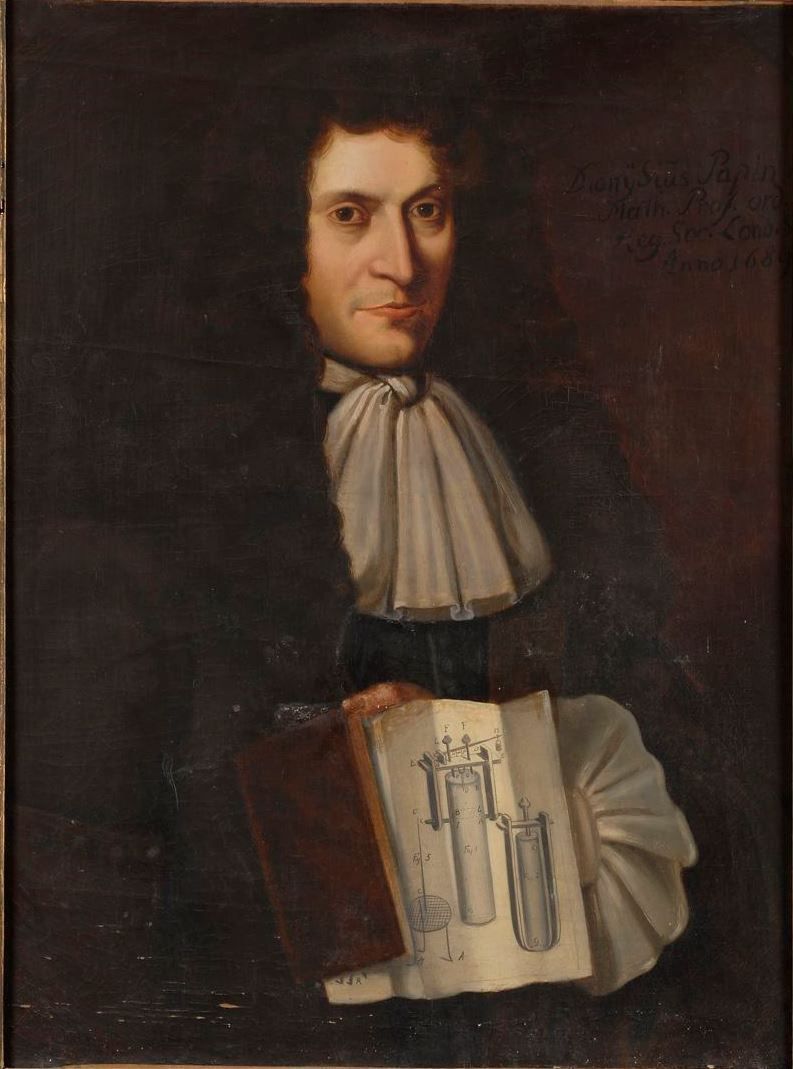
"A New Method of Obtaining Very Great Moving Powers at Small Cost" (1690)
Contexte: AA is a tube of uniform diameter throughout, close shut at the bottom; BB is a piston fitted to the tube; DD a handle fixed to the piston; EE an iron rod moveable round an axis in F; G a spring, pressing the cross rod EE, so that the said rod must be forced into the groove H as soon as the piston with the handle has arrived at such a height as that the said groove H appears above the lid II; L is a little hole in the piston, through which the air can escape from the bottom of the tube AA, when first the piston is forced into it. The use of this instrument is as follows: A small quantity of water is poured into the tube AA; to the depth of 3 or 4 lines; then the piston is inserted, and forced down to the bottom, till a portion of the water previously poured in comes through the hole L; then the said hole is closed by the rod MM. Next the lid II, pierced with the apertures requisite for that purpose, is put on, and a moderate fire being applied, the tube AA soon grows warm, (being made of thin metal), and the water within it, being turned into steam, exerts a pressure so powerful as to overcome the weight of the atmosphere and force up the piston BB, till the groove H of the handle DD appears above the lid II, and the rod EE is forced, with some noise, into the said groove by the spring G. Then forthwith the fire is to be removed, and the steam in the thin metal tube is soon resolved into water, and leaves the tube entirely void of air. Next, the rod EE being turned round so far as to come out of the groove H, and allow the handle DD to descend, the piston BB is forthwith pressed down by the whole weight of the atmosphere, and causes the intended movement, which is of an energy great in proportion to the size of the tube. Nor is it to be doubted that the whole weight of the atmosphere exerts its force in tubes so constructed; for I have established by experiment, that a piston, raised to the top of the tube by the force of heat, shortly afterwards descends again to the bottom, and so on alternately for a number of times, so that no suspicion can arise of air pressing beneath. Now my tube, the diameter of which does not exceed 2 ½ inches, yet raises sixty lbs. aloft with the same velocity as the piston is forced down into the tube, and the tube itself scarcely weighs five ounces. I therefore have little doubt but that tubes may be manufactured, the weight of each of which would scarcely amount to 40 lbs., and yet which could raise, at each operation, two thousand lbs. to a height of four feet.... If any one now will consider the magnitude of the forces to be obtained in this way, and the trifling expense at which a sufficient quantity of fuel can be procured, he will certainly admit that this my method is far preferable to the use of gunpowder above spoken of, especially as in this way a perfect vacuum is obtained, and so the inconveniences above recounted are avoided.
Denis Papin: Citations en anglais
"A New Method of Obtaining Very Great Moving Powers at Small Cost" (1690)
Denis Papin, as quoted by Bernard Forest de Bélidor, Architecture Hydraulique Vol.2 https://books.google.com/books?id=tBkWAAAAYAAJ, p. 309 Tr. Patrick Muirhead, The Life of James Watt https://books.google.com/books?id=MeJUAAAAcAAJ (1859) p. 145
Denis Papin, Recueil de diverses Pièces touchant quelques nouvelles Machines (1695) p. 53 as quoted by Dionysius Lardner, The Steam Engine Explained and Illustrated (1840) pp. 45-46
Denis Papin, Letter, as quoted by Robert Stuart Meikleham, A Descriptive History of the Steam Engine (1824)
"A New Method of Obtaining Very Great Moving Powers at Small Cost" (1690)
"A New Method of Obtaining Very Great Moving Powers at Small Cost" (1690)


