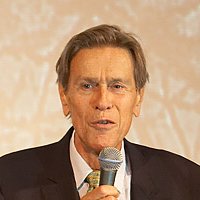
Pierre-Gilles de Gennes Citations
Pierre-Gilles de Gennes: Citations en anglais
“Benjamin Franklin performed a beautiful experiment using surfactants”
"Soft Matter" Nobel lecture (9 December 1991) - full text in PDF format http://nobelprize.org/nobel_prizes/physics/laureates/1991/gennes-lecture.html <br class="br">Contexte: Benjamin Franklin performed a beautiful experiment using surfactants; on a pond at Clapham Common, he poured a small amount of oleic acid, a natural surfactant which tends to form a dense film at the water-air interface. He measured the volume required to cover all the pond. Knowing the area, he then knew the height of the film, something like three nanometers in our current units. This was to my knowledge the first measurement of the size of molecules. In our days, when we are spoilt with exceedingly complex toys, such as nuclear reactors or synchrotron sources, I particularly like to describe experiments of this Franklin style to my students.<br>Surfactants allow us to protect a water surface, and to generate these beautiful soap bubbles, which are the delight of our children.
"Soft Matter" Nobel lecture (9 December 1991) - full text in PDF format http://nobelprize.org/nobel_prizes/physics/laureates/1991/gennes-lecture.html <br class="br">Contexte: Benjamin Franklin performed a beautiful experiment using surfactants; on a pond at Clapham Common, he poured a small amount of oleic acid, a natural surfactant which tends to form a dense film at the water-air interface. He measured the volume required to cover all the pond. Knowing the area, he then knew the height of the film, something like three nanometers in our current units. This was to my knowledge the first measurement of the size of molecules. In our days, when we are spoilt with exceedingly complex toys, such as nuclear reactors or synchrotron sources, I particularly like to describe experiments of this Franklin style to my students.<br>Surfactants allow us to protect a water surface, and to generate these beautiful soap bubbles, which are the delight of our children.
This may possibly be of some practical interest.
"Soft Matter" Nobel lecture (9 December 1991)
'No conclusion could be more appropriate today.'
"Soft Matter" Nobel lecture (9 December 1991)
Le vrai point d'honneur [d'un scientifique] n'est pas d'être toujours dans le vrai. Il est d'oser, de proposer des idées neuves, et ensuite de les vérifier.
As quoted in La Science des Rêves, Science et Vie Junior, 214, (18 May 2007), p. 13


