“This man is the master of us all.”
Er ist der Meister von uns allen!
Haydn, at a performance of Messiah. Quoted in John Galt George the Third, His Court and Family (1824) p. 34, and in Leopold Schmidt Joseph Haydn (1898) p. 86.
Criticism
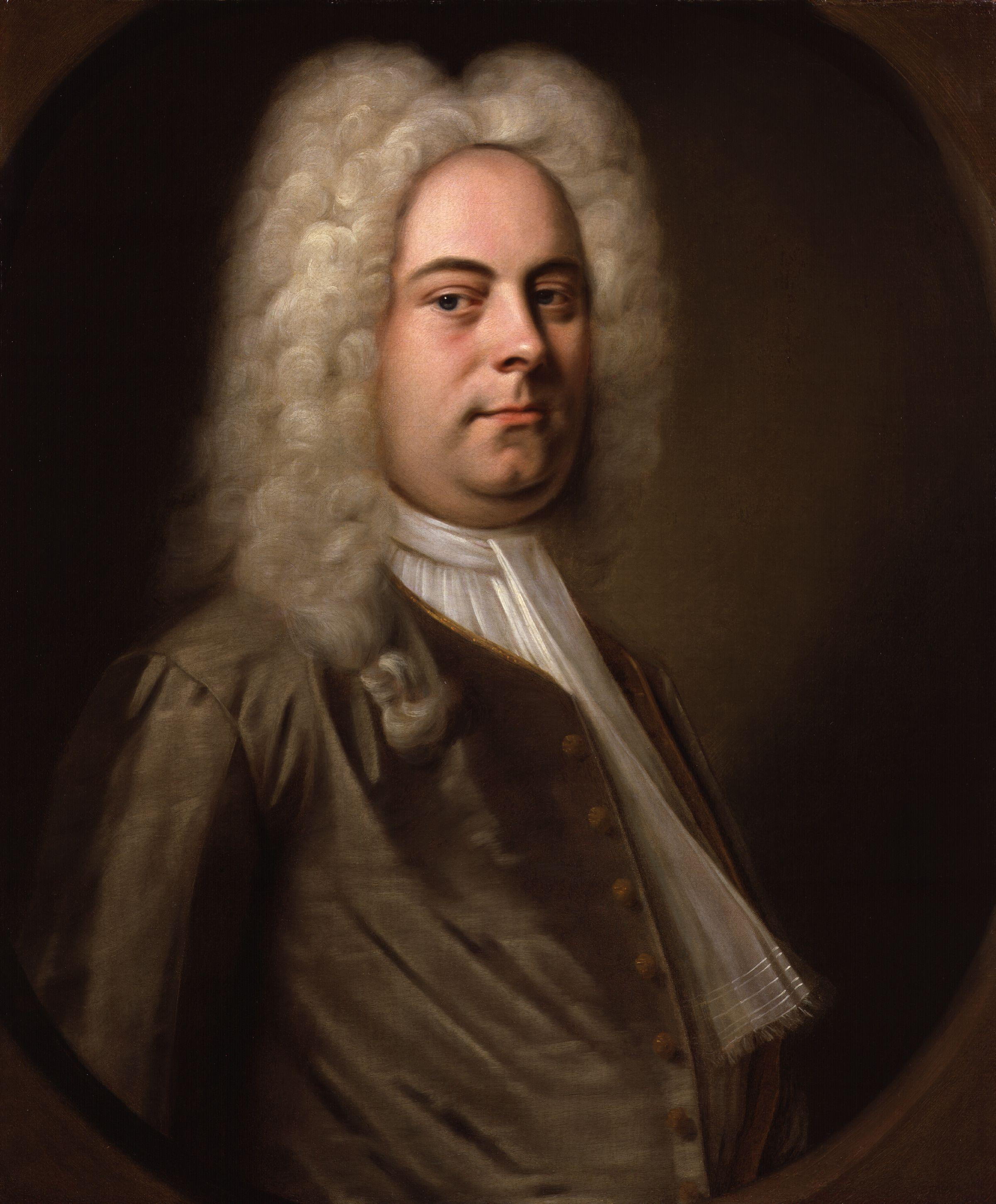
Georg Friedrich Haendel [ˈɡeːɔʁk ˈfʁiːdʁɪç ˈhɛndəl] ou Georg Friederich Händel est un compositeur allemand, devenu sujet anglais, né le 23 février 1685 à Halle-sur-Saale et mort le 14 avril 1759 à Westminster.
Haendel personnifie souvent de nos jours l'apogée de la musique baroque aux côtés de Jean-Sébastien Bach,, Antonio Vivaldi, Georg Philipp Telemann et Jean-Philippe Rameau, et l'on peut considérer que l'ère de la musique baroque européenne prend fin avec l'achèvement de l’œuvre de Haendel. Né et formé en Saxe, installé quelques mois à Hambourg avant un séjour initiatique et itinérant de trois ans en Italie, revenu brièvement à Hanovre avant de s'établir définitivement en Angleterre, il réalisa dans son œuvre une synthèse magistrale des traditions musicales de l'Allemagne, de l'Italie, de la France et de l'Angleterre,.
Virtuose hors pair à l'orgue et au clavecin, Haendel dut à quelques-unes de ses œuvres très connues — notamment son oratorio Le Messie, ses concertos pour orgue et concerti grossi, ses suites pour clavecin , ses musiques de plein air — de conserver une notoriété active pendant tout le XIXe siècle, période d'oubli pour la plupart de ses contemporains. Cependant, pendant plus de trente-cinq ans, il se consacra pour l'essentiel à l'opéra en italien , avant d'inventer et promouvoir l'oratorio en anglais dont il est un des maîtres incontestés.
Son nom peut se trouver sous plusieurs graphies : son extrait de baptême en allemand, utilise la forme Händel, son nom s'écrit également Haendel , et cette forme a été adoptée en français à la suite de Romain Rolland. Après son installation en Angleterre, lui-même l'écrivait Handel sans tréma, manière quasi homophone retenue par les anglophones, et signait George Frideric Handel. Wikipedia
“This man is the master of us all.”
Er ist der Meister von uns allen!
Haydn, at a performance of Messiah. Quoted in John Galt George the Third, His Court and Family (1824) p. 34, and in Leopold Schmidt Joseph Haydn (1898) p. 86.
Criticism
“I should be sorry if I only entertained them, I wish to make them better.”
James Beattie, letter of May 25, 1780, published in William Forbes An Account of the Life and Writings of James Beattie, LL.D. (1806) p. 331.
In reply to Lord Kinnoull, who had complimented him on his Messiah, "the noble entertainment which he had lately given the town". Beattie had this on the authority of Kinnoull himself.
“Händel is the greatest and ablest of all composers; from him I can still learn.”
Händel ist der Größte und Fähigste aller Komponisten; von ihm kann ich immer noch lernen. <br class="br">Beethoven on his deathbed, speaking to Gerhard von Breuning. Published in Friedrich Kerst Beethoven der Mann und der Künstler, wie in seinen Eigenen Words enthüllt no. 111 http://www.bucheralle.org/6C76626D613131/ch35.html; Friedrich Kerst (trans. Henry Edward Krehbiel) Beethoven, the Man and the Artist, as Revealed in his own Words (1964), p. 54. <br class="br">Criticism
“Händel is the greatest composer that ever lived. I would uncover my head and kneel on his grave.”
Händel ist der größte Komponist, der je lebte. Ich würde meine Kopfbedeckung abnehmen und auf seinem Grab knien. <br class="br">Beethoven, speaking to J. A. Stumpff in the autumn of 1823. Published in Friedrich Kerst Beethoven der Mann und der Künstler, wie in seinen Eigenen Words enthüllt no. 112 http://www.bucheralle.org/6C76626D613131/ch35.html; Friedrich Kerst (trans. Henry Edward Krehbiel) Beethoven, the Man and the Artist, as Revealed in his own Words (1964), p. 54. <br class="br">Criticism
Richard Alexander Streatfeild Handel (2005) p. 195, citing Anton Schmid Christoph Willibald Ritter von Gluck (1854) p. 29
In conversation with Gluck.
Samuel Butler Notebooks (2004) p. 153.
Criticism
Leigh Hunt Table-Talk (1851) pp. 147-8.
Criticism
“Whether I was in my body or out of my body I know not. God knows it!”
Quoted in The Harvard Magazine (December 1862), p. 141.
On composing the "Hallelujah Chorus" in 1741.
“I did think I did see all heaven before me, and the great God himself.”
Horatio Townsend An Account of the Visit of Handel to Dublin (1852) p. 93, citing Laetitia Matilda Hawkins Anecdotes, Biographical Sketches and Memoirs vol. 1 (1822).
His reply on being asked what his feelings were while writing the "Hallelujah Chorus".
George Bernard Shaw in Ainslee's Magazine, May 1913.
Criticism
“Handel paralysed music in England for generations and they have not yet quite got over him.”
Frederick Delius, letter to Ethel Smyth, February 17, 1909; Lionel Carley Delius: A Life in Letters vol. 2 (1988) p. 9.
Criticism


