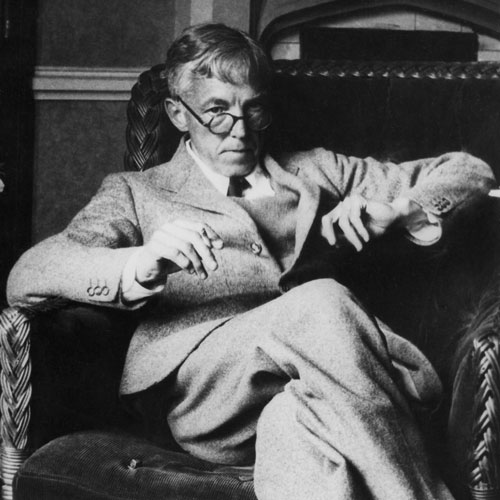
Godfrey Harold Hardy citations

Godfrey Harold Hardy est un mathématicien britannique, né le 7 février 1877 à Cranleigh et mort le 1er décembre 1947 à Cambridge.

Il a été lauréat de la médaille Sylvester en 1940 et de la médaille Copley en 1947 ; il est connu pour ses travaux en théorie des nombres et en analyse. Les non-mathématiciens le connaissent surtout pour deux choses :


L'Apologie d'un mathématicien, son essai de 1940 sur l'esthétique des mathématiques avec un certain contenu personnel — qui est peut-être le meilleur témoignage sur la pensée d'un mathématicien au travail ;

sa relation particulière comme mentor à partir de 1914 avec le mathématicien indien Srinivasa Ramanujan ; Hardy reconnut immédiatement le génie inclassable de Ramanujan, pourtant tout séparait ces deux mathématiciens : Hardy était un athée britannique rigoureux et précis, et Ramanujan un Indien mystique et intuitif, mais ils devinrent amis et collègues ; dans une interview à Paul Erdős, quand celui-ci lui demanda quelle était sa plus grande contribution aux mathématiques, Hardy répondit sans hésitation que ce fut la découverte de Ramanujan. Wikipedia  

✵ 7. février 1877 – 1. décembre 1947
Godfrey Harold Hardy photo
Godfrey Harold Hardy: 20 citations0 J'aime

Godfrey Harold Hardy: Citations en anglais

“Mathematicians have constructed a very large number of different systems of geometry, Euclidean or non-Euclidean, of one, two, three, or any number of dimensions. All these systems are of complete and equal validity. They embody the results of mathematicians' observations of their reality, a reality far more intense and far more rigid than the dubious and elusive reality of physics. The old-fashioned geometry of Euclid, the entertaining seven-point geometry of Veblen, the space-times of Minkowski and Einstein, are all absolutely and equally real. …There may be three dimensions in this room and five next door. As a professional mathematician, I have no idea; I can only ask some competent physicist to instruct me in the facts.
The function of a mathematician, then, is simply to observe the facts about his own intricate system of reality, that astonishingly beautiful complex of logical relations which forms the subject-matter of his science, as if he were an explorer looking at a distant range of mountains, and to record the results of his observations in a series of maps, each of which is a branch of pure mathematics. …Among them there perhaps none quite so fascinating, with quite the astonishing contrasts of sharp outline and shade, as that which constitutes the theory of numbers.”

G. H. Hardy

"The Theory of Numbers," Nature (Sep 16, 1922) Vol. 110 https://books.google.com/books?id=1bMzAQAAMAAJ p. 381

“I am interested in mathematics only as a creative art.”

G. H. Hardy livre A Mathematician's Apology

Source: A Mathematician's Apology (1941)

“Chess problems are the hymn-tunes of mathematics.”

G. H. Hardy livre A Mathematician's Apology

A Mathematician's Apology (1941)

“If I knew I was going to die today, I think I should still want to hear the cricket scores.”

G. H. Hardy

Source: Quoted in The Joy of Cricket (ed. John Bright-Holmes, 1984)

Auteurs similaires

Bertrand Russell photo
Bertrand Russell20
mathématicien, logicien, philosophe, épistémologue, homme p… None
Terry Pratchett photo
Terry Pratchett82
écrivain britannique None
George Orwell photo
George Orwell27
écrivain britannique None
Richard Dawkins photo
Richard Dawkins8
biologiste et éthologiste britannique None
John Maynard Keynes photo
John Maynard Keynes12
économiste britannique None
Elias Canetti photo
Elias Canetti8
écrivain britannique germanophone None
Ludwig Wittgenstein photo
Ludwig Wittgenstein28
philosophe et logicien autrichien, puis britannique None
Aldous Huxley photo
Aldous Huxley43
Romancier et essayiste britannique None
Winston Churchill photo
Winston Churchill23
homme d'État britannique None
Audrey Hepburn photo
Audrey Hepburn6
actrice britannique None